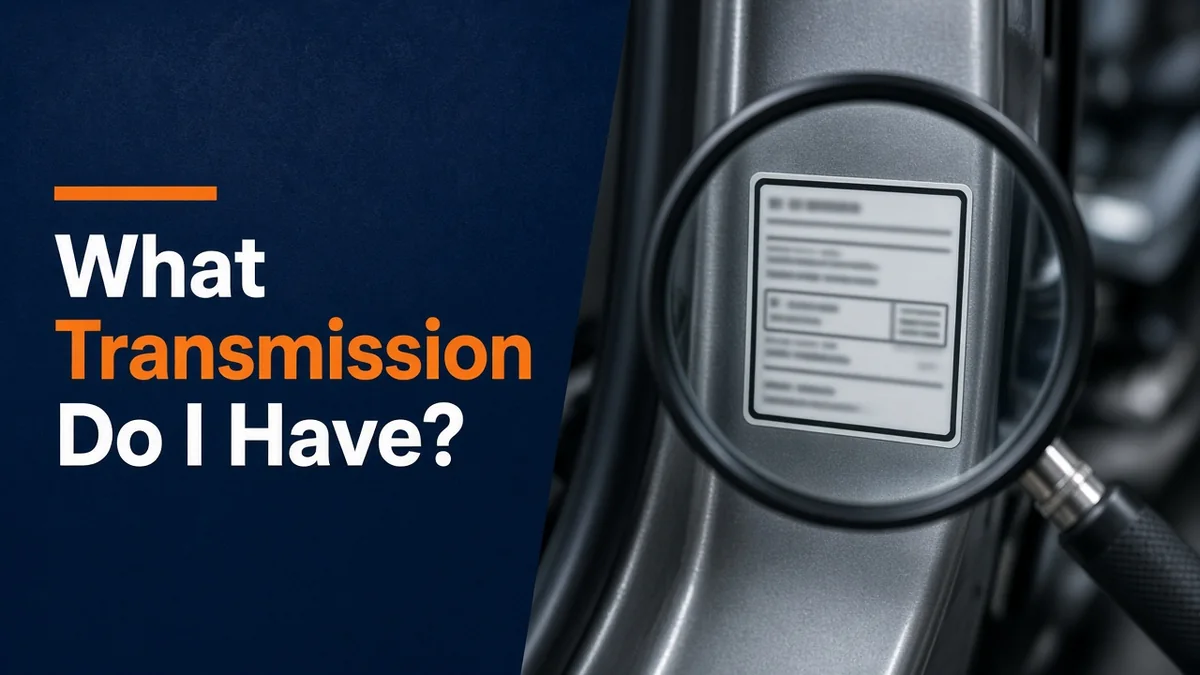
What Transmission Do I Have? 5 Ways to Find Out
The fastest ways to find out what transmission you have are to check the owner’s manual or window sticker, decode your VIN with a free VIN decoder or a dealer, look at the transmission code on the vehicle identification sticker (often on the driver’s door jamb or under the hood), or read the ID tag on the transmission itself. A dealer service department can also look up the exact transmission from your VIN in a few minutes. Knowing the exact model matters when you buy fluid, parts or a replacement transmission.
Quick Methods Compared
| Method | What It Tells You | Difficulty |
|---|---|---|
| Owner’s manual | Transmission type and fluid spec; sometimes model | Easy |
| Original window sticker (Monroney) | Transmission type and number of speeds | Easy if you have it |
| Online VIN decoder | Type, speeds, drivetrain; sometimes model code | Easy |
| Dealer parts or service department (VIN) | Exact transmission model and part number | Easy (call or visit) |
| Door jamb or under-hood sticker | Transmission code on many brands | Easy to moderate |
| GM glovebox RPO sticker | Three-character transmission RPO code | Easy on GM vehicles |
| Transmission ID tag or casting | Exact model and serial number | Moderate to hard (under the car) |
| Pan shape and bolt count | Identifies many automatic transmissions | Hard; for experienced DIYers |
Method 1: Check the Owner’s Manual
The specifications section of your owner’s manual lists the transmission type, number of speeds and the transmission fluid specification. Some manuals list multiple transmissions for different engines, so match it to your engine size. Digital copies are usually available on the manufacturer’s owner website.
Method 2: Decode Your VIN
The 17-character vehicle identification number (VIN) is on the driver’s side dashboard (visible through the windshield), the driver’s door jamb, your registration and your insurance card. Enter it into a free VIN decoder, such as the one offered by the National Highway Traffic Safety Administration (NHTSA), or the decoder on many auto parts and history report sites.
- What you usually get: transmission type (automatic, manual, CVT, dual-clutch), number of speeds and drivetrain (FWD, RWD, AWD, 4WD).
- What you may not get: the exact model code (for example, 6L80 or 8HP50). For that, a dealer lookup is more reliable.
Method 3: Ask a Dealer
Call or visit the parts or service department of a dealer for your brand and give them your VIN. They can pull up the factory build data, including the exact transmission model and part number. This is the most accurate method, and most dealers do it free.
Method 4: Look for the Transmission Code on a Sticker
GM Vehicles (Chevrolet, GMC, Buick, Cadillac)
GM uses three-character Regular Production Option (RPO) codes printed on the Service Parts Identification sticker, usually in the glovebox, trunk or on the spare tire cover. Common automatic transmission RPO codes start with “M” (for example, MYC, MHC, MQE); manual transmissions often start with “M” as well. Look the code up online to identify the transmission.
Ford and Lincoln
Many Ford vehicles have a Safety Compliance Certification Label on the driver’s door jamb with a “TR” (transmission) code. A decoder chart or a Ford dealer can translate the code.
Toyota and Lexus
The door jamb or firewall label on many Toyota vehicles lists a “Trans/Axle” code. Toyota dealers or online charts can match it to the transmission model.
Other Brands
Honda, Nissan, Hyundai, Kia, Subaru, Volkswagen and others vary. The engine bay may have an emissions or build label, but the most reliable method is usually a dealer VIN lookup.
Method 5: Read the Tag on the Transmission
Most transmissions have an identification tag, sticker or stamped code on the case, often on the side, near the bell housing or near the pan. You will usually need to safely raise the vehicle to see it. Clean off dirt and oil to read it. Take a clear photo to share with a parts store or shop.
Is It Automatic, Manual or CVT?
- Manual: three pedals (clutch, brake, gas) and a gear shift with an H-pattern.
- Automatic: two pedals and a P-R-N-D shifter, knob or buttons.
- CVT: also two pedals and P-R-N-D, but no shift feel during acceleration; often listed as “CVT” or “Xtronic,” “Lineartronic,” etc. in specs.
- Dual-clutch (DCT/DSG): drives like an automatic but may feel like quick manual shifts; common in some VW, Audi, Porsche, Hyundai and Kia models.
If you are new to manual cars, our guide on how to drive a manual car explains the basics, and whether automatic cars have a clutch covers how automatics engage.
Why You Need to Know Your Transmission
- Buying the right fluid: using the wrong ATF or CVT fluid can cause shifting problems and damage.
- Ordering parts: filters, pans, gaskets, solenoids and mounts differ between transmissions.
- Replacement or rebuild quotes: shops price by exact transmission model.
- Towing: some transmissions have lower tow ratings or require a cooler.
- Researching reliability and known issues before buying a used car.
For routine service intervals, see our car maintenance schedule by mileage, and our guide on how to check car fluids explains how to check automatic transmission fluid on cars with a dipstick.
Safety note: If you need to get under the car to read the transmission tag, park on level ground, set the parking brake, chock the wheels and support the vehicle on rated jack stands. Never rely on a jack alone, and let the transmission cool before touching it.
Related guides: How to drive a manual car · Car maintenance schedule · How to check car fluids
Transmission ID FAQs
Check the owner’s manual or window sticker, decode your VIN online, look for a transmission code on the door jamb or glovebox sticker, or ask a dealer to look it up from your VIN.
Yes. Most VIN decoders show whether the car has an automatic, manual or CVT and how many speeds. For the exact model code, a dealer VIN lookup is most accurate.
It is usually on the transmission case, often on the side, near the bell housing or near the oil pan. You may need to raise the vehicle to see it.
Check your owner’s manual or VIN decoder for “CVT.” When driving, a CVT accelerates smoothly without noticeable gear shifts, although some are programmed to simulate shifts.
Yes. Each transmission requires a specific fluid. The correct type is listed in the owner’s manual and sometimes on the dipstick or fluid fill cap.
Yes. A dealer’s parts or service department can use your VIN to find the exact transmission model and part number, usually for free.