How to Check Car Fluids: Oil, Coolant, Brake Fluid and More
Here is how to check car fluids at home in about 10 minutes. To check your car’s fluids, park on level ground, let the engine cool, open the hood and look at six things: engine oil (dipstick), coolant, brake fluid and windshield washer fluid (see-through reservoirs with level marks), plus transmission fluid and power steering fluid if your car has a dipstick or reservoir for them. Each check takes about a minute, and doing them once a month catches leaks before they turn into expensive repairs.
Below is a step-by-step guide to each fluid, what healthy fluid looks like, how often to check and change it, and what to do if a level is low.
Key Takeaways
- Check monthly and before long trips; takes about 10 minutes.
- Engine cool and car level for most checks; never open a hot radiator or coolant cap.
- Oil goes between the two dipstick marks; coolant and brake fluid between MIN and MAX.
- A dropping level means a leak or wear, not just a top-up need.
- Use the exact fluid type listed in your owner’s manual.
The 6 Car Fluids to Check at a Glance
| Fluid | Where to find it | Healthy color | Check | Typical change interval |
|---|---|---|---|---|
| Engine oil | Dipstick with a yellow or orange handle | Amber to dark brown | Monthly | Every 5,000–10,000 miles or per your oil-life monitor |
| Coolant (antifreeze) | Plastic overflow reservoir near the radiator | Green, orange, pink or blue; clear, not rusty | Monthly, engine cold | Every 5 years or 100,000+ miles for long-life coolant; follow your manual |
| Brake fluid | Small reservoir near the driver side firewall | Clear to light amber | Monthly | Every 2–3 years |
| Transmission fluid | Dipstick with a red handle (many new cars have none) | Pink to red, not brown or burnt-smelling | Every few months if there is a dipstick | Every 30,000–60,000 miles, or per manual |
| Power steering fluid | Reservoir marked with a steering wheel (not on electric steering) | Clear, pink or red | Every few months | Often every 50,000–100,000 miles or per manual |
| Windshield washer fluid | Reservoir with a windshield and spray symbol | Usually blue | Monthly | Top up as needed |
Intervals vary a lot between vehicles. Your owner’s manual and maintenance schedule always come first.
Before You Start
- Park on flat, level ground so readings are accurate.
- Turn the engine off and let it cool for at least 30 minutes for most checks. Transmission fluid is the main exception on some cars.
- Have a clean, lint-free rag or paper towel and a flashlight.
- Wipe dirt away from caps before opening them so nothing falls in.
- Wear gloves if you like; fluids can irritate skin, and used oil should be washed off.
Safety note: never open the radiator cap or the coolant reservoir cap on a hot engine. The system is under pressure and can spray scalding coolant. Keep fingers, hair and clothing away from the fan, which can switch on even with the engine off on some cars. Brake fluid damages paint, so wipe up drips right away, and store coolant away from children and pets because it is toxic and tastes sweet.
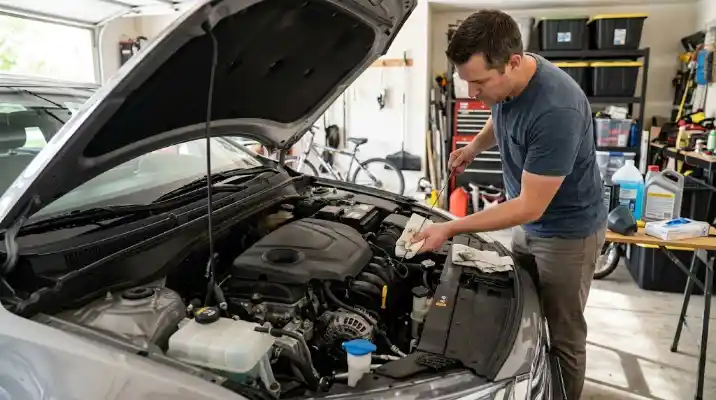
1. How to Check Engine Oil
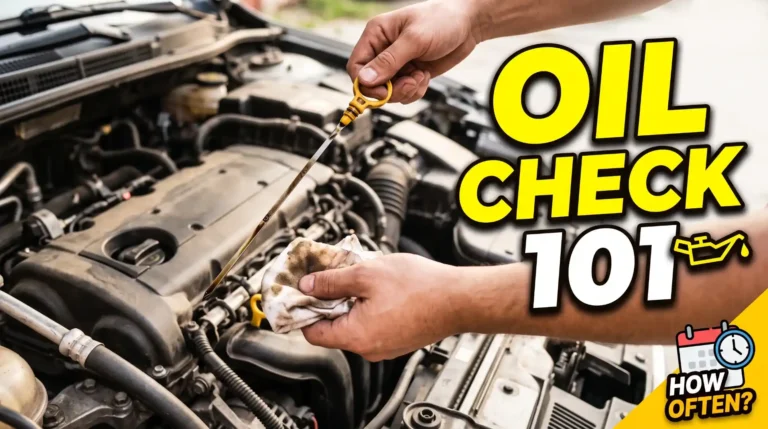
- Find the dipstick, usually with a yellow or orange loop handle.
- Pull it out and wipe it clean.
- Push it all the way back in, then pull it out again.
- Read the level: it should sit between the two marks or in the cross-hatched area.
- Check the color and feel. Amber to dark brown is normal. Milky or foamy oil can mean coolant is getting into the oil, and a gritty feel or a strong fuel smell also needs attention.
- If the level is at or below the lower mark, add the grade listed in your manual (for example 0W-20) a little at a time through the filler cap on top of the engine, then recheck. On most cars about one quart raises the level from the low to the full mark.
Some newer cars, including many European models, have no dipstick and show the oil level in the instrument cluster or infotainment menu instead.
2. How to Check Coolant (Antifreeze)
- With the engine cold, find the translucent coolant overflow reservoir near the radiator.
- Look at the side of the tank. The level should be between the MIN and MAX (or COLD FULL) lines.
- Check the color. It should be clean and bright. Rusty, brown or sludgy coolant, or an oily film, means the system needs service.
- If it is low, add the coolant type specified in your manual, usually a 50/50 premixed coolant, to the reservoir, not the radiator, unless your manual says otherwise.
Do not mix different coolant types or colors unless the product says it is compatible. Coolant that keeps dropping points to a leak from a hose, radiator, water pump or head gasket, and running low can cause overheating.
3. How to Check Brake Fluid
- Find the small reservoir on the driver’s side near the back of the engine bay. The cap usually says DOT 3, DOT 4 or similar.
- Check that the level is between MIN and MAX without opening the cap if you can see through the plastic.
- Look at the color: fresh brake fluid is nearly clear to light amber. Dark brown fluid has absorbed moisture and should be replaced.
Brake fluid level drops slowly as brake pads wear, so a slightly lower level can be normal on older pads. A sudden drop, a spongy pedal or wet spots near the wheels signal a leak, which is a safety problem. If you need to add fluid, use only the DOT type on the cap and a freshly opened bottle, since brake fluid absorbs moisture from the air.
4. How to Check Transmission Fluid
Many modern automatic transmissions are sealed and have no dipstick; they are checked by a technician during service. If your car has a transmission dipstick, the check is usually done with the engine warm and running:
- Drive for a few minutes to warm up the transmission, then park on level ground and set the parking brake.
- With the engine idling, shift slowly through each gear and back to Park or Neutral, as your manual specifies.
- Pull the transmission dipstick, wipe it, reinsert it fully and pull it again.
- The level should be in the HOT range. Healthy fluid is pink to red and smells neutral; brown or black fluid with a burnt smell means it needs service, and possibly the transmission needs inspection.
Use only the transmission fluid type named in your manual (for example a specific ATF or CVT fluid). The wrong fluid can damage the transmission.
5. How to Check Power Steering Fluid
Many newer cars use electric power steering, which has no fluid at all. If your car has a power steering reservoir, usually marked with a steering wheel symbol, check the level against the MIN and MAX or HOT and COLD marks on the tank or the dipstick in the cap. The fluid should be clear, pink or red. Whining when you turn the wheel or a stiff steering feel can mean the level is low or there is a leak.
6. How to Check Windshield Washer Fluid
Find the reservoir with the windshield and spray symbol on the cap. Many are see-through; others have a dipstick in the cap. Fill it with washer fluid, not plain water, especially in winter, when a de-icing, freeze-resistant fluid keeps the lines and nozzles from freezing.
Other Fluids Your Car Uses
- Differential and transfer case fluid: on rear-wheel-drive, all-wheel-drive and 4×4 vehicles. These are checked through fill plugs, usually by a shop, at intervals listed in your manual.
- Clutch fluid: manual transmission cars with a hydraulic clutch often share the brake fluid reservoir or have a small separate one.
- AC refrigerant: sealed and not checked by owners. See our guide to car AC repair costs if the air is not cold.
- Electric vehicles: no engine oil, but they still use coolant for the battery and motors, brake fluid and washer fluid.
What Leak Colors Mean
| Leak color | Likely fluid | What to do |
|---|---|---|
| Clear and watery, near the front passenger side | AC condensation | Normal on hot days |
| Light brown to black, slippery | Engine oil | Check the oil level and look for the source |
| Green, orange, pink or blue, sweet smell | Coolant | Check the level when cold; fix soon to avoid overheating |
| Red or pink | Transmission or power steering fluid | Check levels; have the leak inspected |
| Clear to yellowish-brown, slippery, near a wheel | Brake fluid | Do not drive until inspected |
| Blue, thin | Washer fluid | Refill and check the reservoir and lines |
| Clear with a gasoline smell | Fuel | Do not drive; fire risk |
How Often Should You Check Your Car Fluids?
- Monthly: engine oil, coolant, brake fluid and washer fluid.
- Every few months: transmission and power steering fluid, if your car has dipsticks or reservoirs for them.
- Before a road trip and before summer and winter.
- Any time you see a leak, a warning light, a temperature gauge climbing or a change in how the brakes or steering feel.
What Fluid Services Typically Cost
| Service | Typical cost |
|---|---|
| Oil and filter change | $40–$130 (synthetic costs more) |
| Coolant drain or flush | $100–$250 |
| Brake fluid flush | $80–$150 |
| Automatic transmission fluid service | $100–$300+ |
| Power steering fluid flush | $80–$150 |
| Differential fluid change | $80–$150 per axle |
Prices are typical US shop ranges. Topping up between services yourself costs only the price of the fluid.
Find more easy maintenance jobs in our car maintenance guides.
Car Fluids FAQ
Check engine oil, coolant, brake fluid and windshield washer fluid monthly. If your car has a transmission dipstick or a power steering reservoir, check those every few months too.
Check oil, coolant and brake fluid with the engine off and cool on level ground. Transmission fluid on cars with a dipstick is usually checked with the engine warm and running. Never open a hot coolant cap.
About once a month and before long trips. Many owners check oil at every other fill-up.
Low coolant can make the engine overheat, which can warp the cylinder head or damage the head gasket. If the temperature gauge rises, pull over safely and turn the engine off.
Brake fluid drops slightly as brake pads wear. A larger or sudden drop, a soft pedal or fluid near a wheel means a leak and should be inspected before you drive.
In an emergency, plain water can get you to a shop, but it lowers freeze and boil protection and can cause corrosion. Replace it with the correct coolant mix as soon as possible.
Look for a second dipstick, often with a red handle, near the back of the engine. Many newer cars have sealed transmissions without a dipstick; check your owner manual.
Oil is amber to dark brown, coolant is bright green, orange, pink or blue, brake fluid is clear to light amber, transmission fluid is pink to red, and washer fluid is usually blue.