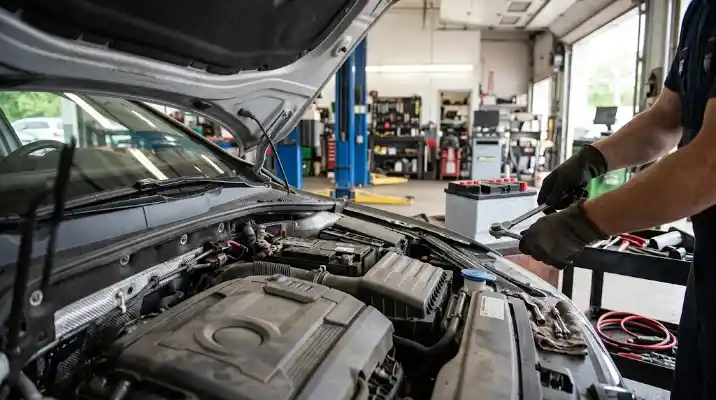
How to Disconnect and Remove a Car Battery (And Pick the Right Replacement)
To disconnect a car battery, turn the car off, loosen the negative (black, −) terminal first and move the cable away from the battery, then loosen and remove the positive (red, +) terminal. When you reconnect, do the opposite: positive first, negative last. That order keeps your wrench from creating a spark if it touches the car body while you work.
This guide walks through the whole job, from disconnecting and removing the battery safely to cleaning corrosion, choosing the right replacement and resetting anything that loses its memory afterward.
Key Takeaways
- Disconnect: negative (−) first, then positive (+).
- Reconnect: positive (+) first, then negative (−).
- Tools: usually a 10 mm wrench or socket, gloves and safety glasses; some hold-downs need a 13 mm socket and an extension.
- Before you start: find your radio or navigation code, or use a memory saver, because some cars lose settings.
- Replacement: match the group size and at least the original cold cranking amps (CCA), and never downgrade from AGM to a standard battery.
Why the Negative Terminal Comes Off First
In almost every modern car the negative battery cable is bolted to the chassis, so the whole metal body of the car is part of the negative side of the circuit. If you loosen the positive terminal first and your wrench touches any metal part of the car, you complete a circuit straight across the battery. That can cause a big spark, weld the wrench, blow fuses or damage electronics.
Once the negative cable is off, the circuit is broken. Touching the car body with the wrench while you remove the positive cable no longer does anything. The same logic explains why the negative cable goes back on last.
Tools You Need
- Wrench or socket: 10 mm fits most terminal clamps; some cars use 8 mm, 12 mm or 13 mm, and many hold-downs need a socket with an extension.
- Safety glasses and gloves: battery acid and corrosion irritate skin and eyes.
- Terminal cleaning brush: a cheap wire brush for posts and clamps.
- Baking soda and water: to neutralize corrosion.
- Rag or terminal cover: to keep the removed cable from touching the battery.
- Memory saver (optional): plugs into the OBD-II port or power outlet to keep radio presets and computer settings.
- Battery carrier strap (optional): makes lifting a 30–60 lb battery easier and safer.
How to Disconnect a Car Battery Step by Step
- Park and power down: park on a flat surface, set the parking brake, turn the ignition off, remove the key or move the smart key away, and switch off lights and accessories.
- Get your codes ready: check your owner’s manual for a radio or navigation security code, or connect a memory saver now.
- Find the battery: most batteries sit under the hood, but some cars put it in the trunk, under the rear seat or under a cover. Cars with a remote battery usually have jump-start terminals under the hood, but you still disconnect at the battery itself.
- Identify the terminals: the negative post is marked “−” or NEG and usually has a black cable; the positive post is marked “+” or POS, often has a red cable and may sit under a plastic cover.
- Loosen the negative clamp: turn the nut counterclockwise a few turns, then twist and lift the clamp straight off the post. Do not pry against the battery case.
- Secure the negative cable: tuck it away from the battery or wrap it in a rag so it cannot spring back onto the post.
- Remove the positive clamp: open the cover if there is one, loosen the nut and lift the clamp off the same way.
- Wait if you are working on electrical parts: some manufacturers recommend waiting a few minutes before touching airbag or other safety systems. Follow your service manual.
Safety note: never let a tool touch both terminals at once, never smoke or create sparks near a battery, which can vent flammable hydrogen gas, and do not work on a battery that is cracked, leaking or bulging. If acid gets on your skin or in your eyes, rinse with plenty of water and get medical help for eye contact.
How to Remove the Battery From the Car
With both cables off, the battery is still held in place by a hold-down so it cannot move while driving.
- Remove the hold-down: this is either a bracket across the top secured by long J-bolts or a small clamp at the base of the battery. Keep the hardware together.
- Disconnect any vent tube: batteries in the trunk or cabin often have a vent hose to route gases outside.
- Lift straight up: use the built-in handle or a carrier strap, lift with your legs and keep the battery upright to avoid spilling acid.
- Set it down safely: place it on a flat surface on the ground, not on the engine or fender, away from children and pets.
How to Clean Battery Corrosion
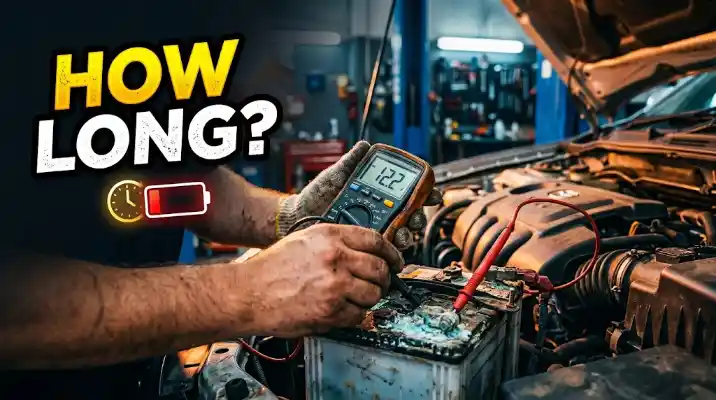
White, blue or green crust on the terminals is corrosion. It adds resistance and can cause slow starts or a no-start even with a healthy battery.
- Mix about one tablespoon of baking soda into a cup of water.
- With the cables disconnected, brush the mixture onto the posts, clamps and tray. It will fizz as it neutralizes the acid.
- Scrub with a terminal brush until the metal is bright, then rinse with a little clean water and dry thoroughly.
- Check the cable ends for heavy corrosion or damage. If the metal is eaten away, replace the terminal ends or cable.
- After reconnecting, a thin coat of dielectric grease or anti-corrosion spray helps slow future buildup.
How to Reconnect a Car Battery
- Set the battery in the tray the right way round and reinstall the hold-down so it cannot shift.
- Connect the positive (+) clamp first and tighten it until you cannot twist it on the post by hand. Do not overtighten.
- Connect the negative (−) clamp last. A small spark when it touches the post is normal as the car’s electronics wake up.
- Close the positive terminal cover, start the car and check that warning lights go off after a few seconds.
What to Reset After Disconnecting the Battery
Many cars keep working normally after a disconnect, but you may notice some of these:
- Clock, radio presets and seat or mirror memory may reset.
- Radio or navigation security code: some older and European cars ask for a code before the stereo works again.
- Power windows: auto up and down may need relearning. Usually you hold the switch up for a few seconds after the window closes.
- Idle and shifting: the engine computer relearns idle speed and fuel trims, so the car may idle or shift a little differently for the first 20–40 minutes of driving.
- Steering angle or stability control warnings: some cars need the steering wheel turned lock to lock before the light clears.
- Battery registration: many BMW, Mercedes, Audi, Volkswagen and some other newer cars with smart charging need the new battery registered with a scan tool so the charging system matches its size and type.
Does Disconnecting the Battery Reset the Check Engine Light?
It can clear stored trouble codes and turn the light off temporarily, but it does not fix the problem. The light will come back if the fault is still there, and clearing codes also resets the readiness monitors, which can make a car fail an emissions test until you have driven enough for them to complete. It is better to read the code first with an OBD-II scanner.
How to Choose the Right Replacement Battery
| Spec | What it means | What to buy |
|---|---|---|
| Group size | The battery’s physical size, terminal positions and layout (for example 24F, 35, 48/H6, 65) | Exactly the size listed in your owner’s manual or parts lookup |
| Cold cranking amps (CCA) | Starting power at 0 °F | Equal to or higher than the original rating |
| Reserve capacity (RC) | Minutes the battery can run key systems if the alternator fails | Equal to or higher than the original |
| Battery type | Flooded, EFB or AGM | The same type or an upgrade, never a downgrade |
| Date code | When the battery was made | Buy one made within the last 6 months |
| Warranty | Free-replacement period | Longer free-replacement periods usually mean a better battery |
Flooded vs EFB vs AGM
- Flooded (standard lead-acid): the cheapest option and fine for most older cars without start-stop.
- EFB (enhanced flooded battery): a tougher flooded design for basic start-stop systems.
- AGM (absorbed glass mat): handles deep cycling, heavy electrical loads and advanced start-stop systems, resists vibration and is spill-proof. It costs more but usually lasts longer.
The rule is simple: if your car came with an AGM battery, replace it with an AGM battery. Putting a cheaper flooded battery into a start-stop car designed for AGM can shorten its life dramatically and trigger electrical warnings. Upgrading from flooded to AGM is usually fine.
Hybrid and Electric Cars
Hybrids and EVs still have a small 12-volt battery that powers the computers and lets the car wake up. It is often in the trunk or under a panel, and it is usually replaced like a normal battery. Never touch the orange high-voltage cables or the main drive battery; that work is only for trained technicians.
What Does a Car Battery Replacement Cost?
A new car battery usually costs about $100 to $250 for a standard flooded battery and $200 to $400 for an AGM battery. Installation is free at many auto parts stores for easy-to-reach batteries, and shops typically charge around $50 to $150 when the battery is hard to reach or needs registration. Most stores also add a refundable core charge that you get back when you return the old battery.
How to Dispose of an Old Car Battery
Car batteries contain lead and sulfuric acid, so they must not go in household trash. Nearly all lead-acid batteries in the US are recycled. Take the old battery back to the store where you buy the new one to get your core charge refunded, or drop it at an auto parts store, a scrap yard or a household hazardous waste site. Keep it upright and in a sturdy box or bin while you transport it.
Disconnecting the Battery for Storage
If a car will sit for more than a few weeks, disconnecting the negative cable stops small electrical drains from flattening the battery. A battery disconnect switch, a knob or lever that fits on the negative post, makes this a tool-free job. A better option for longer storage is a battery maintainer (smart trickle charger), which keeps the battery topped up without overcharging and keeps your settings intact.
Find more simple jobs that save money in our car maintenance guides.
Car Battery FAQ
Always disconnect the negative (black, minus) terminal first, then the positive. The negative cable is connected to the car body, so removing it first prevents sparks if your wrench touches metal.
Connect the positive (red, plus) terminal first and the negative terminal last. This is the reverse of the disconnect order.
A 10 mm wrench or socket fits most battery terminal clamps. Some cars use 8 mm, 12 mm or 13 mm, and hold-downs often need a 13 mm socket with an extension.
Yes. For storage or for most electrical repairs, removing just the negative cable is enough to break the circuit. You only need to remove both cables when you take the battery out.
About 15 to 30 minutes is usually enough to clear the engine computer memory. The car then relearns idle and fuel settings over the next drive. It will not fix the cause of a warning light.
No, if you follow the correct order. You may lose radio presets, the clock or window settings, and some cars need a radio code or battery registration after a battery change.
Most car batteries cost $100 to $250 for flooded types and $200 to $400 for AGM. Many parts stores install easy-to-reach batteries for free; shops may charge $50 to $150 for difficult installs.
Yes, on most cars it takes 15 to 30 minutes with basic tools. It is harder on cars with batteries under seats or in the trunk, or on models that require battery registration with a scan tool.