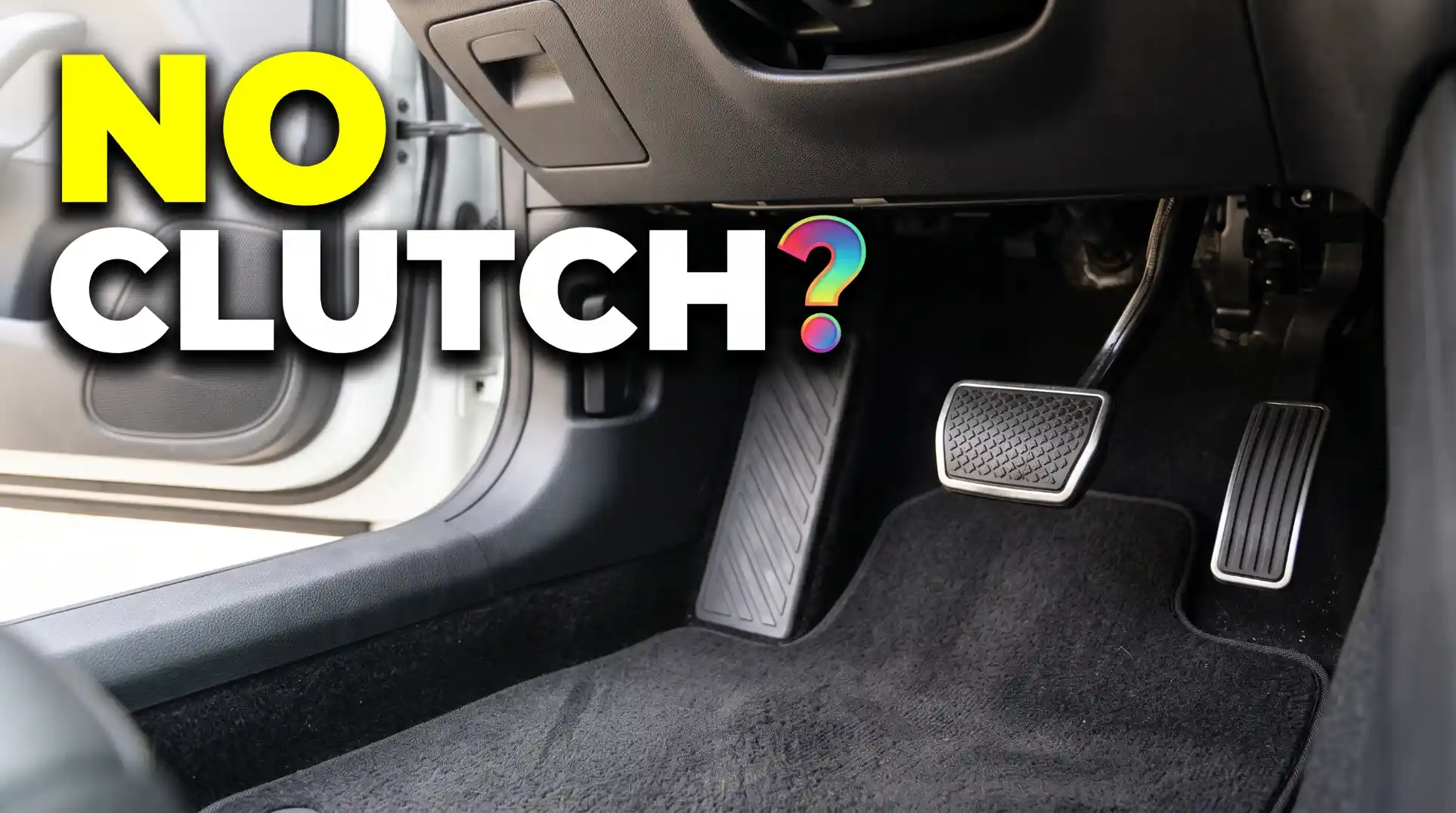
Do Automatic Cars Have a Clutch? How Automatic Transmissions Work
Do automatic cars have a clutch? Yes and no. Automatic cars do not have a clutch pedal, but most of them do have clutches inside the transmission. A traditional automatic uses a fluid coupling called a torque converter in place of the manual clutch, plus several internal clutch packs and bands that engage different gears automatically. Dual-clutch automatics (DCTs) use two computer-controlled clutches, and some CVTs use a clutch or a torque converter. The difference is that the car operates them for you.
Key Takeaways
- No clutch pedal: automatic cars have only an accelerator and a brake.
- Torque converter: does the job of the manual clutch in a conventional automatic, letting the car sit still in gear.
- Internal clutches: clutch packs, bands and a lock-up clutch inside the transmission change and hold gears.
- DCTs use two automated clutches for fast shifts; CVTs use belts and pulleys instead of fixed gears.
- Clutch problems still happen in automatics, but they show up as slipping, harsh or delayed shifts.
What a Clutch Does
A clutch connects and disconnects the engine from the wheels. In a manual car, pressing the clutch pedal separates a friction disc from the engine’s flywheel so you can change gear or stop without stalling. Releasing the pedal clamps them back together and sends power to the wheels.
An automatic still has to solve the same problem: the engine keeps running at idle while the car is stopped in Drive. It just solves it without driver input.
How Automatic Transmissions Work Without a Clutch Pedal
Torque Converter Automatic (Most Common)
The torque converter sits where a manual clutch would. Inside, an engine-driven pump spins transmission fluid into a turbine connected to the transmission. At idle the fluid coupling slips, so the car can sit at a light in Drive; as you accelerate, the fluid transfers more torque. Most modern converters also have a lock-up clutch that locks the engine and transmission together at cruising speed to save fuel.
Gear changes happen in a planetary gearset, where hydraulic pressure applies different clutch packs and bands to hold or release parts of the gearset. A computer (the transmission control module) decides when to shift based on speed, throttle and load.
Dual-Clutch Transmission (DCT)
A DCT is essentially two automated manual gearboxes in one: one clutch handles odd gears and the other handles even gears. While you are in one gear, the next is already pre-selected, so shifts are very fast. DCTs are common in performance cars and some Volkswagen, Audi, Porsche, Hyundai and Kia models. They can feel less smooth than a torque converter at very low speeds, such as creeping in traffic.
Continuously Variable Transmission (CVT)
A CVT has no fixed gears. A steel belt or chain runs between two pulleys that change diameter, giving a seamless range of ratios. Most CVTs use a torque converter or a start clutch to get the car moving. They are common in small cars and hybrids for fuel economy.
Automated Manual Transmission (AMT)
An AMT is a regular manual gearbox with a single clutch that a computer operates. It is cheap and efficient but can feel jerky between shifts. AMTs are rare in the US today.
Electric Vehicles
Most EVs have a single-speed reduction gear and no clutch at all, because electric motors deliver torque from zero rpm and do not idle.
Manual vs Automatic Transmission Types Compared
| Type | Clutch pedal? | Clutch inside? | How it moves off | Feel |
|---|---|---|---|---|
| Manual | Yes | One friction clutch | Driver releases clutch | Most control |
| Torque converter automatic | No | Clutch packs, bands, lock-up clutch | Fluid coupling | Smooth |
| Dual-clutch (DCT) | No | Two automated clutches | Computer slips a clutch | Very fast shifts |
| CVT | No | Usually a start clutch or torque converter | Converter or clutch | Seamless, no shift points |
| Automated manual (AMT) | No | One automated clutch | Computer releases clutch | Can be jerky |
| Electric vehicle | No | Usually none | Motor torque from zero | Seamless |
Signs of Clutch or Transmission Problems in an Automatic
- Slipping: engine revs rise but the car does not speed up to match.
- Delayed engagement: a pause or clunk when shifting into Drive or Reverse.
- Harsh or erratic shifts, or the car stuck in one gear (limp mode).
- Shuddering at steady speeds, often a torque converter lock-up clutch issue.
- Burning smell or dark, burnt-smelling transmission fluid.
- Transmission or check engine warning light.
Many of these start with low or old transmission fluid, so checking fluid level and condition (where the car has a dipstick) and following the service schedule are the cheapest ways to protect an automatic. Keeping up with transmission service is part of basic care; see fueleconomy.gov’s maintenance tips.
Common Questions From Drivers Switching to Automatic
- What do I do with my left foot? Nothing. Rest it on the footrest (dead pedal) and use your right foot for both gas and brake.
- Can an automatic stall? Very rarely in normal driving, because the torque converter lets the engine idle with the car stopped.
- Can I get a manual license in an automatic? In the US there is no separate license; in the UK and some other countries, passing in an automatic restricts you to automatics.
- What do P, R, N, D, L mean? Park, Reverse, Neutral, Drive and Low (or a manual mode); some cars show S for sport or M with +/− for manual shifting.
Automatic Transmission FAQ
They have no clutch pedal, but most automatics have clutches inside the transmission. Traditional automatics use a torque converter plus internal clutch packs, and dual-clutch automatics use two computer-controlled clutches.
In a conventional automatic, the torque converter replaces the manual clutch. It uses transmission fluid to connect the engine to the transmission so the car can idle in gear.
Many CVTs use a torque converter, while some use a start clutch that the car engages automatically. The CVT itself uses pulleys and a belt instead of gears.
Yes. Internal clutch packs, the torque converter lock-up clutch and DCT clutches can wear, causing slipping, shuddering or harsh shifts.
Most electric cars have no clutch and a single-speed transmission because electric motors produce torque from a standstill.
Yes. A DCT drives like an automatic with no clutch pedal, although mechanically it works like two automated manual gearboxes.
Two: the accelerator on the right and the brake pedal to its left.