How Long Do Tires Last? Miles, Years and When to Replace
How long do tires last? Usually a few years, but mileage, age and care all matter. Most car tires last about 40,000 to 60,000 miles, or roughly 3 to 6 years of normal driving, whichever comes first. Long-life touring tires can reach 70,000–80,000 miles, while performance and winter tires often wear out much sooner. Replace a tire when its tread reaches 2/32 of an inch (the legal minimum in most US states), and consider replacing at 4/32 inch for better wet and snow grip. Many vehicle and tire manufacturers also recommend replacing tires 6 to 10 years after they were made, regardless of tread.
Key Takeaways
- Average life: about 40,000–60,000 miles or 3–6 years.
- Replace at 2/32 inch tread depth at the latest; 4/32 inch is safer in rain and snow.
- Age limit: many manufacturers say 6–10 years from the manufacture date, even with tread left.
- Rotate every 5,000–7,500 miles (often with each oil change); rotation costs about $20–$50.
- Alignment: about $100–$200 for a four-wheel alignment; poor alignment causes uneven wear.
How Long Do Different Types of Tires Last?
| Tire type | Typical tread life | Notes |
|---|---|---|
| All-season touring / passenger | 50,000–80,000 miles | Often backed by a mileage warranty |
| All-season standard | 40,000–60,000 miles | Most common on cars and small SUVs |
| All-terrain (trucks/SUVs) | 40,000–60,000 miles | Varies widely with off-road use |
| High-performance / summer | 20,000–40,000 miles | Softer compounds grip better but wear faster |
| Winter / snow tires | About 3–5 winter seasons | Wear fast on warm, dry pavement; swap in spring |
| EV-specific tires | Often less than similar gas-car tires | Extra weight and instant torque increase wear |
Check the tread-life warranty and the UTQG treadwear rating on the sidewall: a higher number means longer expected wear compared with a reference tire, though it is not a mileage figure.
How to Tell When You Need New Tires
1. Check Tread Depth
- Penny test: insert a penny into the tread with Lincoln’s head upside down and facing you. If you can see the top of his head, the tread is at or below 2/32 inch: replace the tire.
- Quarter test: using a quarter the same way, if you can see the top of Washington’s head, the tread is below about 4/32 inch and wet grip is reduced.
- Tread wear bars: small raised bars across the grooves. When the tread is flush with them, the tire is worn out.
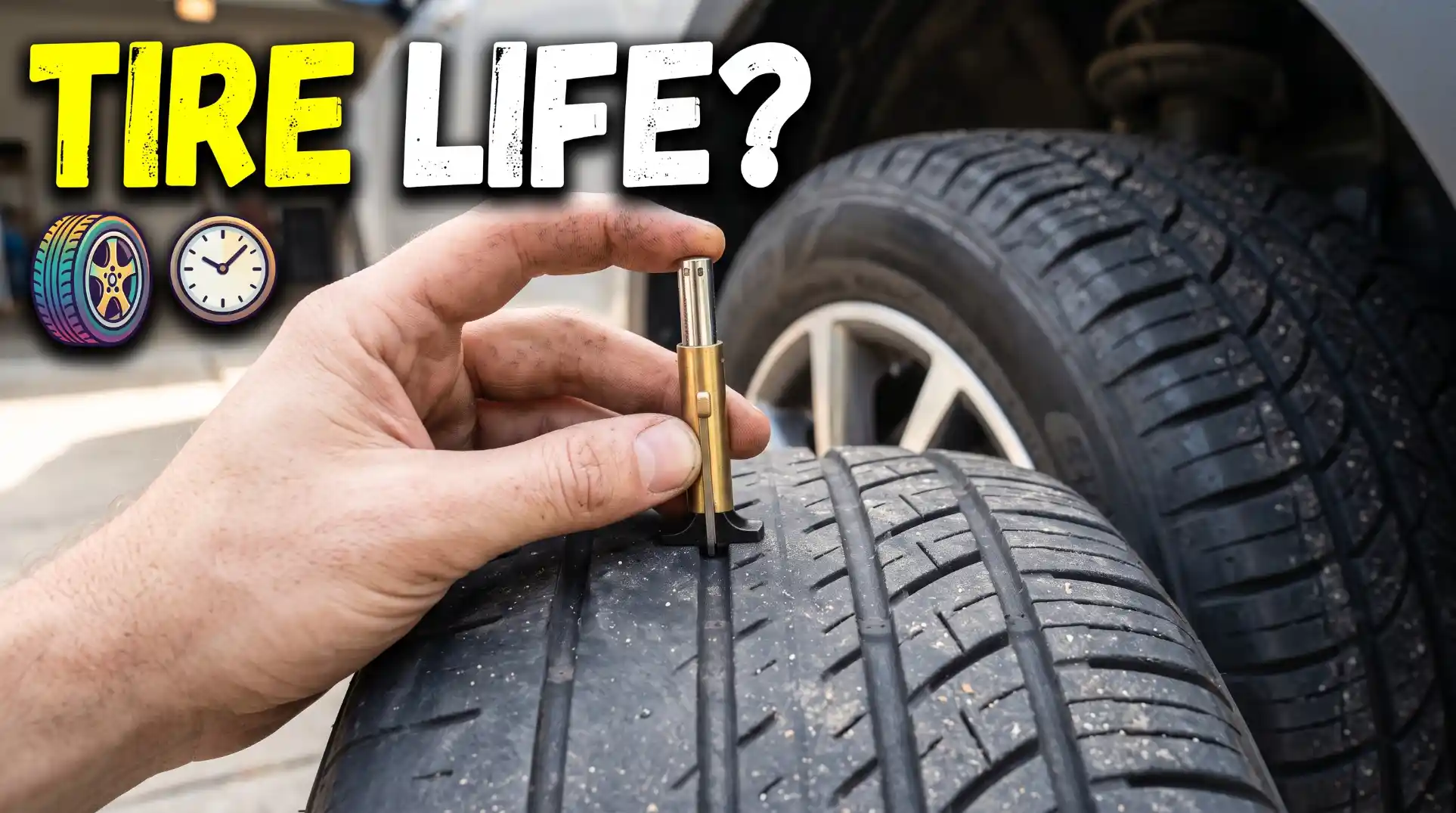
- Tread depth gauge: a cheap tool that gives an exact reading. Check several spots on each tire.
2. Check the Tire’s Age
Find the DOT code on the sidewall. The last four digits show the week and year of manufacture: 2423 means the 24th week of 2023. Rubber hardens and cracks with age even on a spare or a car that sits, so older tires can fail even with deep tread.
3. Look for Damage
- Cracks in the sidewall or between tread blocks (dry rot)
- Bulges or blisters on the sidewall
- Cuts, punctures near the shoulder or sidewall (usually not repairable)
- Exposed cords or steel belts
- Vibration that remains after balancing
What Makes Tires Wear Out Faster?
- Wrong tire pressure: underinflation wears both shoulders and builds heat; overinflation wears the center.
- Poor wheel alignment: causes feathering and wear on one edge.
- Skipping rotations: front tires on front-wheel-drive cars wear faster.
- Aggressive driving: hard braking, fast cornering and quick launches.
- Worn suspension parts: bad shocks or struts cause cupping (scalloped wear).
- Heavy loads and towing.
- Hot climates and rough roads.
Uneven Tire Wear Patterns and Causes
| Wear pattern | Likely cause | Fix |
|---|---|---|
| Both outer edges worn | Underinflation | Set pressure to the door-jamb sticker value |
| Center worn | Overinflation | Lower pressure to spec |
| One edge worn (inner or outer) | Camber or toe misalignment | Wheel alignment |
| Feathered tread (sharp on one side) | Toe misalignment | Wheel alignment |
| Cupping or scalloping | Worn shocks, struts or unbalanced wheel | Inspect suspension, balance wheels |
| Flat spots | Hard braking/skidding or long storage | Replace if vibration persists |
How to Make Your Tires Last Longer
- Check pressure monthly with the tires cold, using the pressure on the driver door-jamb sticker, not the maximum on the sidewall.
- Rotate every 5,000–7,500 miles or as your owner’s manual says. Many tire shops rotate free for tires you bought there.
- Get an alignment when you buy new tires, after hitting a big pothole or curb, or if the car pulls or the steering wheel is off-center.
- Balance the wheels if you feel vibration at highway speeds.
- Drive smoothly: gentle acceleration, braking and cornering.
- Do not overload the vehicle beyond its payload rating.
- Swap seasonal tires on time so winter tires are not wearing out in summer heat.
Should You Replace All Four Tires at Once?
It is best to replace tires in pairs (both fronts or both rears) at minimum, and many all-wheel-drive vehicles need all four replaced together or the new tire shaved to match, because different tread depths can strain the drivetrain. Check your owner’s manual. When replacing only two, most tire makers recommend putting the new pair on the rear axle for stability.
Safety note: Worn or aged tires take longer to stop on wet roads and are more likely to hydroplane or fail. If a tire shows a bulge, exposed cords or deep sidewall cracks, replace it before driving further at highway speed.
Try the calculator: use our tire size calculator to compare tire sizes.
Tire Life FAQ
Most tires last about 40,000 to 60,000 miles, or roughly three to six years of typical driving.
Many vehicle and tire manufacturers recommend replacing tires six to ten years after the manufacture date, even if tread remains. Check your tire maker’s guidance.
2/32 of an inch is the legal minimum in most US states. For better wet and snow traction, many experts suggest replacing at 4/32 inch.
Put a penny in the tread with Lincoln’s head upside down and facing you. If you can see the top of his head, the tread is worn out.
Every 5,000 to 7,500 miles for most cars, or as listed in the owner’s manual. Many drivers do it with each oil change.
A four-wheel alignment typically costs about $100 to $200, and a front-end alignment about $50 to $100. Dealerships and luxury vehicles cost more.
Incorrect tire pressure, poor wheel alignment, missed rotations, worn suspension parts and unbalanced wheels are the most common causes.
Look for the DOT code on the sidewall. The last four digits give the week and year the tire was made, such as 2423 for week 24 of 2023.