How to Tell If Your Car Battery Is Dead (And How to Test It)
How do you know if your car battery is dead or something else is wrong? Your car battery is probably dead if the engine won’t crank or only clicks, the dashboard lights are dim or flicker, and the car starts right away with a jump start. To confirm, test it with a multimeter: a healthy, fully charged battery reads about 12.6 volts with the car off, and it should not drop below about 9.6 volts while the engine cranks. A reading under 12.0 volts means the battery is discharged; if it will not hold a charge after recharging, it needs replacing.
This guide shows how to tell a dead battery from an alternator or starter problem, how to test a battery with a multimeter or load tester, and how to find a hidden drain that keeps killing your battery.
Key Takeaways
- Classic signs: clicking, slow or no cranking, dim or flickering dash lights, and a quick start with a jump.
- Resting voltage: 12.6 V full, 12.4 V about 75%, 12.2 V about 50%, under 12.0 V discharged.
- Cranking test: voltage should stay above about 9.6 V while the engine cranks.
- Charging test: about 13.7–14.7 V with the engine running means the alternator is working.
- Free option: most auto parts stores load-test batteries at no charge.
Signs Your Car Battery Is Dead or Dying
- Rapid clicking when you turn the key or press start
- The engine cranks very slowly, or not at all
- Dashboard and interior lights are dim, flicker or do not come on
- The car starts immediately after a jump start
- A battery warning light or “low battery” message
- Electrical glitches, such as the radio resetting or power windows moving slowly
- The battery is swollen, leaking, corroded or more than 3–5 years old
Dead Battery, Alternator or Starter? How to Tell
| Symptom | Most likely cause |
|---|---|
| Rapid clicking, dim lights, starts with a jump | Dead or weak battery |
| Car starts with a jump but dies soon after, or the battery keeps going flat while driving | Alternator not charging |
| Battery warning light while driving, lights dim as you drive | Alternator or drive belt |
| A single loud click, bright dash lights, engine does not crank | Starter or starter relay |
| Cranks normally but will not start | Not the battery: fuel, ignition or security system |
| Battery dies after sitting overnight or a few days | Parasitic drain or an old battery |
How to Test a Car Battery With a Multimeter
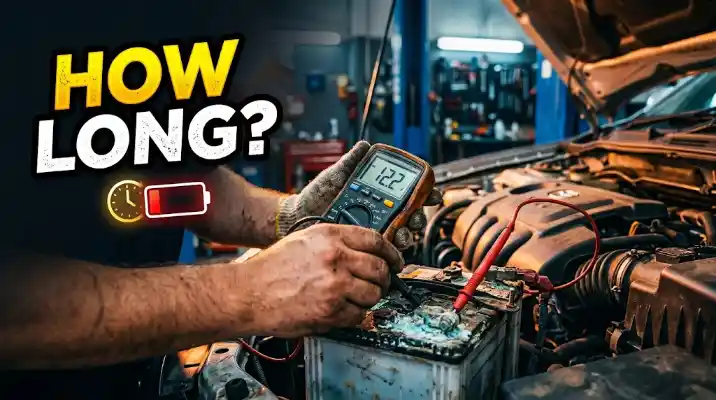
A digital multimeter costs about $15–$40 and answers most battery questions in a few minutes.
1. Resting Voltage Test
- Turn the car off and let it sit for at least an hour, ideally a few hours, so any surface charge fades.
- Set the multimeter to DC volts on the 20 V range.
- Touch the red probe to the positive (+) terminal and the black probe to the negative (−) terminal.
- Read the voltage and compare it with the table below.
| Resting voltage | State of charge | What to do |
|---|---|---|
| 12.6 V or higher | About 100% | Battery is charged; do a cranking test if problems continue |
| 12.4 V | About 75% | OK, but charge it |
| 12.2 V | About 50% | Charge it and retest |
| 12.0 V | About 25% | Discharged; charge fully and retest |
| Below 11.9 V | Discharged or dead | Charge and load test; a cell may have failed |
2. Cranking (Load) Test
- Keep the probes on the terminals, or clip them on.
- Have a helper crank the engine for a few seconds (disable the fuel pump or ignition only if your manual explains how; otherwise just start it normally).
- Watch the lowest reading while it cranks.
A healthy battery usually stays above about 9.6 volts while cranking. If it drops into the 8s or lower, the battery cannot deliver enough current even if its resting voltage looked fine. Note that a battery can read 12.6 volts at rest and still fail under load.
3. Charging System Test
Start the engine and measure across the battery terminals at idle. About 13.7 to 14.7 volts means the alternator is charging. Much lower suggests a weak alternator, a slipping belt or a wiring problem; much higher suggests the voltage regulator is overcharging, which can damage the battery. Turn on the headlights, blower and rear defroster; the voltage should stay above about 13 volts.
Using a Load Tester or a Free Store Test
A dedicated battery load tester or electronic conductance tester, like the ones auto parts stores use, measures the battery’s actual cold cranking ability and gives a clear pass, charge-and-retest or replace result. Many stores will test the battery in your car, and often the alternator and starter too, for free. This is the most reliable way to decide whether a borderline battery needs replacing.
What to Do If Your Battery Is Dead
- Jump-start it with jumper cables and another car or a portable jump starter, following your owner’s manual.
- Drive for at least 30 minutes if it starts, avoiding short trips, or better, recharge it fully with a battery charger.
- Test it after recharging. If it fails a load test or goes flat again, replace it.
- Check the terminals for corrosion or looseness, which can mimic a dead battery.
Safety note: wear eye protection when working near a battery, keep sparks and flames away, and never jump-start a battery that is frozen, cracked, leaking or bulging. Connect jumper cables in the order your owner’s manual gives, usually with the final black clamp on bare metal away from the battery.
Why Does My Battery Keep Dying?
- Age: most batteries last 3–5 years.
- Short trips: the alternator does not have time to recharge the energy used to start the engine.
- Lights or accessories left on, including a glove box or trunk light that does not turn off.
- A failing alternator that does not fully recharge the battery.
- Corroded or loose connections.
- A parasitic drain: a component that keeps drawing power after the car is off.
- Extreme heat or cold, which weakens batteries.
How to Test for a Parasitic Battery Drain
If a healthy, fully charged battery goes flat after the car sits, something may be drawing too much power while the car is off. Most cars draw a small amount to keep memory and security systems alive, typically under about 50 milliamps once the car goes to sleep.
- Make sure the battery is fully charged and turn everything off. Close the doors (latch the door switches if you need a door open), and remove the key or move the smart key away.
- Set the multimeter to measure DC amps, with the red lead in the amp socket.
- Disconnect the negative battery cable and connect the multimeter in series: one lead to the negative battery post and the other to the disconnected cable.
- Wait 20–60 minutes for the car’s modules to go to sleep, then read the current.
- If it is well above about 50 milliamps, pull fuses one at a time until the reading drops. That fuse’s circuit contains the drain.
Do not start the car or turn on high-current items while the meter is connected, since it can blow the meter’s internal fuse. If this sounds like too much, a shop can do a parasitic draw test for you, usually as part of an electrical diagnosis.
When to Replace the Battery
- It fails a load test at a store or with a load tester.
- It will not hold a charge after a full recharge.
- Cranking voltage drops below about 9.6 V.
- The case is swollen, cracked or leaking.
- It is more than about 4–5 years old and starting to struggle.
Dead Battery FAQ
Common signs are clicking or no cranking, dim or flickering dash lights and a car that starts right away with a jump. A resting voltage below about 12.0 volts confirms the battery is discharged.
A fully charged battery reads about 12.6 volts. Around 12.0 volts is roughly 25 percent charged, and below about 11.9 volts is considered discharged or dead.
Set the meter to DC volts, touch red to positive and black to negative with the car off, and read the voltage. Then watch the voltage while someone cranks the engine; it should stay above about 9.6 volts.
If the car starts with a jump but dies again soon or the battery keeps going flat while driving, suspect the alternator. With the engine running, a healthy charging system shows about 13.7 to 14.7 volts.
Yes. A battery can show normal voltage at rest but fail under load. A cranking test or store load test shows whether it can still deliver starting power.
Many auto parts stores test batteries for free, often while the battery is still in your car, and some also check the alternator and starter.
Lights or accessories left on, a glove box or trunk light that stays on, aftermarket electronics, a faulty module or an alternator diode problem can all create a parasitic drain.
Often yes, using a proper charger, but a battery that has been deeply discharged or left dead for a long time may be permanently damaged. Recharge it, then load test it.