How to Check Your Car’s Oil (And How Often to Change It)
Learning how to check car oil takes two minutes and can save an engine. To check your car’s oil, park on level ground with the engine off and cool, pull out the dipstick, wipe it clean, push it all the way back in and pull it out again. The oil should sit between the two marks and look amber to dark brown. Most modern cars need an oil change every 5,000 to 10,000 miles with synthetic oil, or when the oil-life monitor says so, and at least once a year even if you drive very little.
This guide covers how to check and read your oil, how often to change it, how much and what type your car needs, the signs of an engine burning oil, and how to dispose of used oil properly.
Key Takeaways
- Check monthly and before long trips; it takes two minutes.
- Level between the marks: add oil if it is near or below the lower mark.
- Change interval: commonly 5,000–10,000 miles for synthetic; follow your manual or oil-life monitor.
- Capacity: most cars hold about 4 to 8 quarts; your manual gives the exact amount.
- Use the right oil: the viscosity (such as 0W-20) and certification listed for your engine.
How to Check Your Oil Step by Step
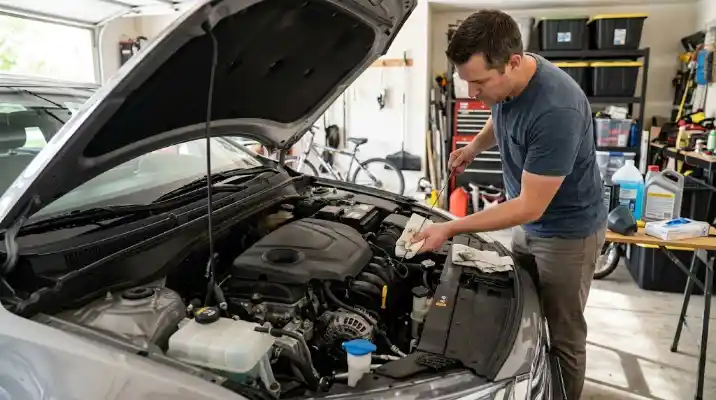
- Park on level ground and turn the engine off. Wait at least 5–10 minutes after driving so oil drains back to the pan, or check it cold in the morning.
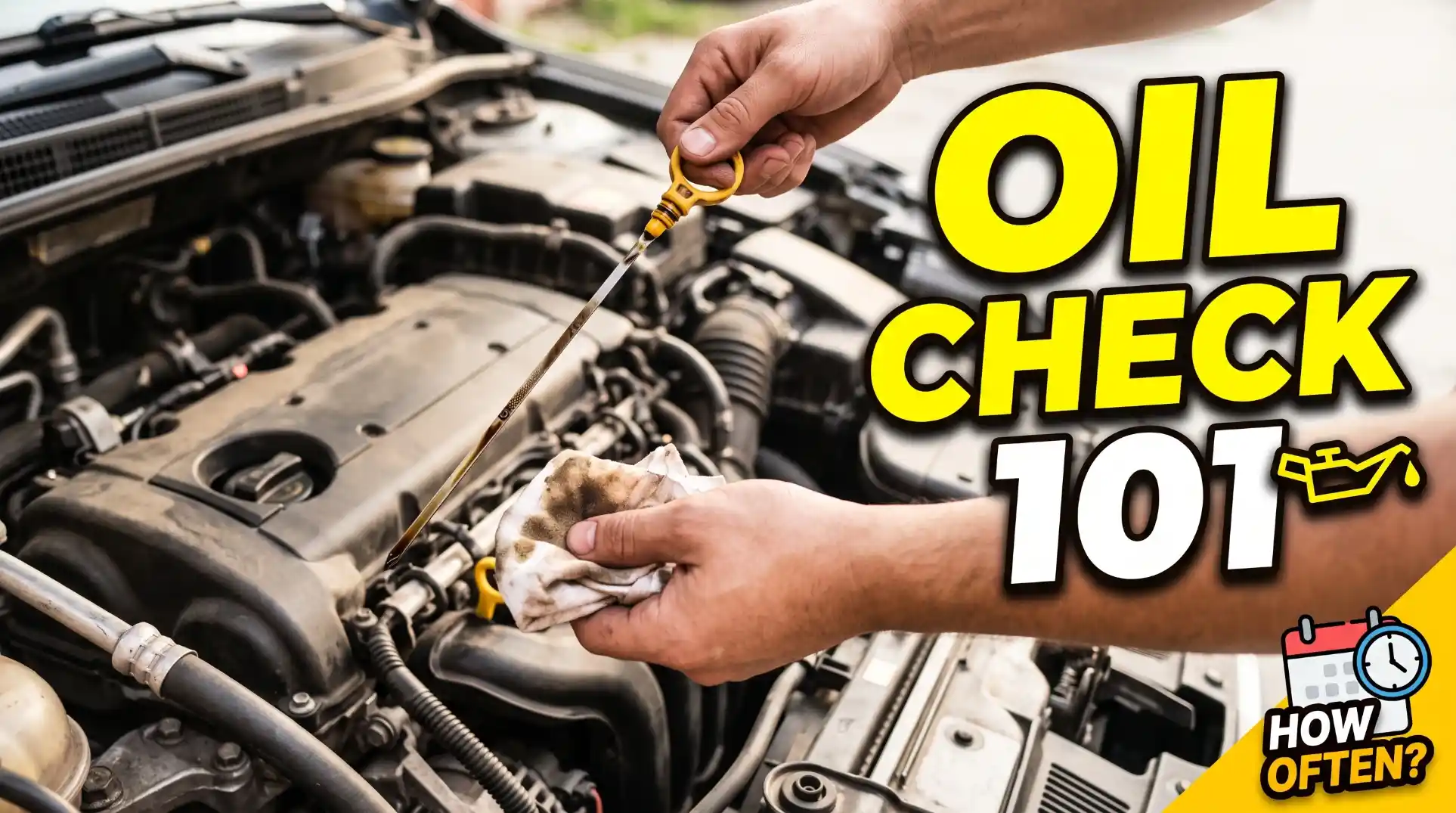
- Open the hood and find the dipstick, usually with a yellow or orange loop handle.
- Pull it out and wipe it clean with a lint-free cloth or paper towel.
- Reinsert it fully, then pull it out again and hold it level.
- Read the level: it should be between the two dots, lines or the cross-hatched area.
- Check the condition: look at the color and rub a drop between your fingers.
- Top up if needed: remove the oil filler cap on top of the engine and add a small amount of the correct oil with a funnel, wait a minute, and recheck. Do not overfill.
Some newer cars, especially many European models, have no dipstick and show oil level on the dashboard or infotainment screen. Follow the owner’s manual for how to check it.
What Your Oil Should Look Like
| What you see | What it means |
|---|---|
| Amber, translucent | Fresh oil |
| Dark brown to black, smooth | Normal used oil doing its job; change on schedule |
| Gritty or with metal flecks | Contamination or wear; have it checked |
| Milky, light brown or foamy | Coolant may be mixing with oil; possible head gasket problem, see a mechanic |
| Smells strongly of gasoline | Fuel dilution; worth having checked |
| Level well above the full mark | Overfilled, or fuel or coolant contamination |
How Often Should You Change Your Oil?
| Situation | Typical interval |
|---|---|
| Most modern cars on full synthetic oil | Every 5,000–10,000 miles, some up to 15,000 per the manufacturer |
| Conventional or synthetic blend oil | Often every 3,000–5,000 miles |
| Car with an oil-life monitor | When the monitor reaches about 5–15%, or per the manual |
| Severe driving: short trips, towing, dusty roads, extreme heat or cold, stop-and-go, rideshare | Toward the shorter end of the manufacturer’s range |
| Car driven very little | At least once a year, even if the mileage is low |
The old 3,000-mile rule does not apply to most modern engines and oils. Your owner’s manual is the best guide, and many list a “normal” and a “severe” schedule. Oil-life monitors calculate remaining life from engine revolutions, temperatures and driving patterns, so they call for changes sooner on short-trip city driving and later on steady highway driving.
How Much Oil Does My Car Need?
Most passenger cars hold about 4 to 8 quarts of oil including the filter. Small four-cylinder engines are often around 4 to 5 quarts, while V6 and V8 engines commonly need 6 to 8 quarts or more. The exact capacity is in your owner’s manual under specifications. When topping up between changes, you usually need much less: on many cars one quart raises the level from the low mark to the full mark on the dipstick.
What Type of Oil Does My Car Take?
- Viscosity grade: the two numbers, such as 0W-20 or 5W-30. The first number with a “W” (winter) shows how easily the oil flows when cold; lower means better cold starts. The second number shows thickness at normal engine temperature.
- Certification: look for the certification your manual specifies, such as the API “starburst” or an ILSAC or manufacturer approval. European cars often require specific manufacturer approvals.
- Synthetic, blend or conventional: many modern engines require full synthetic. Synthetic resists breakdown better and allows longer intervals.
- High-mileage oil: contains seal conditioners that may help older engines with minor leaks or oil consumption.
Use exactly the grade and specification in your manual or on the oil filler cap. The wrong viscosity can affect fuel economy, oil pressure and, on some engines, timing systems.
Is Your Car Burning Oil?
Some oil consumption between changes is normal on some engines, but losing a lot, or suddenly more than usual, needs attention. Signs include:
- Needing to add oil frequently between changes
- Blue-gray smoke from the exhaust, especially on start-up or when accelerating
- A burning oil smell
- Oily or fouled spark plugs, misfires or a rough idle
- An oil pressure warning light (pull over safely and turn the engine off)
Common causes are worn piston rings or valve seals, a clogged PCV valve, or a turbocharger leaking oil. Oil that disappears without smoke is often leaking instead: look for drips under the car or oil on the engine. Keep track of how much you add and how often; that record helps your mechanic diagnose the problem.
Safety note: if the oil pressure light comes on while driving, pull over as soon as it is safe and turn off the engine. Running an engine with low oil pressure can destroy it within minutes. Check the level and do not drive until the cause is known.
Changing Your Own Oil
A DIY oil change usually costs about $30 to $60 in oil and a filter, compared with roughly $40 to $130 at a shop depending on oil type. You need the right oil and filter, a wrench for the drain plug, a filter wrench, a drain pan, a funnel and gloves.
- Lift the car safely: use drive-on ramps or a jack with rated jack stands on solid, level ground. Never get under a car supported only by a jack.
- Replace the drain plug washer if your car uses one, and tighten the plug and filter to spec, not as hard as possible.
- Fill with the correct amount, run the engine for a minute, check for leaks, then recheck the level after it settles.
- Reset the oil-life monitor using the procedure in your manual.
How to Dispose of Used Motor Oil
Never pour used oil on the ground, into drains or in the trash. According to the EPA, the oil from one oil change can contaminate a million gallons of fresh water. Pour used oil into a sealed container, such as the empty new-oil bottles, and take it with the used filter to an auto parts store that accepts used oil, a quick-lube shop or a household hazardous waste site. Most take it for free.
What an Oil Change Costs
| Service | Typical cost |
|---|---|
| Conventional oil change at a shop | $40–$75 |
| Full synthetic oil change at a shop | $65–$130 |
| Dealer oil change | $60–$150+ |
| DIY (oil and filter) | $30–$60 |
Car Oil FAQ
Park on level ground with the engine off, pull out the dipstick, wipe it, reinsert it fully and pull it out again. The oil should be between the two marks.
Check it with the engine off, either cold or 5 to 10 minutes after driving so the oil drains back to the pan. Follow your manual if it gives a specific procedure.
Most modern cars using synthetic oil need a change every 5,000 to 10,000 miles or when the oil-life monitor says so, and at least once a year. Severe driving calls for shorter intervals.
Most cars hold about 4 to 8 quarts including the filter. Check your owner manual for the exact capacity.
Use the viscosity grade, such as 0W-20 or 5W-30, and the certification listed in your owner manual or on the oil filler cap.
Milky or foamy oil can mean coolant is mixing with the oil, which may point to a head gasket problem. Have the car checked before driving much further.
Signs include needing to add oil often, blue-gray exhaust smoke, a burning oil smell and oily spark plugs or misfires.
Take it in a sealed container to an auto parts store, quick-lube shop or household hazardous waste site. Most accept used oil and filters for free.