Signs of a Bad Starter (And How It Differs From a Dead Battery)
The signs of a bad starter are easy to confuse with a dead battery. The clearest sign of a bad starter is when you turn the key or press the start button and hear a single loud click, a grinding noise, or nothing at all, while your dashboard lights and headlights stay bright. That pattern points to the starter rather than the battery. A dead or weak battery usually causes rapid clicking, dim lights and slow cranking instead. Starter replacement typically costs about $250 to $650 at most shops, and more on vehicles where the starter is hard to reach.
Key Takeaways
- Starter problem: single click or no sound, lights stay bright.
- Battery problem: rapid clicking, dim or flickering lights, slow crank.
- Test the battery first: a healthy battery reads about 12.6 volts with the engine off, and most parts stores load-test for free.
- Replacement cost: about $250–$650; the part alone is roughly $80–$350.
- Lifespan: commonly 100,000–150,000 miles or 7–10 years.
What Does a Starter Do?
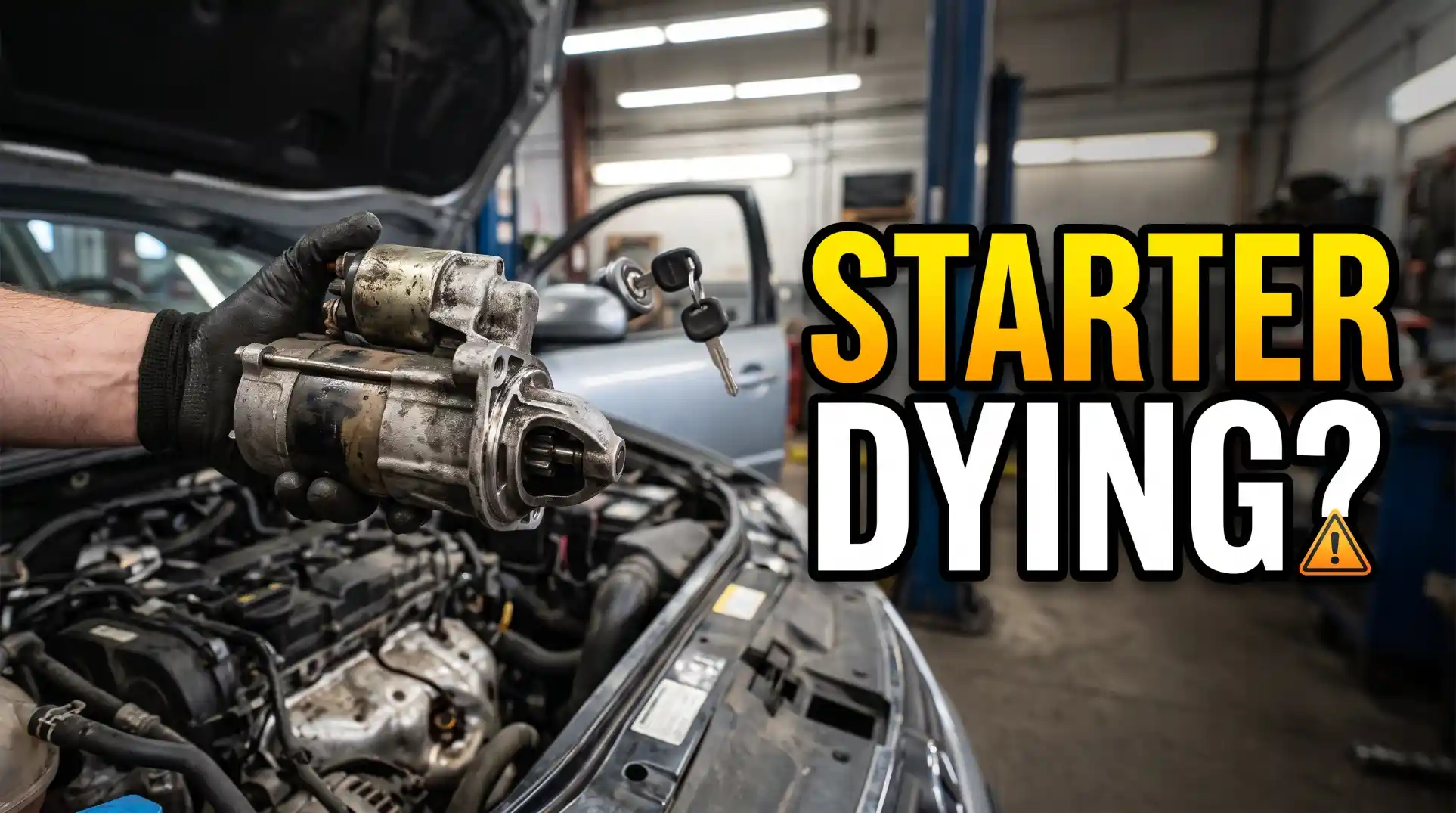
The starter is a small, powerful electric motor bolted to the engine near the transmission. When you turn the key, the battery sends current through the starter solenoid, which pushes a small gear (the pinion) forward to mesh with the engine’s flywheel and spins the motor. That turns the engine over until it fires and runs on its own. The starter then disengages. If any part of that chain fails, the engine will not crank.
8 Signs of a Bad Starter
- Single loud click, no crank: the solenoid engages but the motor does not spin.
- No sound at all: the key turns, lights come on, but nothing happens under the hood.
- Grinding noise: worn pinion gear teeth or a damaged flywheel ring gear.
- Whirring or spinning without cranking: the starter motor spins but its gear does not engage the flywheel.
- Intermittent starting: the car starts fine one day and not the next, often a worn solenoid or dead spot in the motor.
- Slow or labored cranking with a good battery: worn brushes or bearings make the motor drag.
- Smoke or a burning smell: an overheating starter or shorted wiring; stop trying to start the car.
- Starter keeps running after the engine starts: a stuck solenoid or relay; this can quickly damage the starter and flywheel.
Bad Starter vs Dead Battery vs Bad Alternator
| Symptom | Likely starter | Likely battery | Likely alternator |
|---|---|---|---|
| Single click, lights bright | Yes | Less likely | No |
| Rapid clicking, lights dim | Less likely | Yes | Possible (if it drained the battery) |
| Slow crank | Possible | Yes | Possible |
| Starts with a jump, then keeps running | No | Yes | Less likely |
| Starts with a jump, dies soon after | No | Possible | Yes |
| Grinding noise when starting | Yes | No | No |
| Battery light on while driving | No | Less likely | Yes |
How to Tell If It Is the Starter: Quick Checks
- Check the lights: turn on the headlights and try to start. If they dim heavily or go out, suspect the battery or its cables. If they stay bright and nothing cranks, suspect the starter.
- Test battery voltage: about 12.6 V is fully charged; below about 12.2 V the battery may be too weak to crank.
- Inspect the battery cables: loose or corroded terminals can mimic a bad starter. Clean and tighten them.
- Try a jump start: if the car starts right away with a jump, the battery is the more likely cause.
- Check the gear selector: on automatics, try starting in Neutral. A faulty neutral safety switch can block cranking in Park.
- Check fuses and the starter relay listed in your owner’s manual.
- Get a free test: many auto parts stores test batteries, alternators and starters at no charge.
Safety note: Keep hands, tools and clothing away from the engine’s belts and fan when someone tries to start the car. Do not work on the starter without disconnecting the negative battery cable first, and never tap a starter while standing where the car could move.
The “Tap the Starter” Trick
Lightly tapping the starter motor with a hammer or tire iron while someone turns the key sometimes gets a car with worn brushes or a sticky solenoid to start one more time. It is a short-term way to get home or to a shop, not a fix. If it works, plan to replace the starter soon.
Starter Replacement Cost
| Item | Typical cost |
|---|---|
| Starter replacement at a shop (most cars) | $250–$650 |
| Hard-to-access starters (some V6/V8, AWD or luxury models) | $650–$1,000+ |
| Remanufactured starter (part only) | About $80–$250 |
| New starter (part only) | About $150–$350+ |
| Starter solenoid or relay only | Often much less, depending on design |
Labor varies a lot because some starters bolt on in minutes while others require removing intake parts, exhaust or suspension components. A quality remanufactured starter with a good warranty is a common money saver.
What Causes a Starter to Fail?
- Normal wear of brushes, bearings and the solenoid contacts
- Oil or coolant leaks dripping onto the starter
- Loose, corroded or damaged wiring and ground straps
- Cranking for too long at once, which overheats the motor
- Frequent short trips and many start cycles
- A weak battery that forces the starter to work harder
How Long Does a Starter Last?
Most starters last roughly 100,000 to 150,000 miles or 7 to 10 years, though some fail sooner and others last the life of the car. Vehicles with engine start-stop systems use heavier-duty starters designed for many more start cycles. To help it last, keep battery terminals clean, fix oil leaks, and crank for no more than about 10 seconds at a time, pausing between attempts.
Car Starter FAQ
A single loud click, no sound when you turn the key, grinding, a starter that spins without cranking the engine, intermittent starting, smoke or a burning smell.
If the lights stay bright but the engine does not crank, suspect the starter. If you hear rapid clicking and the lights dim, suspect the battery.
Most starter replacements cost about $250 to $650, and more on vehicles where the starter is difficult to reach.
Yes. A starter with a short or a stuck solenoid can draw heavy current and drain the battery, and repeated failed attempts also drain it.
Usually not. A jump start helps a weak battery, but it will not fix a failed starter motor or solenoid.
Typically about 100,000 to 150,000 miles or 7 to 10 years, depending on the vehicle and how often it is started.
Once the engine is running, the starter is not needed, so you can drive. The risk is that the car may not restart after you turn it off.