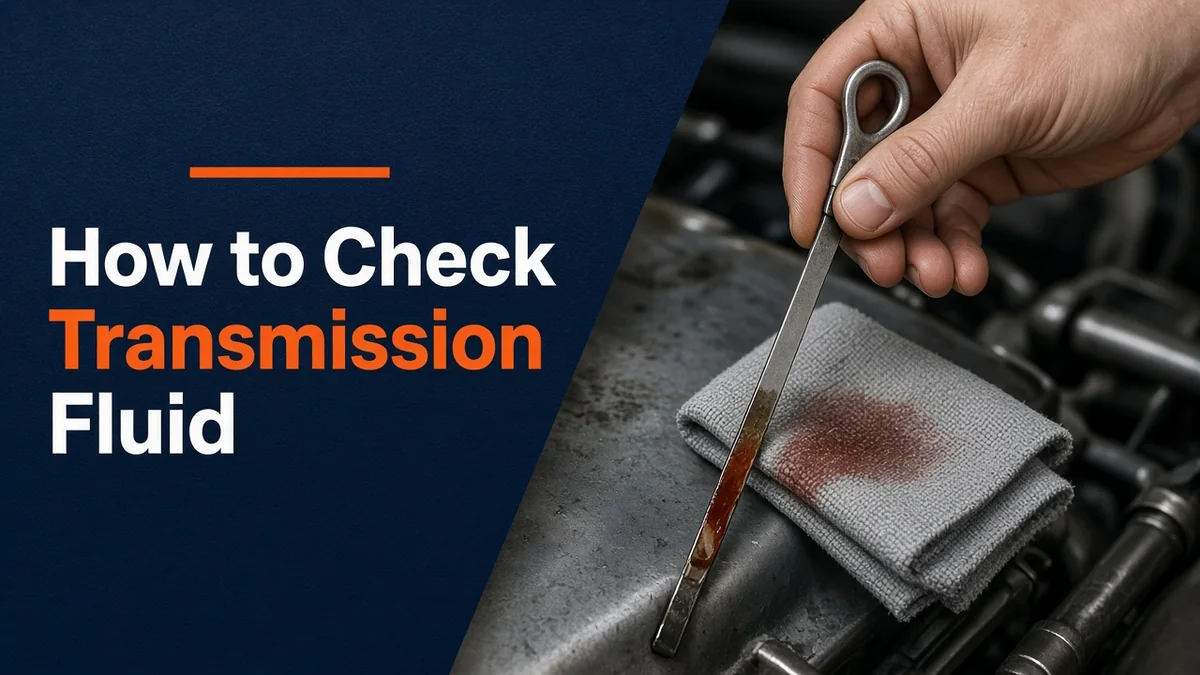
How to Check Transmission Fluid (and Signs It’s Low)
To check automatic transmission fluid, warm the car up with a 10- to 15-minute drive, park on level ground, set the parking brake and, with the engine idling in Park, pull the transmission dipstick. Wipe it with a lint-free cloth, push it back in fully, pull it out again and read the level against the “hot” marks. Healthy fluid is usually pink to red and smells faintly oily. Procedures vary: a few cars are checked in Neutral or with the engine off, and many newer cars have no dipstick at all, so follow your owner’s manual.
What You Need
- A clean, lint-free cloth or paper towel
- Your owner’s manual, to confirm the procedure and fluid type
- A long, narrow funnel if you need to add fluid
- The correct transmission fluid, in case the level is low
- Gloves, because the dipstick and engine bay will be hot
Where Is the Transmission Dipstick?
On cars that have one, the transmission dipstick is under the hood, usually toward the back of the engine bay near the firewall.
- Front-wheel-drive cars: often on the driver’s or passenger’s side of the engine, near the transaxle, and usually farther back than the engine oil dipstick.
- Rear-wheel-drive trucks and SUVs: often near the back of the engine, sometimes close to the firewall on the passenger side.
- How to recognize it: the handle is often red, yellow or orange and may be marked “ATF,” “Trans” or with a gear symbol. The engine oil dipstick is usually yellow and marked with an oil can.
- No dipstick? Many cars built since the mid-2000s have a sealed transmission with a check plug instead. See the section below on checking without a dipstick.
If you are unsure, the owner’s manual has a diagram of the engine bay showing each dipstick and fill point.
How to Check Transmission Fluid Step by Step
- Warm up the transmission: drive for 10 to 15 minutes so the fluid reaches normal operating temperature. Fluid expands when hot, so a warm reading is the accurate one.
- Park on level ground: a slope tilts the fluid and gives a false reading.
- Set the parking brake and leave the engine running: keep it in Park unless your manual says Neutral.
- Cycle through the gears: with your foot on the brake, move the lever slowly through each position and back to Park. This fills the internal passages.
- Find the transmission dipstick: it is usually toward the back of the engine bay, often with a red, orange or yellow handle, and often labeled ATF or with a gear symbol. Do not confuse it with the engine oil dipstick.
- Pull, wipe and reinsert: pull the dipstick out, wipe it clean with a lint-free cloth, then push it all the way back in.
- Pull it again and read the level: the fluid should sit within the HOT range. Check both sides of the dipstick and use the lower reading.
- Check the condition: put a drop on a white paper towel to see the color and feel for grit.
- Reinsert the dipstick fully: a loose dipstick can let dirt in.
If you are already under the hood, it is a good moment to check your other fluids too. Our guide to checking car fluids walks through coolant, brake fluid and more, and checking your engine oil uses a very similar dipstick routine.
Hot vs Cold Marks on the Dipstick
Many transmission dipsticks have two ranges. The upper range, marked HOT, is for a fully warmed transmission after driving. The lower range, marked COLD, is for a quick check after the car has been idling only a minute or two. Because fluid expands as it heats up, a cold reading near the top of the COLD range can be perfectly normal. Always confirm with a warm check before adding fluid.
Exceptions: When the Procedure Is Different
- Engine off: some cars, including certain older Honda models, are checked with the engine off shortly after it has been warmed up.
- Neutral instead of Park: a few manufacturers specify Neutral.
- No dipstick tube: many newer vehicles have sealed transmissions with only a fill or check plug.
- CVTs: some continuously variable transmissions have a dipstick and some do not, and the fluid must be the specific CVT type.
- Manual transmissions: checked through a fill plug on the side of the gearbox, with the car level and the engine off.
How to Check Transmission Fluid Without a Dipstick
Sealed transmissions are designed to be checked from underneath. The car must be perfectly level on a lift, the fluid must be at a specific temperature (often read with a scan tool), and a check plug on the transmission case is removed so any excess drains out. If fluid does not trickle out, it is topped up until it does. Because the temperature window is narrow and the car must be level, this is usually a job for a shop.
You can still keep an eye on it without tools: look for red or brown spots where you park, and pay attention to how the car shifts. If you see drips, our guide to car fluid and oil leaks helps you tell transmission fluid from oil and coolant.
What Transmission Fluid Color Means
| Color and condition | What it means | What to do |
|---|---|---|
| Bright red or pink, clear | Fresh, healthy fluid | Nothing |
| Light brown or darker red | Normal aging | Check the service interval |
| Dark brown or black | Worn or overheated fluid | Plan a fluid service and inspection |
| Burnt smell | Overheating, possible clutch wear | Have the transmission inspected soon |
| Milky or pink and foamy | Coolant contamination, often from a cooler leak | Stop driving long distances and get it checked |
| Metal flakes or grit | Internal wear | Have a transmission specialist inspect it |
Some newer and CVT fluids are naturally green, blue or amber, so compare with what is normal for your fluid type.
Signs Your Transmission Fluid Is Low
- Slipping, where the engine revs rise but the car does not accelerate as it should
- Delayed engagement when shifting into Drive or Reverse
- Harsh, jerky or late shifts
- Whining, humming or grinding noises; our guide to car noises helps narrow these down
- A burning smell or a transmission temperature warning light
- Red or brown fluid spots under the car
How to Check Manual Transmission Fluid
Most manual transmissions do not have a dipstick. Instead, the level is checked at a fill plug on the side of the transmission case:
- Park on level ground and safely raise the car on jack stands, keeping it level.
- Locate the fill plug (upper) and drain plug (lower) on the transmission case.
- Loosen the fill plug first. If you cannot remove it, do not remove the drain plug.
- Remove the fill plug. The fluid should be at, or just below, the bottom edge of the hole. You can check with a fingertip.
- If it is low, add the specified manual transmission fluid or gear oil with a pump until it just begins to drip out.
- Reinstall the fill plug and tighten it to specification.
Checking CVT Fluid
Most CVTs have no dipstick and must be checked at a specific fluid temperature through a check plug, often with a scan tool to read the temperature. Because CVTs are sensitive to fluid level and type, this is best left to a shop unless you have the service procedure for your model.
How to Add Transmission Fluid
- Confirm the exact fluid type in your owner’s manual or on the dipstick handle.
- With the engine running and in Park (unless your manual says otherwise), insert a long, narrow funnel into the dipstick tube.
- Add a small amount, about half a pint at a time.
- Wait a minute, cycle through the gears, then recheck the level.
- Repeat until the level is within the HOT range.
- Reinsert the dipstick fully and look for leaks over the next few days.
Do not overfill: too much fluid can foam, overheat and be pushed out of vents and seals, which causes shifting problems. If you overfill, have the excess drained. And if you keep needing to add fluid, there is a leak that needs fixing; transmissions do not use up fluid the way engines use oil.
What It Costs to Have Transmission Fluid Checked
| Service | Typical Cost (US) |
|---|---|
| Fluid level check at a shop | Often free with other service, or about $20–$50 |
| Check on a sealed transmission (temperature procedure) | About $50–$120 |
| Top-off (fluid plus labor) | About $20–$75 |
| Drain-and-fill | About $100–$250 |
| Leak diagnosis | About $50–$150 |
If the fluid is low, ask the shop to find the leak. Transmissions do not normally consume fluid, so a low level almost always means a leak somewhere.
How Often Should You Check Transmission Fluid?
Check it about once a month or at every oil change if your car has a dipstick, and any time you notice a change in how the car shifts. Transmission fluid is not consumed in normal use, so a dropping level always points to a leak. Fluid replacement intervals vary widely by manufacturer; our car maintenance schedule by mileage shows where transmission service usually falls.
Related guides: do automatic cars have a clutch, why your car is shaking and dashboard symbols and meanings.
Checking Transmission Fluid FAQ
For most automatic transmissions, yes: engine warm and idling, in Park, on level ground. Some cars are checked in Neutral or with the engine off, so confirm in your owner’s manual.
Hot, after a 10- to 15-minute drive, gives the accurate reading. A cold check using the COLD marks is only a rough guide.
Fresh automatic transmission fluid is usually bright red or pink. Darker brown fluid is aging, and dark, burnt-smelling fluid needs attention. Some newer and CVT fluids are a different color.
Low fluid can cause slipping, delayed or harsh shifts, overheating and eventually serious internal damage. Top up with the correct fluid and find the leak.
Yes. Too much fluid can foam and overheat, causing erratic shifting and leaks. Have the excess drained if the level is above the HOT range.
A burnt smell usually means the fluid has overheated, often from towing, slipping clutches or old fluid. Have the transmission inspected, since burnt fluid can signal internal wear.