How Often to Rotate Tires (With Rotation Patterns)
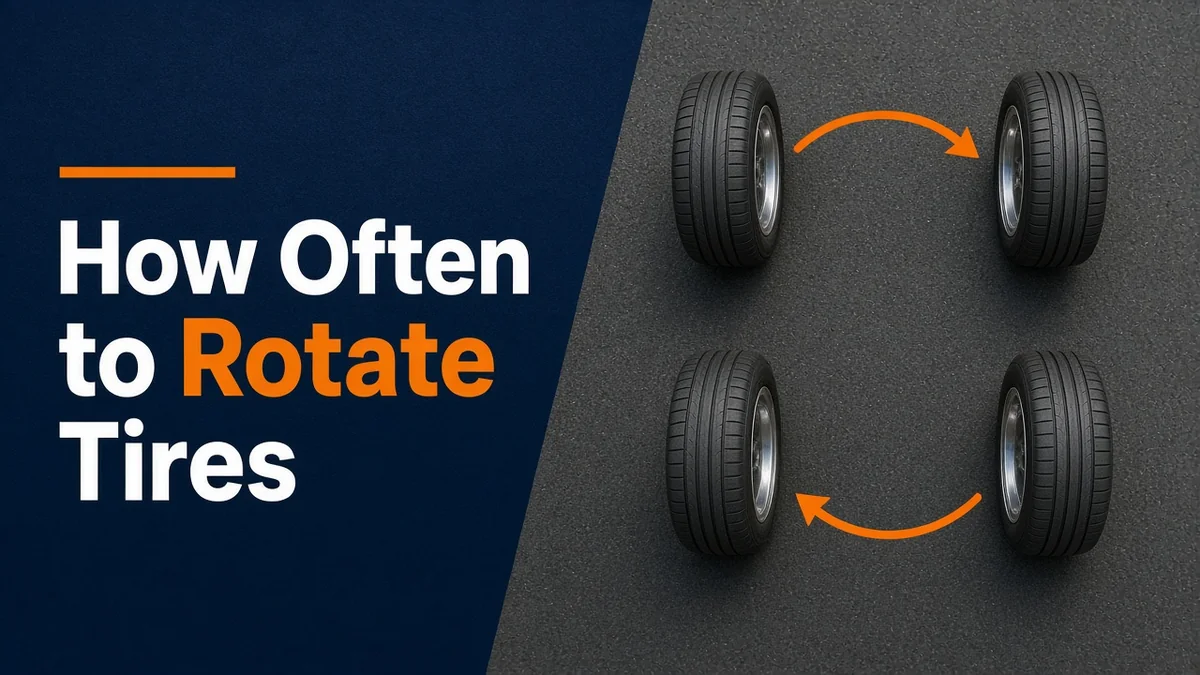
Most vehicles should have their tires rotated every 5,000 to 7,500 miles, which for many drivers lines up with every oil change. All-wheel-drive and four-wheel-drive vehicles often benefit from the shorter end of that range, because even tread wear protects the drivetrain. Your owner’s manual lists the exact interval and pattern. The right pattern depends on your drivetrain and tires: forward cross for front-wheel drive, rearward cross or X-pattern for rear-wheel and all-wheel drive, and front-to-back only for directional or staggered tires.
Why Tire Rotation Matters
Each wheel position wears tires differently. On a front-wheel-drive car, the front tires handle steering, most of the braking and all of the power, so they can wear two or three times faster than the rears. Rotating moves each tire through different positions so all four wear at a similar rate. That means longer tire life, more even handling and braking, and on all-wheel-drive vehicles, less strain on the drivetrain from mismatched tire diameters. Many tire warranties also require regular rotations.
How Often Should You Rotate Your Tires?
| Vehicle or situation | Typical rotation interval |
|---|---|
| Front-wheel-drive car | Every 5,000–7,500 miles |
| Rear-wheel-drive car or truck | Every 5,000–7,500 miles |
| All-wheel or four-wheel drive | Every 3,000–6,000 miles, or per the manual |
| Performance or staggered tires | Per the manual; may be limited to side-to-side or none |
| New tires | First rotation at about 5,000 miles |
An easy rule is to rotate at every oil change if your oil interval is 5,000 to 7,500 miles. If your car goes 10,000 miles between oil changes, rotate the tires in between. Our car maintenance schedule by mileage shows how rotations fit with other services.
Tire Rotation Patterns
| Pattern | How it works | Used for |
|---|---|---|
| Forward cross | Front tires move straight back; rear tires cross to the opposite front positions | Front-wheel drive |
| Rearward cross | Rear tires move straight forward; front tires cross to the opposite rear positions | Rear-wheel drive, 4WD and many AWD vehicles |
| X-pattern | All four tires move diagonally to the opposite axle and side | Many AWD vehicles; also an alternative for FWD |
| Front-to-rear | Tires swap front and back on the same side | Directional tires |
| Side-to-side | Tires swap left and right on the same axle | Staggered setups with non-directional tires |
| Five-tire rotation | A matching full-size spare joins the rotation | Trucks and SUVs with an identical spare |
Directional Tires
Directional tires have an arrow on the sidewall showing which way they must roll. They can only move front to back on the same side, unless they are remounted on the wheels, which costs more.
Staggered Setups
Many performance cars use wider tires on the rear than the front. Those tires cannot move between axles. If they are not directional, they can swap side to side; otherwise they cannot be rotated at all and simply wear at their own rate.
Signs Your Tires Need Rotating
- Tread depth differs noticeably between the front and rear tires
- Uneven wear on the edges or center of the tread
- Vibration at highway speed, which can also come from imbalance or worn parts; our guide to why your car is shaking covers the causes
- More road noise than usual
- It has been more than 7,500 miles since the last rotation
How to Rotate Tires Yourself
- Check your owner’s manual for the correct pattern and lug nut torque.
- Park on level ground, set the parking brake and chock the wheels.
- Loosen the lug nuts slightly on all wheels while the car is on the ground.
- Lift the car safely and support it on jack stands, ideally all four corners, or work one axle at a time.
- Move each wheel to its new position following the pattern.
- Hand-tighten the lug nuts, lower the car and torque them to specification in a star pattern.
- Set the tire pressures for each position using the door-jamb placard, since front and rear pressures can differ.
- Recheck the lug nuts after about 50 to 100 miles.
Never rely on a jack alone: always support the car on rated jack stands before removing wheels, and never get under a car held only by a jack. If you do not have a safe way to lift all four corners, let a shop do the rotation.
On some cars, the tire pressure monitoring system needs to relearn the new sensor positions after a rotation. If a warning appears, see our guide to dashboard symbols and meanings and your owner’s manual for the reset procedure.
How Long Does a Tire Rotation Take?
A tire rotation usually takes about 15 to 30 minutes at a shop, since the technician only needs to lift the car, move the wheels and torque the lug nuts. Adding balancing brings it to about 45 to 60 minutes. Doing it yourself with a jack and four jack stands typically takes 30 to 60 minutes. Cars with direct TPMS may need a sensor relearn afterward, which adds a few minutes.
How Much Does Tire Rotation Cost?
| Service | Typical cost |
|---|---|
| Tire rotation only | $20–$50 |
| Tire rotation and balance | $40–$100 |
| Rotation with an oil change package | Often included or discounted |
| Free rotation | Common for the life of tires bought at many tire shops |
Should You Rotate and Balance at the Same Time?
Not every rotation needs balancing. Balancing corrects weight differences around each wheel and tire and is worth doing if you feel vibration, after a tire repair, or every other rotation as a preventive step. A wheel alignment is separate again; it adjusts suspension angles and is needed when the car pulls or the tires wear on one edge.
What Happens If You Don’t Rotate Your Tires
- Uneven wear: front tires on front-wheel-drive cars can wear out much sooner than the rears, so you replace two tires early instead of four together.
- Shorter overall tire life: tires that are never rotated often need replacing thousands of miles sooner.
- Handling changes: mismatched tread depth front to rear can affect wet grip and stability.
- AWD drivetrain stress: on many all-wheel-drive vehicles, large differences in tread depth can strain the center differential or transfer case.
- Noise and vibration: choppy or cupped wear patterns make tires louder.
- Voided tread warranty: see below.
Tire Rotation and Your Tire Warranty
Most tire manufacturers’ treadwear (mileage) warranties require regular rotations, often every 5,000 to 8,000 miles, and proof of them. Keep receipts or a log with dates and mileage. Many tire retailers rotate tires free for the life of tires bought from them, which also creates the service record you need if you ever make a warranty claim.
How Rotation Affects Tire Life
Regular rotation is one of the simplest ways to get the full rated mileage from a set of tires. Combined with correct pressure and alignment, it helps tires wear evenly so you replace all four together rather than two early. Our guide to how long tires last covers the other factors, and the tire size calculator helps if you are comparing replacement sizes.
Related guides: winter car prep and snow tires, car inspection and suspension repair cost.
Tire Rotation FAQ
Most vehicles need a rotation every 5,000 to 7,500 miles. All-wheel-drive vehicles may need it more often. Check your owner’s manual.
Skipping rotations makes tires wear unevenly, shortens their life, can affect handling and may void a tire warranty. On AWD vehicles it can strain the drivetrain.
Often yes. AWD systems work best when all four tires have similar tread depth, so many manufacturers recommend shorter intervals.
It can. Most treadwear warranties require regular rotations and proof, such as service receipts. Skipping rotations may make a mileage warranty claim invalid.