Transmission Fluid Types: Dexron, Mercon, ATF+4, Honda DW-1, Toyota WS and CVT
There is no single “normal” transmission fluid. Each automaker writes its own specification, and the main ones in the US are GM Dexron (Dexron VI and Dexron ULV today), Ford Mercon (Mercon V, LV and ULV), Chrysler Mopar ATF+4, Toyota WS, Honda DW-1, and a separate family of CVT fluids. The right fluid for your car is the one named in your owner’s manual, often also printed on the dipstick or fill cap. Using the wrong type can cause harsh or slipping shifts and, over time, transmission damage.
What Transmission Fluid Does
Automatic transmission fluid (ATF) is far more than a lubricant. In a conventional automatic it is also the hydraulic fluid that operates the clutches and bands, the medium that transfers power through the torque converter, and the coolant that carries heat away from the gearbox. Its friction properties are tuned so that clutch packs engage smoothly without slipping.
That is why specifications differ. Each transmission design needs a particular balance of viscosity, friction modifiers and heat resistance, and automakers test fluids against their own standards. A fluid that is excellent in one transmission can shift badly in another.
Transmission Fluid Types by Automaker
| Specification | Used by | What to know |
|---|---|---|
| Dexron VI | GM (most automatics since about 2006) | Replaces Dexron II and III; GM approves it for older GM automatics |
| Dexron ULV | GM 10-speed and some newer automatics | Ultra-low viscosity; not a substitute for Dexron VI or the reverse |
| Mercon V | Older Ford automatics | Do not replace with Mercon LV unless Ford says so for your model |
| Mercon LV | Most Ford automatics since roughly 2008 | Lower viscosity; not backward compatible with Mercon V |
| Mercon ULV | Ford 10-speed automatics | Ultra-low viscosity for newer Ford and Lincoln gearboxes |
| Type F | Classic Fords and some older imports | Very different friction properties; only where specified |
| Mopar ATF+4 | Chrysler, Dodge, Jeep and Ram | Replaces ATF+2 and ATF+3 in Chrysler transmissions |
| Toyota WS | Most Toyota and Lexus automatics since the mid-2000s | Low viscosity; older Toyotas used Type T-IV |
| Honda DW-1 | Honda and Acura conventional automatics | Replaced Honda ATF-Z1, which is no longer made |
| Nissan Matic S / J / K | Nissan and Infiniti conventional automatics | Check which letter your model uses |
Specifications change over time, and some models inside a brand use a supplier’s transmission with its own fluid. Treat the table as a guide to what the names mean, not a substitute for your manual.
Dexron VI Explained: Compatibility, Synthetic or Not, and Price
Dexron VI is GM’s automatic transmission fluid specification for most GM automatics built since about 2006, and it is one of the most widely sold ATFs in the US.
- Backward compatible in GM transmissions: GM approves Dexron VI for older GM automatics that originally called for Dexron II or Dexron III, so you can use it when topping up or changing fluid in those units.
- Not the same as Dexron III: Dexron VI is a thinner, longer-lasting fluid with tighter friction and shear-stability requirements. GM no longer licenses Dexron III, so bottles described as “Dexron III type” are made to the old spec without current GM approval.
- Not always full synthetic: the specification sets performance, not the base oil. Some Dexron VI fluids are full synthetic and some are synthetic blends, so read the label if you want full synthetic.
- Not universal: Dexron VI is not a substitute for Dexron ULV in GM 10-speeds, for Mercon LV, Toyota WS, Honda DW-1, or any CVT fluid unless the bottle names that exact specification as well.
- Price: retail listings in October 2026 ran roughly $9 to $16 a quart, with six-quart cases bringing the per-quart price toward the low end. Many cars need 4 to 6 quarts for a drain-and-fill.
Some newer GM 8-speed automatics have been serviced with an updated GM fluid sold under a separate name, and Honda’s 9- and 10-speed automatics use Honda fluids other than DW-1. In both cases the fluid printed in the owner’s manual or given by a dealer parts counter for your VIN is the one to trust.
Other Common Specs: Hyundai, Kia, European Cars and Heavy-Duty Trucks
The big domestic and Japanese names get most of the attention, but many popular vehicles use other fluid specifications:
| Specification | Typically Used In | What to Know |
|---|---|---|
| Hyundai/Kia SP-III | Older Hyundai and Kia 4- and 5-speed automatics | Not interchangeable with newer SP-IV |
| Hyundai/Kia SP-IV | Many Hyundai and Kia 6- and 8-speed automatics | Some newer units use variants of SP-IV; check the manual |
| ZF LifeguardFluid 8 (or licensed equivalent) | ZF 8HP 8-speed automatics in BMW, Jaguar, Land Rover, Audi and others | Often labeled “lifetime” fill, but many specialists recommend changing it around 60,000–100,000 miles |
| Mercedes-Benz MB 236.xx | Mercedes 7G-TRONIC and 9G-TRONIC transmissions | Different numbers for different generations; use the exact approval |
| Allison TES 295 / TES 668 | Allison automatics in heavy-duty pickups and commercial trucks | Use fluid carrying the Allison approval to protect warranty coverage |
European and luxury vehicles are the most likely to need an exact factory approval. When in doubt, a dealer parts counter can look up the fluid by your VIN.
CVT Fluid Is Its Own Category
A continuously variable transmission (CVT) uses a steel belt or chain running between two variable pulleys instead of fixed gears. The fluid has to create controlled friction between that belt and the pulleys, which is the opposite of what ATF is designed to do. That is why CVT fluid and ATF are never interchangeable.
- Nissan: NS-2 or NS-3 depending on the model and year
- Honda: HCF-2 in most current CVT models
- Toyota: CVT Fluid FE or TC depending on the model
- Subaru: Subaru High Torque CVT fluid or the grade listed for your model
Many “universal” CVT fluids exist, but automakers generally recommend their own fluid, particularly while the car is under warranty.
Dual-Clutch and Manual Transmission Fluids
Dual-clutch transmissions, such as Volkswagen DSG units and some Hyundai and Ford gearboxes, use dedicated DCT fluids because their clutches behave differently from both automatics and CVTs. Manual gearboxes vary widely: many use gear oil such as 75W-90, others use a dedicated manual transmission fluid, and some Honda and GM manuals were designed for ATF. If you drive a stick, our guide to driving a manual car covers the basics, and the manual will name the gearbox fluid.
How to Find Out Which Transmission Fluid Your Car Needs
- Check the owner’s manual: look under specifications or capacities for “automatic transmission fluid” or “CVT fluid.”
- Look at the dipstick or fill cap: many cars have the fluid type stamped on the handle, such as “Dexron VI” or “ATF+4 only.”
- Ask a dealer parts counter: give them your VIN and they can tell you the exact fluid and capacity.
- Read the bottle carefully: the label should name your specification directly, not just claim to be “compatible with most vehicles.”
Many newer cars have sealed transmissions with no dipstick at all, which means the fluid is checked and topped up through a fill plug, usually by a shop. Our guide to checking your car’s fluids explains which ones you can check at home.
Is Multi-Vehicle ATF Safe to Use?
Multi-vehicle or universal ATF is blended to meet the needs of several older specifications at once. It is a reasonable choice for many older conventional automatics, especially those that called for Dexron III or Mercon.
It is a poor choice for modern low-viscosity fluids such as Mercon LV, Dexron ULV, Toyota WS and Honda DW-1, and it should never go into a CVT or dual-clutch transmission. If the bottle does not name your exact specification as approved or licensed, choose a fluid that does.
Synthetic vs Conventional Transmission Fluid
Most modern ATF specifications, including Dexron VI and Mercon LV, are met by synthetic or synthetic-blend fluids, so the choice is usually made for you. Synthetic fluid resists heat breakdown better, which matters if you tow, drive in heavy traffic or live somewhere hot. For an older transmission that calls for a conventional fluid, a synthetic that meets the same specification is generally fine.
What Happens If You Use the Wrong Transmission Fluid?
- Harsh, delayed or flaring shifts as clutches engage at the wrong rate
- Shudder or judder, especially in torque converters with lock-up clutches
- Slipping, overheating and faster clutch wear
- Seal problems in some older transmissions
- In CVTs, belt slip and serious internal damage
If you added the wrong fluid: a small top-off of the wrong type is unlikely to destroy a transmission immediately, but do not keep driving long distances on it. Have the fluid drained and replaced with the correct specification as soon as possible, and tell the shop exactly what was added. A full wrong fill in a CVT should be fixed before the car is driven further.
Transmission Fluid Colors
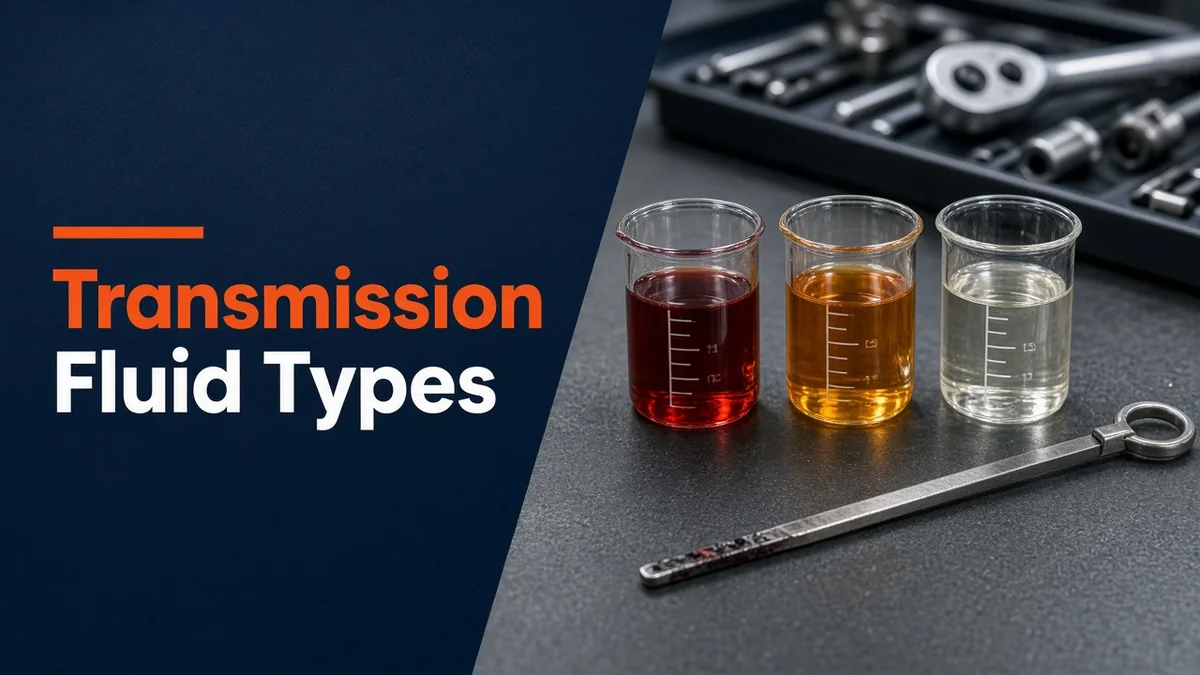
New ATF is usually dyed red so that leaks are easy to tell apart from engine oil or coolant, although some newer and CVT fluids are green, blue, amber or nearly clear. In use, fluid darkens gradually. Dark brown fluid, a burnt smell or visible particles are signs that the fluid is worn and the transmission should be inspected. If you are finding red spots under the car, see our guide to car fluid and oil leaks for how to identify the source.
Can You Mix Transmission Fluid Types?
You should not mix different specifications on purpose. Two fluids that both meet the same specification, such as two brands of Dexron VI, can be mixed. Mixing specifications, or mixing ATF with CVT fluid, changes the friction characteristics and can cause shifting problems. The same caution applies to power steering systems: some cars use ATF in the power steering, while many others require a dedicated power steering fluid.
Type F vs Type A and Other Old Fluid Names
Type F, introduced by Ford, has no friction modifiers, which gives firmer, quicker clutch engagement; it is still specified for some classic Fords, older imports and some power steering systems. Type A was an early general-purpose ATF that has long been replaced by Dexron and Mercon specifications. Do not put Type F in a transmission that calls for a modern friction-modified fluid, or the reverse.
Why Transmission Fluids Keep Getting Thinner
Automakers have steadily moved to lower-viscosity fluids such as Dexron ULV, Mercon ULV and Toyota WS. Thinner fluid reduces internal friction, which improves fuel economy, and it flows quickly in cold weather so modern 8-, 9- and 10-speed transmissions can shift precisely. The trade-off is that these fluids are engineered for specific internal clearances and friction materials.
- Never put a thinner ULV fluid in a transmission designed for a thicker fluid, or the reverse.
- Do not assume a newer spec replaces an older one unless the automaker says it is backward compatible (Dexron VI for older GM units is a common example; Mercon LV for Mercon V units is not).
- Thin fluids are not a sign of lower quality; they are a design requirement.
How Much Transmission Fluid Does a Car Need, and What Does It Cost?
A transmission usually holds far more fluid than one service replaces, because a lot stays in the torque converter and cooler lines.
| Item | Typical Amount or Cost (US) |
|---|---|
| Total transmission capacity | About 8–14 quarts for many cars and SUVs |
| Drain-and-fill service | Replaces about 3–6 quarts (roughly 30%–50% of the fluid) |
| Price per quart (spec fluid) | About $8–$25 depending on the specification and brand |
| Drain-and-fill at a shop | About $100–$250 |
| Machine flush or exchange | About $150–$400 |
| Pan drop with new filter and gasket | About $150–$350 |
Because a single drain-and-fill replaces only part of the fluid, some shops recommend two or three drain-and-fills a few hundred miles apart to refresh very old fluid gradually. Your owner’s manual lists the exact capacity and check procedure.
How Often Should Transmission Fluid Be Changed?
Intervals vary more than for engine oil. Some manufacturers suggest changes every 30,000 to 60,000 miles under severe use, while others describe the fluid as long-life under normal driving. Towing, frequent short trips and hot climates all shorten the interval. Our car maintenance schedule by mileage shows where fluid services usually fall, and if you are wondering whether your car even has a clutch pedal to worry about, our explainer on whether automatic cars have a clutch covers how automatics use internal clutches.
Related guides: car noises explained, dashboard symbols and meanings and why your car is shaking.
Transmission Fluid Types FAQ
Ford says Mercon LV is not backward compatible with Mercon V, so use Mercon V where your manual specifies it.
It can be for many older automatics that used Dexron III or Mercon, but not for modern low-viscosity fluids, CVTs or dual-clutch transmissions. Choose a fluid that names your exact specification.
No. They are separate specifications from GM and Ford. Some multi-vehicle fluids claim to meet both, but you should use a fluid that lists the exact specification your manual requires.
Only if the manufacturer specifies it. Some manual transmissions are designed for ATF, while most use a specific manual transmission fluid or gear oil. Using the wrong one can cause hard shifting or synchro wear.
ATF is the general name for automatic transmission fluid. Dexron is GM’s name for its ATF specifications, such as Dexron VI and Dexron ULV, so Dexron is one type of ATF rather than something different.
Yes. Each automaker specifies a fluid with particular viscosity and friction properties, and the wrong one can cause harsh or slipping shifts, shudder or long-term damage. Use the specification named in your owner’s manual.