How to Check Tire Tread Depth (Penny Test and Gauges)
To check tire tread depth, put a penny upside down into a tread groove with Lincoln’s head facing you. If you can see the top of his head, the tread is at or below 2/32 of an inch, the legal minimum in most states, and the tire needs replacing now. For better wet-road safety, use a quarter the same way: if you can see the top of Washington’s head, you are at about 4/32 of an inch and should start shopping for tires. A tread depth gauge gives an exact reading in seconds.
Why Tread Depth Matters
The grooves in a tire channel water away from the contact patch so the rubber stays in touch with the road. As tread wears, those channels get shallower and can no longer move water fast enough, which lengthens stopping distances and raises the risk of hydroplaning. In AAA testing, tires worn to 4/32 of an inch needed an average of 87 more feet to stop from 60 mph on a wet road than new tires did; at the point where the new tires had stopped, the worn ones were still traveling at about 40 mph. That is why AAA recommends replacing tires at 4/32 inch rather than waiting for the 2/32 legal limit. Worn tires also lose grip in snow and are more likely to be punctured.
How to Check Tire Tread Depth: 3 Methods
Method 1: the Penny Test (2/32 Inch)
- Hold a penny with Lincoln’s head pointing down into the tire.
- Push it into one of the main grooves, where the tread is lowest.
- Look at the penny from the side at tread level.
- If the top of Lincoln’s head is visible, the groove is at or below 2/32 of an inch.
- Repeat across the inner, center and outer grooves and at a few spots around the tire.
The penny test only tells you whether a tire is legally worn out. Passing it does not mean the tire still has plenty of life left.
Method 2: the Quarter Test (4/32 Inch)
Use a quarter the same way, with Washington’s head pointing into the groove. The distance from the edge of a quarter to the top of Washington’s head is about 4/32 of an inch. If you can see the top of his head, the tread is at or below that depth and replacement is due soon, especially if you drive in rain.
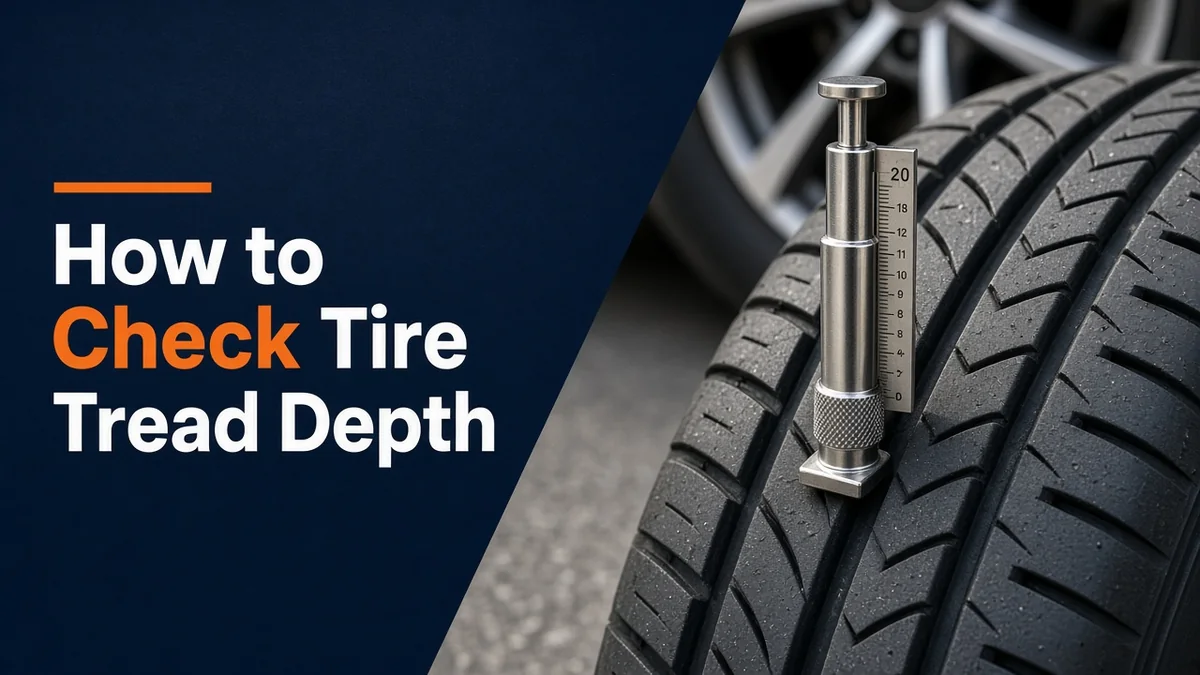
Method 3: a Tread Depth Gauge
A tread depth gauge costs a few dollars and gives an exact reading in 32nds of an inch or millimeters. To use one:
- Push the probe fully into the gauge so it reads zero.
- Place the probe into a main groove, not on a tread-wear bar, and press the shoulders flat against the tread blocks.
- Read the measurement and note it.
- Measure the inner, center and outer grooves; the lowest reading counts.
Method 4: a Ruler (If You Have Nothing Else)
A thin ruler marked in millimeters works in a pinch. Push the end straight down into a main groove and read where the tread surface meets the scale. One thirty-second of an inch is about 0.8 mm, so 2/32 is about 1.6 mm, 4/32 about 3.2 mm and 6/32 about 4.8 mm. Rulers are harder to hold square and read precisely than a gauge, so treat the result as a rough check and confirm borderline readings with a gauge or a tire shop.
What Is Tire Tread? the Parts That Matter
- Ribs (tread blocks): the raised rubber that touches the road.
- Grooves: the channels between ribs that pump water away from the contact patch. Tread depth is measured in the grooves.
- Sipes: thin slits cut into the blocks that add biting edges for snow, ice and wet roads. They wear away as the tire wears.
- Shoulders: the outer edges of the tread, where cornering loads are highest.
- Tread wear indicator bars: small raised bars molded across the grooves at 2/32 inch.
As the tread wears, the grooves get shallower and the sipes disappear, so a worn tire loses wet and snow grip long before it looks “bald.”
Use the Built-In Tread Wear Indicators
Every tire sold in the US has small raised bars molded across the bottom of the main grooves, called tread wear indicators or wear bars. They sit at 2/32 of an inch. When the surrounding tread wears down level with these bars, the tire has reached the legal limit. Many tires show a small triangle or “TWI” mark on the shoulder to help you find them.
Tire Tread Depth Chart
| Tread depth | Millimeters | What it means |
|---|---|---|
| 10/32″–11/32″ | 8–8.7 mm | Typical new passenger tire |
| 6/32″ | 4.8 mm | Good tread; the minimum many experts suggest for snow |
| 5/32″ | 4 mm | Wet and snow grip noticeably reduced |
| 4/32″ | 3.2 mm | Plan to replace, especially if you drive in rain |
| 3/32″ | 2.4 mm | Near the end of safe life; replace soon |
| 2/32″ | 1.6 mm | Legal minimum in most states; replace immediately |
How Tread Depth Affects Wet and Snow Braking
On dry pavement, a worn tire can grip almost as well as a new one. On wet roads, it is a different story. Shallow grooves cannot move water away quickly, so the tire rides up on a film of water and hydroplanes at lower speeds. Independent braking tests by organizations such as Consumer Reports and Tire Rack have repeatedly shown that stopping distances on wet roads grow significantly as tires wear down from new to 4/32 inch and below.
| Remaining Tread | Wet Roads | Snow |
|---|---|---|
| 6/32 inch or more | Good grip | Adequate for snow |
| 5/32 inch | Good | Traction starting to drop; consider replacing before winter |
| 4/32 inch | Reduced; many experts suggest replacing | Poor |
| 3/32 inch | Noticeably longer stopping distances | Poor |
| 2/32 inch or less | Unsafe and illegal in most states | Unsafe |
New Tire Tread Depth by Tire Type
| Tire Type | Typical New Tread Depth |
|---|---|
| Passenger all-season | About 10/32–11/32 inch |
| Summer performance | About 8/32–10/32 inch |
| Winter tires | About 11/32–13/32 inch |
| Light truck all-terrain | About 12/32–15/32 inch |
| Mud-terrain | About 15/32–20/32 inch |
Knowing the starting depth helps you judge how much life is left. A tire that started at 10/32 and now measures 5/32 has used roughly 60% of its usable tread (down to the 2/32 legal limit).
What Your Tread Wear Pattern Tells You
Measuring across the tire does more than tell you when to replace it. How it wears points to problems that will ruin the next set too.
| Wear pattern | Likely cause | What to do |
|---|---|---|
| Worn in the center | Overinflation | Set pressure to the placard on the driver’s door jamb |
| Worn on both edges | Underinflation | Check pressure monthly and when the weather cools |
| Worn on one edge | Wheel alignment out of spec | Get an alignment check |
| Scalloped or cupped patches | Worn shocks, struts or suspension parts | Have the suspension inspected |
| Flat spots | Hard braking lock-ups or long storage | Inspect; may need replacement |
Cupped wear often goes hand in hand with vibration and noise. If you feel shaking at speed, our guide to why your car is shaking covers tire and wheel causes, and suspension repair costs explains what fixing worn shocks and struts usually involves.
When Should You Replace Your Tires?
- At 2/32 of an inch: always, because the tire is legally worn out.
- At about 4/32 of an inch: if you regularly drive in rain.
- At about 6/32 of an inch: if you rely on the tires in snow.
- At any depth: if you see cords, bulges, deep cuts or sidewall cracks.
How quickly you reach those limits depends on driving style, alignment, pressure and the tire itself. Our guide to how long tires last covers mileage ratings and ways to make a set last longer.
Replace tires right away if: you can see steel belts or fabric cords, there is a bulge or bubble in the sidewall, or the tread has separated. These tires can fail suddenly at speed. Drive gently to a tire shop or fit the spare.
How Often Should You Check Tread Depth?
Check tread depth at least once a month and before long trips, ideally at the same time as your tire pressure. Tires wear gradually, so a quick monthly check lets you plan and budget for replacements rather than being caught out. Before winter, check that you have enough depth for snow; our winter car prep guide explains when dedicated snow tires make sense.
Tread Depth and State Safety Inspections
Most states that inspect cars fail tires with less than 2/32 of an inch of tread, and inspectors also look for cords, bulges and damage. Rules differ by state, so check your state’s requirements before your appointment. Commercial trucks and buses face a stricter federal rule: tires on the steering axle need at least 4/32 inch of tread, and other tires at least 2/32 inch. Our guide to car inspections covers what else inspectors look at.
Tread Depth Is Not the Only Reason to Replace a Tire
A tire with plenty of tread can still be unsafe. Replace or inspect a tire if you see:
- Age: many automakers and tire makers recommend inspection after about 5 years and replacement around 6 to 10 years from the manufacture date, even with good tread. Check the last four digits of the DOT code for the week and year.
- Cracking or dry rot on the sidewall or in the grooves.
- Bulges or bubbles on the sidewall.
- Cuts, punctures near the shoulder or sidewall, or exposed cords.
- Repeated slow leaks that do not have an obvious cause.
Should You Replace Tires in Pairs or All Four?
If one tire is worn or damaged, it is best to replace tires in pairs on the same axle so both sides grip evenly, and to put the newer pair on the rear for stability, unless your tire maker says otherwise. On all-wheel-drive vehicles, many manufacturers require all four tires to be close in tread depth, because large differences can strain the drivetrain. Check your owner’s manual before replacing only one or two.
Related guides: tire size calculator, car maintenance schedule by mileage and should you warm up your car in winter.
Tire Tread Depth FAQ
In most US states, the legal minimum is 2/32 of an inch. Tires worn to this depth, or with the tread worn level with the wear bars, should be replaced immediately.
Replace at 2/32 of an inch at the latest. Many experts recommend replacing at about 4/32 of an inch if you drive in rain and about 6/32 of an inch for snow.
It is legal, but wet-road braking is noticeably worse than with new tires, so 4/32 of an inch is a good point to start planning replacements.
At least once a month and before long trips. Checking at the same time as tire pressure makes it an easy habit.
Center wear usually means overinflation, edge wear means underinflation, one-sided wear points to alignment, and cupping suggests worn suspension parts.
Yes. Winter tires lose much of their snow grip below about 6/32 inch, so many experts suggest replacing them around that point, well before the 2/32 legal minimum.