Car AC Repair Cost: What You Will Pay in 2026 (By Repair)
Car AC repair usually costs $150 to $500 when the fix is a recharge, a leak test or a small seal, and $1,000 to $2,500 when a major part such as the compressor or evaporator has to be replaced. Where your bill lands depends on what actually failed, which refrigerant your car uses, and how much of the dashboard or engine bay a technician has to take apart to reach the problem.
This guide breaks down typical prices for every common air conditioning repair, explains why newer cars cost more to service, and shows you how to match your symptoms to the likely fix so a quote never catches you off guard.
Key Takeaways
- Recharge: about $150–$300 on older cars that use R-134a, and $250–$500 on most newer cars that use R-1234yf.
- Leak repair: roughly $150–$550 for O-rings, valves or a hose, plus the recharge that follows.
- Big jobs: a compressor usually runs $1,000–$2,500 and an evaporator $1,000–$2,600, mostly because of labor.
- Refrigerant keeps leaking? A recharge alone is a temporary fix. Pay for a leak test first.
- Save money: independent AC shops are often 20–40% cheaper than dealers for the same repair.
Car AC Repair Cost by Repair Type
The table below shows typical installed prices (parts plus labor) at independent shops in the US, based on 2025–2026 repair-cost guides and parts pricing. Dealers and luxury brands often land at the top of each range or above it.
| Repair or service | Typical cost | What usually drives the price |
|---|---|---|
| AC diagnosis / inspection | $100–$200 | Often credited toward the repair if you approve the work |
| Recharge, R-134a (older cars) | $150–$300 | Amount of refrigerant, shop labor rate |
| Recharge, R-1234yf (most newer cars) | $250–$500 | R-1234yf refrigerant costs several times more per pound |
| Leak detection (dye or electronic) | $50–$250 | Whether dye is added and you return for a check |
| Small leak repair (O-ring, Schrader valve) | $150–$400 | Access to the leaking fitting, plus recharge |
| AC hose or line replacement | $200–$550 | Hose length and routing |
| Compressor clutch or clutch coil | $350–$850 | Whether the clutch can be replaced separately on your model |
| Compressor replacement | $1,000–$2,500 | OEM vs remanufactured part, extra parts replaced with it |
| Condenser replacement | $450–$1,200 | Bumper or grille removal on some models |
| Receiver-drier or accumulator | $150–$400 | Usually replaced whenever the system is opened for a big repair |
| Expansion valve or orifice tube | $150–$450 | Location (some valves sit behind the dash) |
| Evaporator replacement | $1,000–$2,600 | Dashboard removal, often 6–10 hours of labor |
| Blend door actuator | $150–$500 | How deep in the dash the actuator sits |
| Blower motor or resistor | $150–$500 | Resistors are cheap; motors cost more |
| Cabin air filter | $15–$30 DIY, $40–$90 at a shop | Filter quality, shop markup |
| Full system replacement | $2,500–$4,000+ | Rare; usually after contamination or a failed compressor spread debris |
Labor is the biggest variable. Shop rates in most of the US now fall somewhere around $110 to $180 an hour, and a repair that takes one hour on one car can take six on another because of where the part sits.
How Your Car’s AC Works (And What Can Fail)
Your car’s air conditioning is a sealed loop that moves heat out of the cabin. Knowing the main parts makes any repair quote much easier to understand.
- Compressor: the engine-driven (or, on hybrids and EVs, electric) pump that pressurizes the refrigerant. It is the most expensive single part.
- Compressor clutch: engages and disengages the compressor. A worn clutch can stop the AC even when the compressor itself is fine.
- Condenser: sits in front of the radiator and releases heat outside. Road debris and front-end collisions damage it.
- Receiver-drier or accumulator: traps moisture and debris. It is cheap but gets replaced whenever the system is opened for major work.
- Expansion valve or orifice tube: drops the refrigerant pressure so it can turn cold.
- Evaporator: the small radiator behind the dashboard that actually chills the cabin air. Cheap to make, expensive to reach.
- Blower, blend doors and controls: move and direct the air. When these fail, the air may be cold but not reach you.
Because the system is sealed and pressurized, it should not lose refrigerant over time the way an engine burns oil. If your AC needs refrigerant, something is leaking.
Match Your Symptom to the Likely Repair
You can often narrow down the cost range before you visit a shop by noting exactly what the AC is doing.
| What you notice | Most likely causes | Likely cost range |
|---|---|---|
| Air is cool but not cold, and got worse over weeks | Slow refrigerant leak | $150–$550 |
| Blows warm air suddenly | Big leak, failed clutch or compressor, blown fuse or relay | $20 (fuse) to $2,500 |
| Cold on one side, warm on the other | Blend door actuator, low refrigerant on dual-zone systems | $150–$550 |
| Weak airflow even on high | Clogged cabin air filter, blower motor or resistor | $15–$500 |
| Fan only works on the highest setting | Blower motor resistor | $100–$250 |
| Grinding, squealing or rattling when AC is on | Compressor or clutch bearing wearing out | $350–$2,500 |
| Musty or mildew smell from the vents | Mold on the evaporator, dirty cabin filter | $15–$150 |
| Water on the passenger floor | Clogged evaporator drain tube | $50–$150 |
| AC cycles on and off rapidly | Low refrigerant, pressure switch | $150–$400 |
A small puddle of clear water under the car on a hot day is normal. It is condensation draining from the evaporator, not a leak. Refrigerant itself escapes as a gas, so you will not see it drip.
AC Recharge Cost: R-134a vs R-1234yf
The single biggest reason two recharge quotes differ is the refrigerant. Cars built before the mid-2010s almost all use R-134a. Automakers then switched to R-1234yf, a refrigerant with far lower global warming impact, and most new cars sold in the US now use it.
- R-134a recharge: about $150–$300 at a shop. The refrigerant is relatively cheap and DIY cans are widely sold.
- R-1234yf recharge: about $250–$500. The refrigerant costs several times more per pound and requires dedicated service machines.
To check which one your car uses, look for the AC label under the hood, usually on the radiator support or the underside of the hood. It lists the refrigerant type and the exact charge amount. The service ports are also shaped differently, so the two refrigerants cannot be mixed by accident.
Evacuate-and-Recharge vs a Top-Off
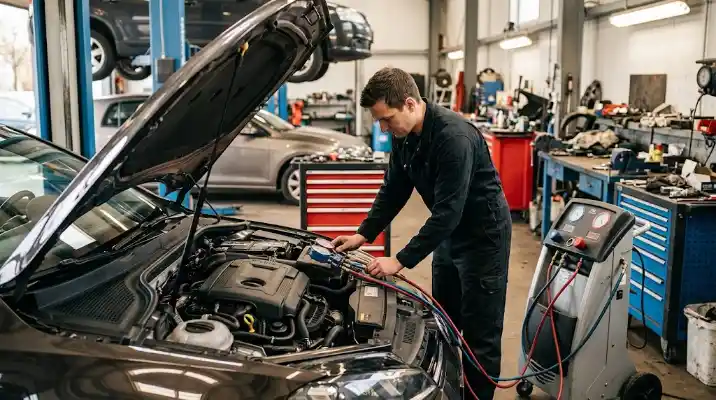
A proper shop recharge is an evacuate and recharge: the machine removes the old refrigerant, pulls a vacuum to boil off moisture, checks that the system holds the vacuum, and refills the exact weight listed on your label. A top-off simply adds refrigerant to whatever is left. The full service costs more, but it is the only way to know the charge is correct and that the system is not leaking badly.
AC Leak Repair Cost
Leaks are the most common reason a car AC stops blowing cold. Typical leak points are O-ring seals at hose connections, the Schrader valves in the service ports, rubber hoses, the condenser (hit by stones) and the compressor shaft seal.
Finding the leak is the first cost. Shops either add UV dye and ask you to drive for a few days, or use an electronic sniffer, typically $50–$250. The fix itself ranges from under $200 for a seal or valve to $1,200 or more if the condenser or evaporator is leaking. Every leak repair ends with an evacuate and recharge, so budget for that too.
Be cautious with “AC stop leak” sealer products. They can plug small leaks in some systems, but they can also clog the expansion valve and contaminate a shop’s recovery equipment. Many shops test for sealer before connecting their machine and charge extra, or refuse the job, if they find it.
AC Compressor Replacement Cost
Replacing a compressor usually costs $1,000 to $2,500 installed. The compressor itself ranges from a few hundred dollars for a remanufactured unit to well over $1,000 for an OEM part on some models, and electric compressors on hybrids and EVs sit at the top of the range.
Quotes often include parts you did not expect. When a compressor fails it can send metal debris through the system, so a good shop will also replace the receiver-drier or accumulator and the expansion valve or orifice tube, flush the lines, and add the correct oil. Compressor makers commonly require these steps for their warranty to apply, so skipping them to save money can backfire.
Signs the Compressor, Not the Refrigerant, Is the Problem
- The center of the compressor pulley does not spin when you switch the AC on.
- Grinding, squealing or knocking starts or gets louder when the AC is on.
- The system holds its charge, but the air still is not cold.
- You see oily residue on the compressor body or around its fittings.
If only the clutch or clutch coil has failed, and your model allows it to be replaced separately, the repair can cost a fraction of a full compressor. Ask the shop whether that option exists before approving a complete replacement.
Condenser and Evaporator Costs
A condenser replacement typically costs $450–$1,200. The part is moderately priced and sits at the front of the car, so labor is reasonable unless the bumper cover has to come off. Condensers fail from stone damage, corrosion from road salt and minor front-end collisions.
An evaporator replacement costs $1,000–$2,600 even though the part itself is often under $300. It lives inside the dashboard, and replacing it can mean removing the entire dash, which is why labor makes up most of the bill. If you are quoted for an evaporator, ask how the leak was confirmed, since misdiagnosis here is expensive.
What Affects the Price of Car AC Repair
- Refrigerant type: R-1234yf systems cost more to service at every step.
- Vehicle make and layout: luxury, European and tightly packaged engine bays mean pricier parts and more labor hours.
- Hybrid or electric car: electric compressors and special non-conductive oil raise the cost and require trained technicians.
- Parts choice: OEM parts cost the most; quality aftermarket or remanufactured parts can save 30–50%.
- Where you live: labor rates in large cities can be double those in rural areas.
- Dealer vs independent shop: dealers typically charge more per hour and use OEM parts by default.
- How long you waited: running a system that is low on refrigerant can starve the compressor of oil and turn a small leak into a big bill.
Can You Recharge Your Car AC Yourself?
Yes, on many R-134a cars you can add refrigerant yourself with a $30–$60 recharge can that includes a gauge. It can restore cold air when the system is only slightly low. It is a top-off, not a repair: it does not remove moisture, cannot tell you where the leak is, and makes it easy to overcharge the system, which also stops the AC from cooling properly.
DIY options for R-1234yf are far more limited and the refrigerant is expensive, so newer cars are usually better handled by a shop with the right machine.
How to Add Refrigerant to a Car (R-134a)
- Confirm the refrigerant type on the under-hood label and buy the matching product. Avoid cans with sealer unless you accept the risks above.
- Put on safety glasses and gloves. Refrigerant can cause frostbite and eye injury.
- Start the engine, set the AC to max cold and the fan to high, and close the doors.
- Find the low-side service port (the larger fitting, usually marked “L”). The can’s coupler only fits this port.
- Read the gauge before adding anything. If the pressure is already in range, refrigerant is not your problem.
- Add refrigerant in short bursts, checking the gauge between each, until it reaches the range for the current outdoor temperature. Do not overfill.
- Disconnect, replace the port cap and check the vent temperature. If the AC is warm again within weeks, book a leak test.
Safety note: never connect anything to the high-side port, never release refrigerant into the air, and stay clear of the moving fan and belts while the engine runs. Venting refrigerant is prohibited under the federal Clean Air Act, and anyone servicing car AC systems for pay must be certified under EPA Section 609 rules. If you smell something sweet or chemical inside the cabin, or the compressor is making loud grinding noises, turn the AC off and have it checked.
Does Warranty or Insurance Cover AC Repair?
A factory bumper-to-bumper warranty normally covers AC parts that fail from defects, so check your warranty booklet before paying for anything on a newer car. A powertrain warranty generally does not include the air conditioning. Many extended warranties and service contracts do cover AC components, but read the list of covered parts and any deductible.
Car insurance does not pay for wear and tear. It may cover AC damage caused by a covered event, such as a condenser crushed in a front-end collision, under your collision or comprehensive coverage.
Is It Worth Fixing the AC in an Older Car?
A $250 recharge or a $300 seal is almost always worth it. The harder call comes with a $1,500–$2,500 compressor or evaporator on a car worth $3,000–$5,000. Consider these points:
- Resale value: a car with working AC is noticeably easier to sell, especially in warm states.
- Defrosting: the AC compressor helps dry the air and clear a fogged windshield, which is a safety issue in cold, wet weather.
- Climate and use: a daily commuter in a hot state gets far more value from the repair than a weekend car in a cool one.
- The rest of the car: if other big repairs are coming, the AC money may be better spent toward a replacement vehicle.
What About a Portable Air Conditioner for the Car?
Plug-in 12-volt “car air conditioners” are mostly evaporative coolers or fans. They can make a small space feel slightly cooler in dry heat, but they cannot cool a whole cabin the way a real AC system does, and they add humidity. They are a stopgap for a short trip or a parked car with windows cracked, not a replacement for repairing the system.
How to Save Money on Car AC Repair
- Pay for diagnosis first: a proper leak test costs less than recharging the system every summer.
- Get two written quotes: ask each shop to list the parts, hours and refrigerant amount separately.
- Use an independent AC specialist: shops that focus on air conditioning often diagnose faster and charge less than dealers.
- Ask about remanufactured parts: a quality reman compressor with a warranty can save hundreds.
- Book service before summer: AC shops are busiest in the first heat wave, when there is less room to negotiate.
- Check warranties and recalls: look up your VIN on the NHTSA recall site and check for manufacturer service campaigns on AC parts.
Red Flags on an AC Repair Quote
- A recommendation to replace the compressor with no pressure readings or leak test.
- Repeated “recharges” without anyone looking for the leak.
- A quote that does not say which refrigerant or how much will be used.
- Pressure to decide on the spot, or no written estimate.
How to Keep Your AC From Failing
- Run it year-round: use the AC or defrost setting for at least 10 minutes a month, even in winter. Circulating refrigerant and oil keeps the seals from drying out.
- Change the cabin air filter: about every 12,000–15,000 miles, or sooner in dusty areas, so the blower does not have to work as hard.
- Keep the condenser clean: gently rinse bugs and leaves off the front of the car when you wash it.
- Act on early signs: slightly warmer air or a new noise is the cheapest moment to fix a problem.
For more help understanding what your car is telling you, browse our warning lights and problems guides, or see what other common jobs cost in our repair cost guides.
Car AC Repair FAQ
Most car AC repairs cost $150 to $500 for a recharge, leak test or small seal, and $1,000 to $2,500 for major parts such as the compressor or evaporator. Newer cars that use R-1234yf refrigerant cost more to service than older R-134a cars.
A professional evacuate-and-recharge usually costs $150 to $300 for R-134a systems and $250 to $500 for R-1234yf systems. A DIY R-134a recharge can costs about $30 to $60 but only tops off the system.
Car AC is a sealed system, so needing refrigerant every year means it has a leak. A leak test costing $50 to $250 usually finds the cause, and fixing it is cheaper than recharging year after year.
If the system has no leak, the refrigerant should last for many years. If the AC blows warm again within days or weeks, the leak is significant and needs to be repaired.
Usually yes, as long as the compressor is not seized or making loud grinding noises. A seized compressor can shred the drive belt, which may also run the alternator or water pump, so turn the AC off and get it checked if you hear grinding.
Many compressors last 8 to 12 years or well over 100,000 miles. Low refrigerant, contamination and long periods without use shorten their life.
Parts stores sell DIY recharge kits and may lend or rent gauges, but they generally do not perform AC service. For an evacuate-and-recharge you need a repair shop with certified technicians and the right machine.
Insurance does not cover normal wear or a failed compressor. It may cover AC damage from a covered event, such as a condenser damaged in a collision, under collision or comprehensive coverage.