CVT Transmission Explained: How It Works, Pros and Cons
A CVT (continuously variable transmission) is an automatic transmission that has no fixed gears. Instead of shifting between first, second, third and so on, it uses a steel belt or chain running between two cone-shaped pulleys that change width, which gives an unlimited number of ratios between its lowest and highest setting. The result is smooth, shift-free acceleration and better fuel economy, with trade-offs in feel, towing ability and long-term durability.
What Is a CVT Transmission?
A continuously variable transmission is a type of automatic transmission. You drive it exactly like any other automatic: put it in D and go. There is no clutch pedal and no gear lever to move. The difference is inside the case. A conventional automatic has a set number of gear ratios (six, eight or ten in most new cars) and jumps from one to the next. A CVT can hold any ratio in its range and move through them seamlessly.
Like a traditional automatic, a CVT does not use a driver-operated clutch. If you are curious how launch and engagement work in automatics generally, see our guide on whether automatic cars have a clutch.
How Does a CVT Work?
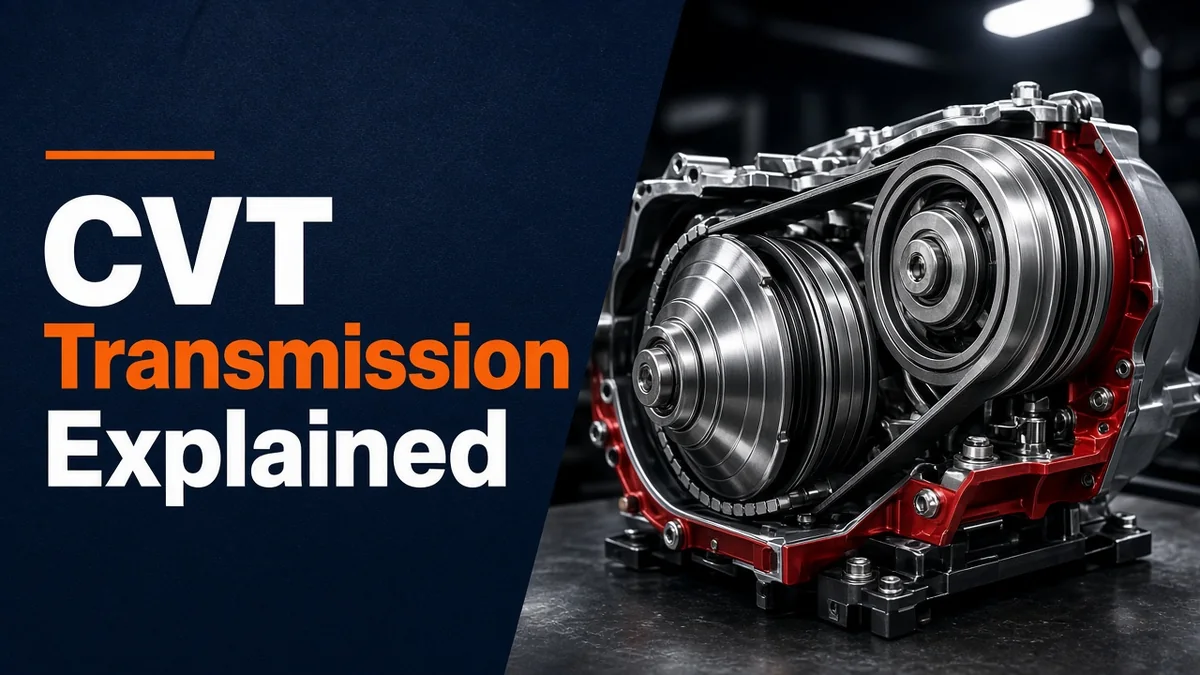
The most common design, found in cars from Nissan, Toyota, Honda, Subaru, Hyundai, Kia and Mitsubishi, is the pulley-and-belt CVT. It has three main parts:
- Drive (input) pulley: connected to the engine. It is made of two cone-shaped halves that can move closer together or farther apart.
- Driven (output) pulley: connected to the wheels through the final drive. It also has two movable cone halves.
- Belt or chain: a segmented steel push belt or a steel chain that runs in the V-shaped groove between the pulley halves.
When the halves of a pulley squeeze together, the belt is pushed outward and rides on a larger diameter. When they spread apart, the belt drops lower and rides on a smaller diameter. Hydraulic pressure, controlled by the transmission computer, moves both pulleys at the same time in opposite directions.
- Pulling away: the belt rides low on the input pulley and high on the output pulley. That is the equivalent of a low gear, giving strong torque multiplication.
- Accelerating: the input pulley narrows and the output pulley widens, so the ratio climbs continuously with no steps.
- Cruising: the belt rides high on the input pulley and low on the output pulley, the equivalent of an overdrive gear, so the engine turns slowly at highway speed.
Because the computer can pick any ratio, it can hold the engine at the rpm where it makes the most power (for hard acceleration) or where it burns the least fuel (for gentle driving). That is the core reason CVTs exist.
Other CVT Designs
- eCVT (power-split hybrids): Toyota, Lexus and Ford hybrids use a planetary gearset and two electric motor-generators instead of belts and pulleys. It behaves like a CVT but has no belt to wear and is known for excellent durability.
- Toroidal CVT: uses rollers between two doughnut-shaped discs. It has appeared in a few Nissan models in Japan but is rare.
- CVT with a launch gear: some Toyota CVTs (Direct Shift-CVT) add a physical first gear for pulling away, then hand off to the belt. This reduces belt load and improves the feel off the line.
- Stepped-shift programming: many CVTs now fake gear changes (often 7 or 8 “steps”) under hard throttle so they feel more like a traditional automatic.
CVT Vs. Automatic Vs. Manual Transmission
| Feature | CVT | Traditional Automatic | Manual |
|---|---|---|---|
| Gears | None fixed; infinite ratios in a range | Fixed (usually 6–10) | Fixed (usually 5–6) |
| Shifting feel | Seamless, no shift shock | Noticeable but smooth shifts | Driver shifts with clutch |
| Fuel economy | Usually best of the three in non-hybrids | Close, especially 8–10 speeds | Varies with driver |
| Towing | Light duty only in most models | Best for heavy towing | Good, but clutch wear rises |
| Driving feel | Can drone; “rubber band” feel | Direct and familiar | Most engaging |
| Typical replacement cost | About $3,500–$8,000 | About $3,000–$7,000+ | Rebuild about $1,500–$3,500 |
| Common in | Compact cars and crossovers | Trucks, SUVs, luxury cars | Sports cars, few economy cars |
Cost ranges are typical US repair-shop figures for a replacement unit including labor and vary widely by vehicle and whether you choose new, remanufactured or used parts.
Advantages of a CVT
- Better fuel economy: keeping the engine at its most efficient rpm often adds a few mpg compared with an older conventional automatic.
- Smooth ride: no shift jolts, which many commuters prefer in stop-and-go traffic.
- Quick response to throttle: the transmission does not have to “hunt” for a gear or kick down several gears. It just changes the ratio.
- Lighter and more compact: fewer parts than a multi-gear automatic, which helps small front-wheel-drive cars.
- Good hill performance: it can find the right ratio for a grade instead of shifting back and forth between two gears.
Disadvantages of a CVT
- Engine drone: under hard acceleration the engine may sit at high rpm while speed catches up, which sounds loud and monotonous.
- “Rubber band” effect: the engine revs rise before the car picks up speed, which some drivers find disconnected.
- Limited torque and towing capacity: belts and pulleys have a torque ceiling, so most CVT vehicles have modest tow ratings.
- Less tolerant of neglect: old or wrong fluid, overheating and hard use shorten life faster than in many conventional automatics.
- Expensive to fix: many shops replace a failed CVT as a unit rather than rebuild it.
- Reputation issues: some early-2010s CVTs had high failure rates, and that reputation still affects resale value on certain models.
Are CVT Transmissions Reliable?
Reliability depends heavily on the manufacturer and the model year. Toyota and Honda CVTs, and the eCVT used in Toyota hybrids, generally have a strong track record. Subaru’s Lineartronic chain CVT has improved over time. Some Nissan (JATCO-built) CVTs from roughly the 2012–2018 period drew many complaints, and Nissan extended warranties on certain models. Newer generations from most brands are noticeably better than the first wave.
With correct fluid service and reasonable driving, many modern CVTs reach 150,000 miles or more. If you are shopping for a car with a CVT, check the specific model’s history rather than judging all CVTs together. Our ranking of the most reliable car brands is a good starting point.
How Long Does a CVT Last?
A well-maintained CVT commonly lasts 100,000 to 150,000 miles, and plenty go beyond that. Factors that shorten life include:
- Skipping fluid changes or using the wrong fluid
- Towing near or above the rated limit
- Frequent hard launches and high-rpm driving
- Overheating in hot climates or mountain driving
- Ignoring early warning signs like shudder or whining
Signs of CVT Problems
Catching issues early can prevent a full replacement. Watch for:
- Shuddering or juddering: often felt at low speed or light throttle, sometimes linked to torque converter or fluid issues.
- Whining or humming: a noise that rises with speed can point to worn bearings or a failing belt or pulleys.
- Slipping or high revs without acceleration: the engine flares but the car does not keep pace.
- Delayed engagement: a pause when shifting into Drive or Reverse.
- Limp mode or reduced power: the computer limits speed to protect the transmission, often with a warning light.
- Overheating warning: some cars show a transmission temperature message on long climbs.
- Burning smell or leaking red/green fluid: signs of low or overheated fluid.
Sounds are often the first clue. Our guide to common car noises and what they mean can help you narrow down a whine versus a grinding or clunking sound. If the check engine light comes on, have the codes read as soon as possible.
CVT Maintenance: Fluid Is Everything
CVT fluid is not the same as regular automatic transmission fluid (ATF). It has specific friction properties so the steel belt can grip the pulleys without slipping. Using the wrong fluid can cause shudder, slipping and permanent damage.
| Brand (examples) | Fluid name examples |
|---|---|
| Nissan | NS-2, NS-3 CVT Fluid |
| Honda | HCF-2 |
| Toyota | CVT Fluid FE, CVT Fluid TC |
| Subaru | High Torque CVTF, Lineartronic CVTF II |
| Hyundai / Kia | SP-CVT1 (varies by model) |
| Mitsubishi | CVTF-J4, CVTF-J1 (varies by model) |
Always confirm the fluid in your owner’s manual because specifications change between models and years.
- Change interval: many manufacturers suggest 25,000 to 60,000 miles under severe service. Some list the fluid as “lifetime,” but most mechanics recommend changing it anyway, often around every 30,000 to 60,000 miles.
- Cost: a CVT fluid service typically runs about $120 to $300 at an independent shop, more at a dealer.
- Checking level: many CVTs have no dipstick and must be checked at a specific temperature by a shop.
- Driving habits: smooth acceleration, avoiding heavy towing and letting the car warm up briefly in very cold weather all reduce wear.
Fold transmission service into your regular routine. Our car maintenance schedule by mileage shows where it fits alongside oil, coolant and brake fluid, and the guide on how to check your car fluids covers what you can inspect at home.
Can You Tow With a CVT?
Yes, within limits. Many CVT-equipped crossovers are rated to tow about 1,000 to 3,500 pounds, which is enough for a small utility trailer, jet ski or light camper in some cases. Always stay under the rating in your owner’s manual, and consider a transmission cooler if your manufacturer offers one. For heavy trailers, a truck or SUV with a conventional automatic is the better choice.
Which Cars Use CVT Transmissions?
CVTs are most common in compact and midsize cars and crossovers. Examples include the Nissan Rogue, Sentra, Altima and Kicks; Honda Civic, Accord, CR-V and HR-V (non-hybrid versions); Toyota Corolla and Corolla Cross; Subaru Outback, Forester, Crosstrek and Impreza; Hyundai Elantra and Kona; Kia Forte and Seltos; and the Mitsubishi Outlander. Nearly every Toyota and Lexus hybrid uses an eCVT. Availability changes by model year and engine, so check the spec sheet for the exact car you are considering.
Is a CVT Good or Bad? Who Should Buy One
A CVT is a good fit if most of your driving is commuting, city traffic and highway cruising, and you value fuel economy and smoothness. It is a weaker fit if you tow often, enjoy spirited driving with a direct feel, or plan to keep a car well past 200,000 miles without keeping up on fluid service. If you are unsure, test-drive the exact model on the highway and up a hill, and ask about the warranty coverage on the transmission.
Safety note: If your CVT goes into limp mode, slips badly or shows an overheating warning, reduce speed, avoid heavy throttle and get off the road safely. Continuing to drive can turn a repairable problem into a complete transmission failure. Have it towed if the car will not move normally.
Related guides: Do automatic cars have a clutch? · Car maintenance schedule by mileage · Most reliable car brands
CVT Transmission FAQs
Yes. A CVT is a type of automatic transmission. You drive it the same way as any automatic, with no clutch pedal or manual shifting required.
Common complaints are engine drone during acceleration, a “rubber band” feel where revs rise before speed does, costly repairs and the poor reliability of some older models.
Replacing a CVT usually costs about $3,500 to $8,000 including labor, depending on the vehicle and whether you choose a new, remanufactured or used unit.
Not exactly. An eCVT, used in many hybrids, uses a planetary gearset and electric motors instead of a belt and pulleys. It behaves like a CVT but has fewer wear parts and is generally very durable.