Drum Brakes vs Disc Brakes
Disc brakes use a caliper to squeeze pads against a spinning rotor, while drum brakes push curved shoes outward against the inside of a spinning drum. Disc brakes stop more consistently, shed heat faster and recover quickly when wet, which is why every modern car uses them on the front wheels. Drum brakes are cheaper to make, last a long time and double neatly as a parking brake, so many affordable cars, small SUVs and trucks still use them on the rear, where the brakes do less of the work.
How Disc Brakes Work
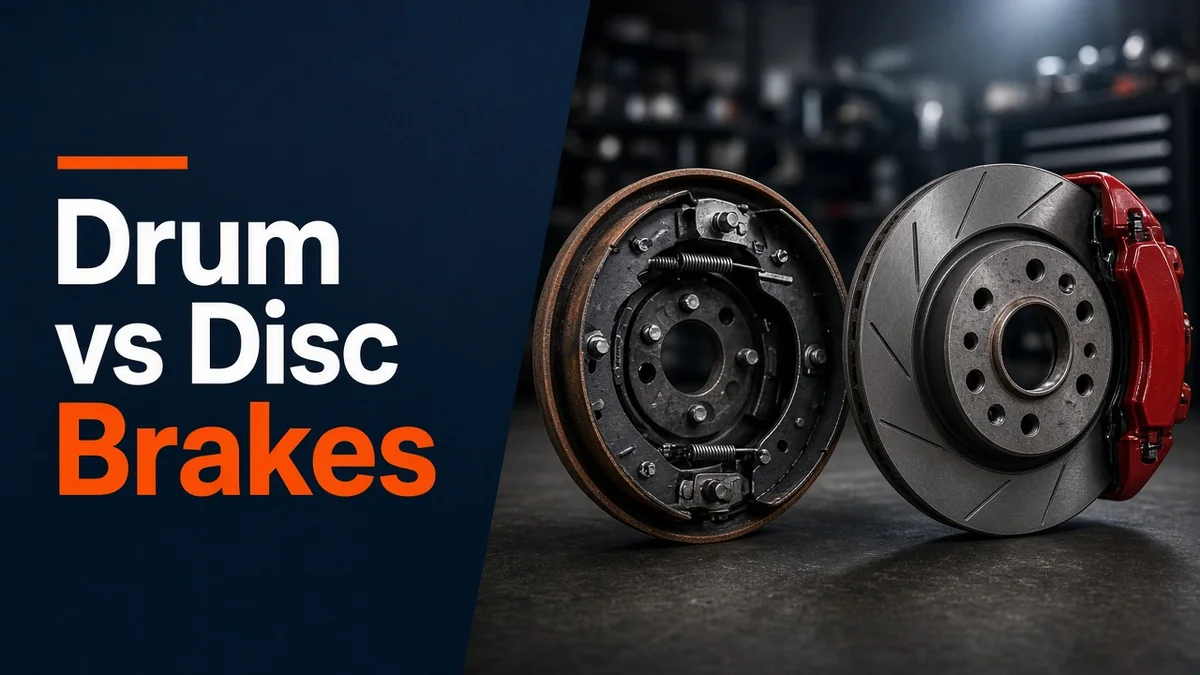
A disc brake has a flat rotor bolted to the wheel hub. When you press the pedal, hydraulic pressure pushes pistons in the caliper, which clamp brake pads against both sides of the rotor. Because the rotor is exposed to air, and front rotors are usually vented with internal cooling fins, heat escapes quickly.
How Drum Brakes Work
A drum brake has a hollow drum that spins with the wheel. Inside sit two curved brake shoes, a wheel cylinder with small pistons, springs and an adjuster. Pressing the pedal pushes the shoes outward against the inside of the drum. Many drum designs have a self-energizing effect, where the rotation of the drum helps wedge the leading shoe harder against it, giving strong braking force from little pressure.
Drum Brakes vs Disc Brakes Compared
| Disc brakes | Drum brakes | |
|---|---|---|
| Stopping performance | Strong and consistent | Strong, but less consistent when hot |
| Heat dissipation | Excellent | Poor; heat builds inside the drum |
| Brake fade | Resists fade | More prone to fade on long descents |
| Wet weather | Water is flung off; recovers quickly | Water can collect inside; slower recovery |
| Parts cost | Higher | Lower |
| Wear life | Pads wear faster | Shoes often last a long time on rear axles |
| Maintenance | Easy to inspect and replace | More parts, harder to service, needs adjustment |
| Parking brake | Needs a separate mechanism or built-in caliper | Integrates simply |
| Typical use | Front wheels of all cars; rear of many | Rear wheels of many economy cars, trucks and some EVs |
Advantages of Disc Brakes
- Better heat dissipation, so they resist fade during repeated or long stops
- More predictable pedal feel and modulation
- Quicker recovery after driving through water
- Self-cleaning of dust and debris
- Easier to inspect pad thickness through the wheel
- Work well with ABS and stability control systems
Advantages of Drum Brakes
- Lower manufacturing cost, which helps keep car prices down
- Long-lasting shoes, especially on the lightly loaded rear axle
- Enclosed design protects parts from dirt and debris
- Simple, effective parking brake
- Less affected by corrosion from lack of use, which is one reason some electric cars use rear drums
Why Many Cars Still Have Rear Drum Brakes
When you brake, weight shifts forward, so the front wheels do most of the stopping. The rear brakes need far less capacity, and drums provide enough for many everyday vehicles at a lower cost. Some electric vehicles also use rear drums because regenerative braking does most of the slowing, and disc brakes that are rarely used can rust and seize, while enclosed drums hold up better.
Which Brake Type Is Better for Your Use?
| Use | Better Choice | Why |
|---|---|---|
| Daily commuting | Disc (front) with disc or drum rear | Rear drums are adequate because the front brakes do most of the work |
| Mountain driving or towing | Four-wheel disc | Better heat dissipation and fade resistance |
| Performance or track driving | Four-wheel disc, often larger rotors | Consistent braking under repeated hard stops |
| Budget economy car | Front disc, rear drum | Lower cost, long-lasting rear shoes |
| Wet climates | Disc | Sheds water faster than enclosed drums |
| Heavy commercial trucks | Drums still common, discs growing | Drums are durable and cheaper; air disc brakes are increasingly used |
| Boat trailers | Disc (often stainless or coated) | Less trapped water and rust than drums |
How to Tell Which Brakes Your Car Has
Look through the rear wheel spokes. If you see a flat disc with a caliper clamped over it, you have disc brakes. If you see a solid, round metal drum with no visible caliper, you have drum brakes. Your owner’s manual or spec sheet will also list them.
Drum Brakes and the Parking Brake
Drum brakes make an excellent parking brake because the shoes can be mechanically wedged against the drum with a simple cable. Many vehicles with rear disc brakes still use a small “drum-in-hat” parking brake: a miniature drum built into the center of the rear rotor with its own tiny shoes. Others use a mechanism inside the rear caliper, and many newer cars use an electric motor on the caliper to apply the parking brake. That is one reason rear drum brakes remain common on budget cars: the parking brake is simple and cheap.
Maintenance and Cost
| Job | Typical cost per axle |
|---|---|
| Disc brake pads | $150–$300 |
| Disc pads and rotors | $300–$600 |
| Drum brake shoes | $150–$350 |
| Shoes, drums and hardware | $300–$600 |
| Wheel cylinder replacement | $150–$350 per side |
Drum brakes need periodic adjustment on some designs, and a leaking wheel cylinder can soak the shoes in brake fluid, which must be fixed immediately. Disc brakes are generally easier and faster for shops to service. Brake inspections are part of routine service; see our car maintenance schedule by mileage.
Signs your rear drums need attention: a pulsing felt in the seat or pedal, a parking brake that pulls higher than usual, scraping or grinding from the rear, or brake fluid on the inside of a rear tire. A leaking wheel cylinder reduces braking and should be repaired before driving far.
Should You Convert Drum Brakes to Disc?
Rear disc conversion kits are available for many cars and trucks. They can improve fade resistance for towing, track use or heavily modified vehicles. For a typical daily driver, the rear drums already provide the braking the car was designed for, and a conversion can cost several hundred to over a thousand dollars and may affect brake balance and the ABS system if done poorly. Well-maintained stock brakes are usually the better investment.
Common Problems With Each Type
- Disc brakes: squealing, uneven rotor thickness causing vibration, sticking calipers. Our guide to why your car is shaking covers brake-related vibration.
- Drum brakes: out-of-adjustment shoes, leaking wheel cylinders, out-of-round drums and weak parking brakes.
Unusual sounds from either system are covered in our guide to car noises explained, and brakes are checked during many state inspections.
Related guides: how to check car fluids, dashboard symbols and meanings and how to drive a manual car.
Drum vs Disc Brakes FAQ
For stopping performance, heat handling and wet weather, yes. Drum brakes are cheaper and work well on the rear wheels of many everyday vehicles.
Rear brake shoes often last a long time, sometimes more than 100,000 miles, because the rear brakes do less of the stopping.
Look through the wheel spokes. A disc with a caliper means disc brakes; a solid round drum means drum brakes.
Many drum brake systems self-adjust, but some need periodic manual adjustment, especially after new shoes are fitted.
Yes. Properly maintained drum brakes meet the same safety standards and are used on millions of vehicles.
Drum brakes are durable, inexpensive and provide a strong mechanical parking brake. Some light trucks keep rear drums, and many heavy commercial trucks still use them, although disc brakes are becoming more common.