Brake Rotors: When to Replace, Resurface and What It Costs
Brake rotors are the metal discs that your brake pads squeeze to slow the car. They usually last 30,000 to 70,000 miles and should be replaced when they wear below the minimum thickness stamped on them, or when they are cracked, deeply grooved or causing vibration when you brake. Replacing rotors typically costs about $250 to $500 per axle at an independent shop, or about $300 to $600 per axle with new pads included. Resurfacing, at roughly $40 to $65 per rotor, is only an option if enough metal remains.
What Brake Rotors Do
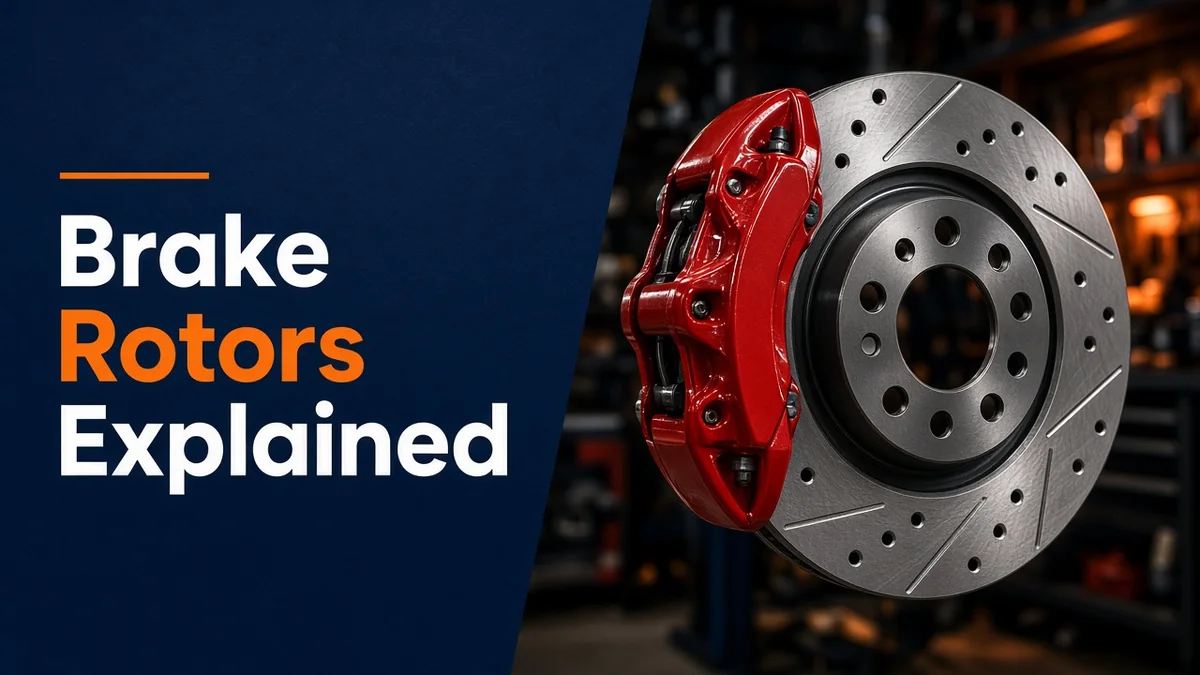
On a disc brake, each wheel has a rotor bolted to the hub that spins with the wheel. When you press the pedal, hydraulic pressure pushes the caliper pistons, which clamp the brake pads against both sides of the rotor. Friction turns the car’s motion into heat, and the rotor has to absorb and shed that heat quickly. That is why rotor thickness matters: a thinner rotor holds less heat and is more likely to overheat, fade or crack.
Signs Your Brake Rotors Need Attention
- Pulsation or vibration when braking: felt through the pedal or steering wheel, usually from uneven rotor thickness. Our guide to why your car is shaking covers other causes of vibration.
- Grinding or scraping: often worn-out pads cutting into the rotor metal.
- Squealing or squeaking: can come from glazed rotors or pad wear indicators; see car noises explained.
- Visible grooves or a lip at the edge: deep scoring or a raised outer edge shows heavy wear.
- Blue or dark spots: signs of overheating.
- Cracks: any crack means the rotor must be replaced.
- Longer stopping distances: worn rotors and pads reduce braking performance.
Grinding brakes need attention now: a metal-on-metal grinding sound usually means the pads are worn down to their backing plates. Every stop damages the rotors further and reduces braking power. Get the brakes inspected before driving more than you have to.
Are My Rotors Really Warped?
Drivers and mechanics often call a pulsing pedal “warped rotors,” but true warping is uncommon. The usual cause is uneven thickness across the rotor face, often from uneven pad material deposits, hard braking followed by holding the pedal down while stopped, or lug nuts tightened unevenly. The effect is the same: the pad grips thicker and thinner spots and you feel a pulse. Resurfacing can fix it if the rotor is thick enough; otherwise it needs replacing.
When to Replace Brake Rotors
Check the Minimum Thickness
Every rotor has a minimum or discard thickness, usually stamped on the rotor hat or edge as “MIN TH” followed by a measurement in millimeters. A mechanic measures the rotor with a micrometer at several points. If it is at or below the minimum, or would drop below it after resurfacing, it must be replaced.
Replace Rather Than Resurface If
- The rotor is at or near its minimum thickness
- There are cracks, deep grooves or heat spots that will not machine out
- The rotor is badly rusted, especially on the cooling vanes
- The rotor is inexpensive enough that replacing costs little more than resurfacing
- The vehicle is a heavy truck, SUV or tow vehicle that needs full thermal capacity
Resurface vs Replace Brake Rotors
Resurfacing, also called turning or machining, shaves a thin layer off both faces of the rotor on a lathe to make it flat and smooth again. It used to be standard practice. Today many shops replace rotors instead, because modern rotors are made thinner to save weight and are relatively cheap, leaving little metal to remove safely.
| Resurfacing | Replacement | |
|---|---|---|
| Typical cost | About $40–$65 per rotor | About $250–$500 per axle installed |
| When it works | Rotor well above minimum thickness, minor grooves or pulsation | Worn thin, cracked, heavily scored or rusted |
| Pros | Cheaper, less waste | Full thickness, best heat capacity, like-new feel |
| Cons | Thinner rotor, not always possible | Higher cost |
Brake Rotor Replacement Cost
These are typical US prices; trucks, performance cars and European vehicles cost more, and dealers charge more than independent shops.
| Job | Typical cost |
|---|---|
| Rotor parts only (standard, each) | $40–$120 |
| Rotor replacement per axle (installed) | $250–$500 |
| Pads and rotors per axle (installed) | $300–$600 |
| Resurfacing (per rotor) | $40–$65 |
| Performance drilled or slotted rotors (each) | $80–$250+ |
| Carbon-ceramic rotors (performance cars) | Often thousands of dollars per axle |
Rear rotors on cars with an electronic parking brake may need a scan tool to retract the caliper, which can add labor. If your car also needs its brake fluid changed, ask for both jobs together to save on labor; our guide to checking car fluids shows how to check the brake fluid level yourself.
National estimators land on either side of these ranges. RepairPal’s September 2026 estimate for a brake rotor replacement averages about $574 to $698, with $168 to $247 of that in labor, while Kelley Blue Book puts a typical pads-and-rotors job at about $250 to $400 per axle. AutoZone lists most standard rotors at roughly $30 to $75 each, plus about $150 to $200 of labor per axle. A pair of standard rotors for a common car therefore often costs about $60 to $240 in parts; the gap between estimates mostly comes from vehicle type, parts quality and local labor rates.
Types of Brake Rotors
| Type | Description | Best for |
|---|---|---|
| Solid | Single solid disc | Rear brakes on many small cars |
| Vented | Two faces joined by internal cooling vanes | Front brakes on most cars |
| Slotted | Grooves in the face to clear gas, dust and water | Towing, heavy loads, spirited driving |
| Drilled | Holes through the face for cooling and wet grip | Appearance and some performance use; can crack under heavy use |
| Drilled and slotted | Both features | Performance-style upgrades |
| Coated | Anti-rust coating on hat and vanes | Wet or salted-road climates |
For a daily driver, a quality rotor that matches the original specification is usually the best value. Drilled and slotted rotors are mostly about appearance or specific performance needs, not everyday stopping power.
How Brake Rotors Are Replaced
A rotor replacement on one axle usually takes a shop about 1 to 1.5 hours. The basic steps for a typical disc brake:
- Loosen the lug nuts, raise the vehicle and support it on jack stands, then remove the wheel.
- Remove the caliper slide bolts and hang the caliper with wire so it does not hang by the brake hose.
- Remove the caliper bracket bolts and the bracket.
- Remove any rotor retaining screw, then pull the rotor off the hub. A rusted rotor may need penetrating oil or a rubber mallet.
- Clean rust and scale from the hub face so the new rotor sits perfectly flat, which prevents vibration.
- Clean the new rotor’s protective coating or oil with brake cleaner if the manufacturer recommends it.
- Install the new rotor, reinstall the bracket and torque its bolts to specification.
- Install new pads and hardware, lubricate slide pins, and reinstall the caliper.
- Reinstall the wheel, torque lug nuts in a star pattern and pump the brake pedal until firm.
- Bed in the new pads and rotors with a series of moderate stops.
Should You Replace Rotors and Pads Together?
Many shops recommend new rotors with every pad change, while others reuse rotors that are in good shape. New pads bed in best on a fresh or freshly machined surface, and putting new pads on grooved or uneven rotors can cause noise, vibration and faster pad wear. At minimum, rotors should be measured and inspected at every pad replacement, and both sides of an axle should always match.
How to Choose Replacement Rotors
- Match your exact vehicle: rotor size can vary by trim, brake package and even production date. Use your VIN or plate for the lookup.
- OE or OE-equivalent: the safest choice for most daily drivers, with correct thickness, weight and metallurgy.
- Coated rotors: a rust-resistant coating on the hat and vanes keeps wheels looking clean and reduces corrosion in snowbelt states.
- Avoid very cheap rotors: thin castings with less metal overheat and warp sooner.
- Drilled or slotted rotors: mainly for looks or specific performance use; most daily drivers do not need them.
- Buy in pairs, and replace pads at the same time for the best braking feel.
How Long Do Brake Rotors Last?
Most rotors last 30,000 to 70,000 miles, and some last longer. They wear faster on heavy vehicles, with frequent city driving, in hilly areas, when towing, and with aggressive pad compounds. Hard braking habits and letting pads wear down to metal shorten rotor life dramatically. Brakes are checked as part of routine maintenance; our car maintenance schedule by mileage shows when brake inspections usually happen.
Front vs Rear Rotors
Front rotors usually wear out first. When you brake, weight shifts forward, so the front brakes do most of the work and are built with larger, vented rotors to handle the heat. Rear rotors are often smaller, sometimes solid, and can last through two or more sets of front brakes. On cars with an electronic parking brake, though, rear rotors and pads can wear faster than you would expect, so have both axles measured at each brake inspection.
Hybrid and Electric Car Rotors
Hybrids and EVs slow down mostly with regenerative braking, so their pads and rotors can last far longer than on a gas car. The flip side is that the friction brakes are used so lightly that rust can build up on the rotor faces, especially in wet or salted-road climates. Using the friction brakes firmly now and then, and having them inspected even when the pads look thick, helps keep the rotors clean.
How to Make Brake Rotors Last Longer
- Replace brake pads before they wear down to the metal backing
- Brake smoothly and early instead of late and hard
- Use engine braking or a lower gear on long downhill stretches
- Avoid holding the brakes firmly while stopped right after a hard stop
- Have lug nuts tightened to the correct torque in a star pattern
- Bed in new pads and rotors as the manufacturer recommends
Do Warranties Cover Brake Rotors?
Rotors are considered wear items, so new-car bumper-to-bumper warranties usually do not cover normal wear. They may be covered in the first months or miles if there is a manufacturing defect, such as excessive runout causing vibration. Many aftermarket rotors come with limited or “lifetime” parts warranties, but these typically cover only the part, not labor, and exclude wear and heat damage. Extended warranties and service contracts almost never cover brake wear.
Is Rust on Brake Rotors a Problem?
A thin layer of orange surface rust after rain, a car wash or a few days parked is normal and wipes off after a few stops. Heavy rust that pits the braking surface, flakes off, or eats into the cooling vanes is different; it reduces braking and usually means replacement. Cars that sit for long periods are prone to this, and our guide to car storage covers how to prepare a car that will not be driven for a while.
Related guides: car inspection, dashboard symbols and meanings and towing costs.
Brake Rotors FAQ
Typically about $250 to $500 per axle at an independent shop, or about $300 to $600 per axle with new pads. Parts alone are often $40 to $120 per rotor for standard rotors.
Resurfacing is cheaper but only works if enough thickness remains. Many shops now replace rotors because modern rotors are thin and relatively inexpensive.
Yes. Rotors should be replaced or resurfaced in pairs on the same axle so both sides brake evenly.
For most daily drivers, no. Quality rotors that match the original specification perform well. Slotted rotors can help when towing or hauling; drilled rotors are mostly cosmetic for street use.
For a short time, carefully, if the brakes still stop the car well. But worn or cracked rotors lengthen stopping distances and can damage pads and calipers, and grinding means metal-on-metal contact that needs immediate repair.
A pair of standard rotors for a common car usually costs about $60 to $240 in parts. Installed, expect about $250 to $500 per axle at an independent shop, more for trucks and performance cars.