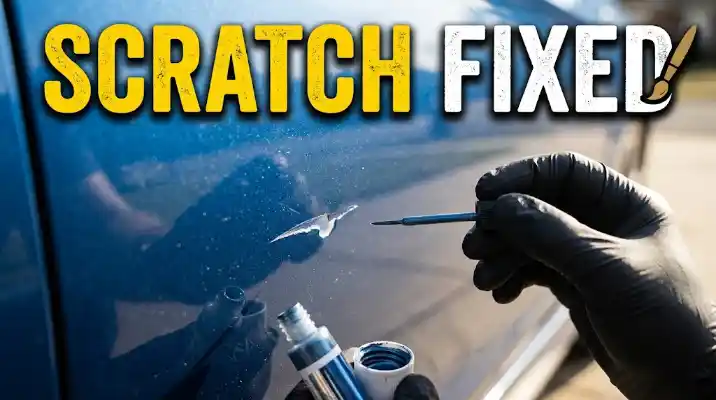
How to Fix Paint Chips and Scratches (And What It Costs)
Car paint chips and light scratches are easy to fix at home if you catch them early. To fix a paint chip, clean the spot with rubbing alcohol, dab on thin layers of touch-up paint matched to your car’s paint code, let each coat dry, add clear coat, and after it cures, gently level and polish the area. Light scratches that stay in the clear coat can often be polished out completely. Use the fingernail test to decide: if your nail does not catch, polish it; if it catches, you need touch-up paint or a body shop. Doing it yourself costs about $15 to $70, while a mobile or body shop repair usually runs $150 to $400 per panel.
How Deep Is the Damage?
| What you see and feel | Damage level | Best fix |
|---|---|---|
| Fine line, nail glides over it | Clear coat only | Polish or scratch remover |
| Nail catches slightly, color still visible | Deep clear coat or into the color | Touch-up paint and clear, or professional repair |
| White or gray showing | Through the color to the primer | Touch-up paint and clear coat |
| Shiny silver metal showing | Down to bare metal | Primer, paint and clear, as soon as possible |
| Brown or orange around the chip | Rust has started | Remove rust, then prime and paint |
Modern car paint has three layers over the metal: primer, the colored base coat and a transparent clear coat on top. The deeper the damage goes, the more layers you need to rebuild.
How Much Does It Cost to Fix a Paint Chip?
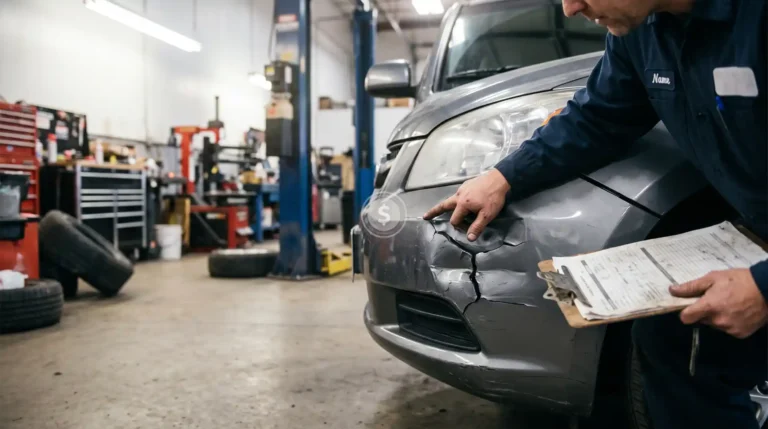
Fixing a paint chip costs about $15 to $70 if you do it yourself with a touch-up kit, $150 to $300 for a mobile touch-up technician, and roughly $150 to $400 per panel at a body or smart-repair shop. The price jumps when a shop has to refinish and blend the whole panel to match the color, which is why a single chip on a hood or door can be quoted at $500 or more.
| Repair option | Typical cost | What you get |
|---|---|---|
| DIY touch-up pen or kit | $15–$70 | Color plus clear coat; best on small chips |
| Scratch remover or polishing compound | $10–$40 | Removes clear-coat scratches only |
| Mobile touch-up service | $150–$300 | Several chips filled and leveled in one visit |
| Smart repair or spot repair at a shop | $150–$400 per panel | Chips on one panel repaired and blended |
| Professional polish for light scratches | $100–$300 per area | Machine polishing, no paint added |
| Body shop refinish of one panel | $250–$800+ | Panel sanded, painted, cleared and blended |
| Bumper scuff or chip repair | $200–$500 | Plastic bumper cover refinished |
Why One Small Chip Can Get a Big Quote
A body shop rarely paints just the chip. To make the color match under different light, they sand and spray the damaged area, fade the new color into the surrounding paint and often clear-coat the whole panel. Metallic, pearl and tri-coat colors such as white pearl or deep red need more blending, so they cost more. Dealer body shops usually quote higher than independent shops or mobile techs for the same chip.
What Changes the Price
- Depth: a chip down to bare metal needs primer and rust treatment, which adds time.
- Number and spread: 20 rock chips across the hood cost far more than one, and many owners refinish the hood at that point.
- Paint type: three-stage pearl and matte finishes are harder to match than solid colors.
- Location: chips on plastic bumpers need flex additive, and chips near panel edges are harder to blend.
- Rust: once orange or brown shows, the shop has to remove corrosion first. Our guide on preventing rust on a car explains why early touch-up matters.
Is It Worth Paying a Shop?
For a daily driver, a careful DIY touch-up is usually enough because it seals the metal, which is the part that matters most. A professional repair makes sense on a newer car, a lease you are about to return, a chip at eye level on the hood, or before you sell or trade in the car, where clean paint helps the appraisal. Insurance rarely helps here: road chips are treated as normal wear, and even when comprehensive coverage applies, the repair usually costs less than the deductible.
How to Remove Light Scratches (Clear Coat)
- Wash and dry the area thoroughly.
- Apply a small amount of scratch remover or polishing compound to a microfiber applicator.
- Work it in with moderate pressure using overlapping passes for a minute or two.
- Wipe off and inspect in good light. Repeat a few times if needed.
- Finish with a finer polish if the area looks hazy, then protect it with wax or sealant.
A dual-action machine polisher does this faster and more evenly, especially for swirl marks across a whole panel. Do not overdo it; each pass removes a tiny amount of clear coat.
How to Fix Paint Chips With Touch-Up Paint
What You Need
- Touch-up paint matched to your paint code (pen, brush bottle or kit)
- Clear coat touch-up
- Primer if the chip reaches bare metal
- Rubbing alcohol or wax-and-grease remover
- Fine applicators such as micro brushes or toothpicks
- Very fine sandpaper (2,000–3,000 grit) and polishing compound for leveling, optional
Step by Step
- Find your paint code on the sticker in the driver’s door jamb, under the hood or in your manual, and buy the matching touch-up paint.
- Clean the chip with soap and water, then wipe with rubbing alcohol to remove wax and oils.
- Treat bare metal: remove any loose paint or rust with the tip of a fine tool, then dab on a tiny amount of primer and let it dry.
- Apply color in thin dabs: shake the paint well and fill the chip with small dabs rather than brush strokes. Let each thin layer dry for 20–30 minutes.
- Build it up slightly: repeat until the paint sits just level with or very slightly above the surrounding surface.
- Add clear coat: apply one or two thin coats over the color.
- Let it cure: wait at least a few days, ideally a week.
- Level and polish (optional): for a near-invisible repair, wet-sand the raised spot very lightly with 2,000–3,000 grit paper, then polish to blend the shine.
Safety note: work in a ventilated area, keep touch-up paint and solvents away from heat and flames, and wear gloves when handling solvents and rust treatments.
Deeper Scratches
A longer scratch that reaches the primer or metal can be filled with touch-up paint in the same way, working along the scratch with a fine brush. Results on long scratches are usually less invisible than on small chips. If a scratch runs across several panels, is on a very visible spot, or is on a newer car you care about, a professional repair gives a far better finish.
How to Get Spray Paint or Paint Transfer Off a Car
Paint transfer from another car or a scuff against a painted wall usually sits on top of your clear coat. Try in order: a clay bar with lubricant, a scratch remover or light polishing compound, and, for stubborn marks, a small amount of a paint-safe adhesive or tar remover. For vandalism with spray paint, act quickly and use products labeled safe for automotive clear coat; test on a hidden area first. A detailer can remove it with less risk than aggressive solvents.
How to Prevent Paint Chips
- Leave extra distance behind trucks and on gravel roads.
- Apply clear paint protection film (PPF) to the hood, bumper and mirrors, which take the most hits.
- Keep the paint waxed, sealed or coated to make chips less likely to spread.
- Fix chips early, before water gets under the paint and rust starts.
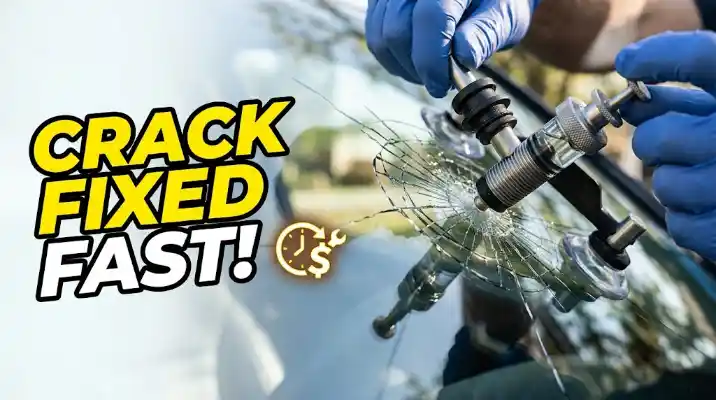
- Rock chips in the glass are a separate repair; see our windshield chip repair cost guide before a small chip spreads into a crack.
Paint Chip and Scratch FAQ
Use the fingernail test. If your nail does not catch, the scratch is in the clear coat and can usually be polished out. If it catches, it likely needs paint.
On the sticker in the driver door jamb, under the hood or in the owner manual. A dealer can also look it up from your VIN.
Light scratches can be polished for $10 to $40 DIY or about $100 to $300 professionally. Deeper scratches that need repainting cost about $250 to $800 or more per panel at a body shop.
Yes, especially for small chips. Dab thin layers rather than drawing lines, add clear coat, and polish after curing for the best result.
Yes, especially if bare metal is showing. Water and salt can get under the paint and start rust that spreads.
Yes, but not directly. Remove loose flakes and any rust, clean the edge with alcohol, prime bare metal, then apply thin layers of matching color and clear coat. Painting over loose or rusty edges lets the chip keep spreading underneath.