How Much Does a Car Weigh? Average Weight in Pounds, Tons and Kg
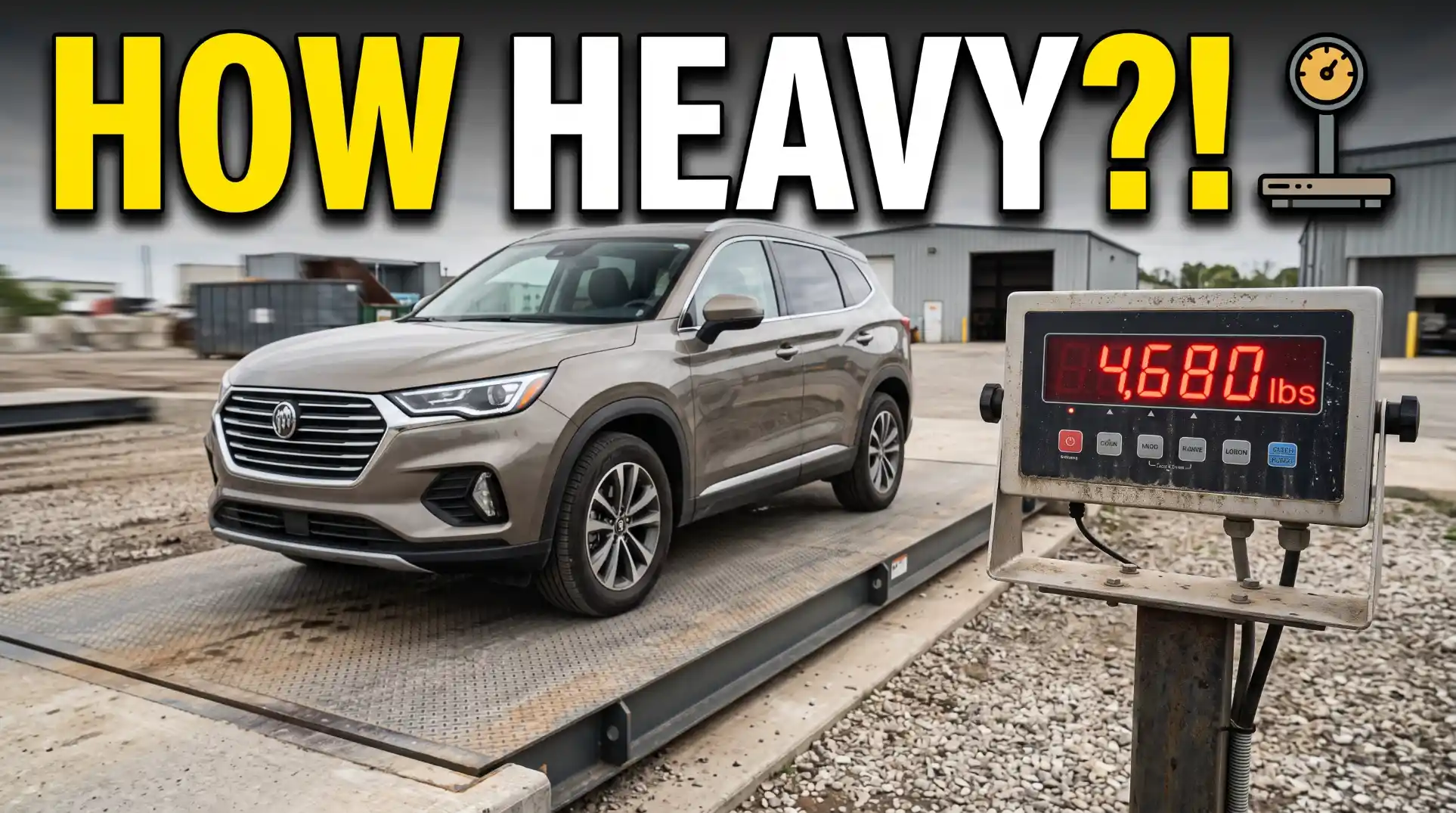
The average new vehicle sold in the US weighs about 4,354 pounds, which is roughly 2.2 US tons or 1,975 kilograms, according to the EPA’s 2025 Automotive Trends Report for model year 2024. Small cars usually weigh 2,500 to 3,200 pounds, midsize sedans 3,300 to 3,600 pounds, SUVs 3,300 to 6,000 pounds and full-size pickups 4,500 pounds or more. Electric vehicles are typically several hundred pounds heavier than similar gas models because of their battery packs.
One detail most weight guides miss: the EPA figure is an “inertia weight,” which is the empty vehicle plus 300 pounds for a driver and load. Subtract that and the average new vehicle’s curb weight works out to roughly 4,050 pounds (about 1,840 kg). Either way, a typical car today weighs about two tons.
Below you will find weights by vehicle type in pounds, tons and kilograms, averages by automaker, the difference between curb weight and GVWR, how to find your own car’s exact weight, and why weight matters for safety, towing and running costs.
How Much Does a Car Weigh by Type?
| Vehicle type | Typical curb weight (pounds) | Approx. in kilograms | Approx. in US tons |
|---|---|---|---|
| Microcar (such as a two-seat city car) | About 1,800–2,200 | 816–998 | About 1 |
| Subcompact or compact car | 2,500–3,200 | 1,134–1,451 | 1.25–1.6 |
| Midsize sedan | 3,300–3,600 | 1,497–1,633 | 1.65–1.8 |
| Full-size sedan | 3,600–4,300 | 1,633–1,950 | 1.8–2.15 |
| Compact SUV or crossover | 3,300–3,900 | 1,497–1,769 | 1.65–1.95 |
| Midsize SUV | 4,000–4,800 | 1,814–2,177 | 2–2.4 |
| Full-size SUV | 5,200–6,000 | 2,359–2,722 | 2.6–3 |
| Minivan | 4,300–4,700 | 1,950–2,132 | 2.15–2.35 |
| Half-ton pickup truck | 4,500–5,700 | 2,041–2,585 | 2.25–2.85 |
| Heavy-duty pickup | 6,000–8,000+ | 2,722–3,629+ | 3–4+ |
| Compact or midsize EV | 3,800–4,800 | 1,724–2,177 | 1.9–2.4 |
| Large electric SUV or pickup | 5,500–9,000+ | 2,495–4,082+ | 2.75–4.5+ |
Weights vary with engine, trim, drivetrain and options; all-wheel drive, larger engines, panoramic roofs and bigger batteries all add weight. Check your exact model for precise figures.
Car Weight in Pounds, Tons and Kilograms
“Ton” means different things depending on where you live, which is why you see different answers to the same question. In the US, a ton is a short ton of 2,000 pounds. Most other countries use the metric tonne, which is 1,000 kilograms (about 2,205 pounds). The UK’s older long ton is 2,240 pounds.
| Unit | Average new vehicle (EPA, model year 2024) | Estimated average curb weight |
|---|---|---|
| Pounds (lb) | 4,354 | About 4,050 |
| Kilograms (kg) | 1,975 | About 1,840 |
| US short tons | 2.18 | About 2.03 |
| Metric tonnes | 1.97 | About 1.84 |
To convert a car’s weight yourself, multiply pounds by 0.4536 to get kilograms, or divide pounds by 2,000 to get US tons. A 3,000-pound compact car is about 1,361 kg or 1.5 tons; a 5,000-pound SUV is about 2,268 kg or 2.5 tons.
Average New Vehicle Weight by Automaker
The brand you buy says a lot about how heavy your car is likely to be, mostly because of the mix of trucks, SUVs and sedans each company sells. These are the EPA’s production-weighted averages for model year 2024 vehicles (inertia weight, so subtract about 300 pounds for curb weight).
| Automaker | Average weight (lb) | Average weight (kg) |
|---|---|---|
| Mercedes | 5,082 | 2,305 |
| Stellantis (Jeep, Ram, Dodge, Chrysler) | 4,955 | 2,248 |
| Ford | 4,782 | 2,169 |
| GM (Chevrolet, GMC, Buick, Cadillac) | 4,685 | 2,125 |
| BMW | 4,679 | 2,122 |
| Tesla | 4,410 | 2,000 |
| Toyota | 4,274 | 1,939 |
| Volkswagen | 4,273 | 1,938 |
| Mazda | 4,043 | 1,834 |
| Nissan | 3,993 | 1,811 |
| Hyundai | 3,923 | 1,779 |
| Honda | 3,903 | 1,770 |
| Kia | 3,899 | 1,769 |
| Subaru | 3,836 | 1,740 |
| All automakers | 4,354 | 1,975 |
Truck-heavy lineups such as Ford, Stellantis and GM sit near the top, along with Mercedes, whose large SUVs and EVs push its average past 5,000 pounds. Subaru, Kia, Honda and Hyundai, which sell more compact cars and crossovers, average under 4,000 pounds.
Why Cars Keep Getting Heavier
New vehicles are not getting heavier because individual models suddenly gained weight. The biggest driver is what Americans buy: trucks and SUVs made up about 66% of new vehicle production in model year 2024, compared with roughly 19% in 1975. Extra safety structures, airbags, larger wheels, more technology and heavy EV battery packs add to the trend.
| Model year | Average new vehicle weight (lb) | What changed |
|---|---|---|
| 1975 | 4,060 | Large, body-on-frame sedans dominated |
| 1981 | About 3,200 | Fuel-economy rules and high gas prices shrank cars |
| 2004 | 4,111 | SUV boom pushed weight back up |
| 2023 | 4,372 | Highest average on record |
| 2024 | 4,354 | Slight dip as pickups got lighter designs |
| 2025 (preliminary) | 4,441 | Expected to set a new high |
The gap between vehicle types has also widened. In 1975 the heaviest and lightest categories were separated by about 215 pounds. In model year 2024 the average new pickup outweighed the average new sedan or wagon by about 1,700 pounds. EPA data (inertia weights) from its 2025 Automotive Trends Report.
Curb Weight vs Gross Weight vs GVWR
| Term | Meaning |
|---|---|
| Curb weight | The car with all standard equipment and fluids, including a full tank of fuel, but no passengers or cargo |
| Dry weight | The vehicle without fuel or other fluids; mostly quoted for motorcycles and race cars, rarely for passenger cars |
| Inertia weight (EPA) | Curb weight plus 300 pounds; the figure the EPA uses for fuel-economy testing and its average weight statistics |
| Gross vehicle weight | The actual weight at any moment, including people and cargo |
| GVWR (gross vehicle weight rating) | The maximum total weight the manufacturer says the vehicle can safely carry, including itself, passengers and cargo |
| Payload capacity | GVWR minus curb weight: how much people and cargo you can add |
| GCWR (gross combined weight rating) | Maximum weight of the vehicle plus a loaded trailer |
| Towing capacity | Maximum trailer weight the vehicle is rated to pull |
How to Find Your Car’s Weight
- Door-jamb sticker: the driver-side door jamb label lists the GVWR, axle weight ratings and often the maximum occupant and cargo weight.
- Owner’s manual: usually lists curb weight and towing limits in the specifications section.
- Manufacturer website or window sticker: lists curb weight for each trim.
- A public scale: truck stop scales can weigh your vehicle for a small fee if you need the exact loaded weight.
How Much Do Car Parts Weigh?
| Part | Approximate weight |
|---|---|
| Engine (complete, typical passenger car) | 300–700 lb |
| Car battery (12-volt) | 30–60 lb |
| EV battery pack | About 700–2,000+ lb depending on size |
| Wheel and tire (passenger car) | 35–60 lb each |
| Tire alone | 20–30 lb for most passenger cars |
| Car seat (vehicle seat) | 40–80 lb |
Why Car Weight Matters
- Fuel economy and range: heavier vehicles need more energy to move, reducing mpg or EV range.
- Braking and handling: more weight means longer stopping distances and more wear on brakes and tires.
- Safety: in a crash between two vehicles, occupants of the heavier vehicle generally fare better, while heavier vehicles can cause more harm to smaller cars and pedestrians.
- Towing and loading: overloading beyond GVWR or axle ratings can damage suspension, tires and brakes and is unsafe.
- Parking and lifts: some parking garages, driveway surfaces and car lifts have weight limits.
- Registration and tolls: some states base registration fees on vehicle weight, and some toll roads charge by weight class.
- Shipping and towing costs: heavier vehicles cost more to tow or transport.
Vehicle Weight Classes 1–8 Explained
Federal agencies group vehicles into eight classes by gross vehicle weight rating (GVWR), not by how much the vehicle weighs empty. These classes decide things like commercial licensing rules, some registration fees and which roads or bridges a vehicle may use.
| Class | GVWR range (lb) | Typical vehicles |
|---|---|---|
| Class 1 | Up to 6,000 | Most cars, crossovers, small SUVs and small pickups |
| Class 2a | 6,001–8,500 | Many half-ton pickups, large SUVs and full-size vans |
| Class 2b | 8,501–10,000 | Three-quarter-ton (heavy-duty) pickups and heavier vans |
| Class 3 | 10,001–14,000 | One-ton pickups, dually trucks and small box trucks |
| Classes 4–6 | 14,001–26,000 | Large box trucks, delivery trucks and school buses |
| Classes 7–8 | 26,001 and up | City buses, dump trucks and tractor-trailers |
For scale, a fully loaded tractor-trailer can weigh up to 80,000 pounds, the federal gross weight limit on Interstate highways, which is about 18 times as much as the average new car.
Tips for Staying Within Weight Limits
- Check your payload before loading passengers, luggage and roof boxes.
- Remember a trailer’s tongue weight counts toward your vehicle’s payload.
- Keep tires inflated to the door-jamb pressure, especially when fully loaded.
- Remove unnecessary heavy items from the trunk to save fuel.
Car Weight FAQ
Most subcompact and compact cars weigh about 2,500 to 3,200 pounds.
Compact SUVs typically weigh 3,300 to 3,900 pounds, midsize SUVs 4,000 to 4,800 pounds and full-size SUVs 5,200 to 6,000 pounds.
A typical passenger car engine weighs about 300 to 700 pounds, depending on size and materials.
No. A 3,000-pound car is light by today’s standards. That is typical of a compact car such as a small hatchback or sedan, while the average new vehicle weighs over 4,000 pounds.
About as much as today. The average new vehicle in model year 1975 weighed around 4,060 pounds, according to EPA data, before dropping to about 3,200 pounds by 1981 as cars were downsized.
Yes, and usually closer to two. Almost every new car sold in the US weighs more than 2,000 pounds (one US ton), and the average new vehicle weighs about 2.2 tons.