2-Car Garage Dimensions: Minimum, Standard and Ideal Sizes
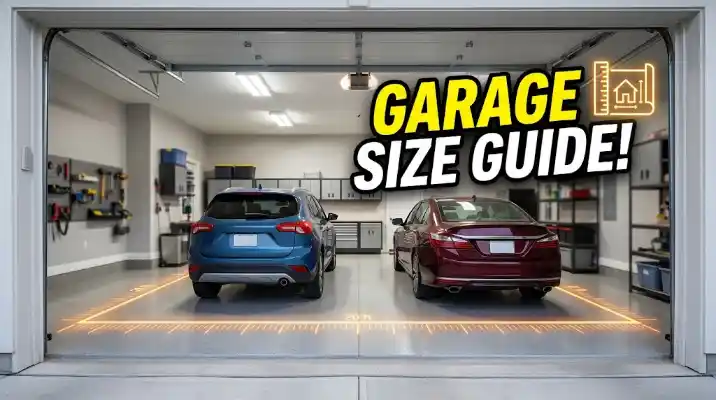
Typical 2 car garage dimensions leave less room than most people expect. A standard two-car garage is about 20 to 24 feet wide and 20 to 24 feet deep, or roughly 400 to 576 square feet. The practical minimum is 20 × 20 feet, which fits two compact or mid-size cars with little room to spare. For two SUVs or a full-size pickup, plus room to open doors and store things, aim for 24 × 24 feet or larger, with a 16-foot-wide garage door and a ceiling of at least 9 to 10 feet.
This guide covers minimum, standard and ideal sizes for one-, two- and three-car garages, garage door sizes, ceiling heights, typical vehicle dimensions, and how to check that your car or truck will actually fit.
Key Takeaways
- 2-car minimum: 20 × 20 ft (400 sq ft). Comfortable standard: 24 × 24 ft (576 sq ft).
- For trucks or storage: 24 × 26 to 26 × 28 ft or more.
- Door: one 16 × 7 ft double door, or two 8–9 ft single doors; 8 ft tall for lifted trucks and roof racks.
- Ceiling: 8–9 ft is common; 10–12 ft allows overhead storage, and a car lift needs about 12 ft.
- Allow clearance: about 3 ft between vehicles and walls to open doors, and 2–3 ft in front for walking space.
Garage Dimensions at a Glance
| Garage | Minimum | Standard | Comfortable / ideal |
|---|---|---|---|
| One-car | 12 × 20 ft (240 sq ft) | 12 × 22 ft (264 sq ft) | 14 × 22 to 16 × 24 ft |
| Two-car | 20 × 20 ft (400 sq ft) | 22 × 22 to 24 × 24 ft (484–576 sq ft) | 24 × 26 to 26 × 28 ft (624–728 sq ft) |
| Three-car | 30 × 20 ft (600 sq ft) | 32 × 22 to 36 × 24 ft | 36 × 26 ft or larger |
| Four-car (2 deep or 4 wide) | 40 × 20 ft or 24 × 40 ft | 44 × 24 ft | 48 × 26 ft or larger |
Width is measured side to side across the door wall; depth is measured from the garage door to the back wall. Local building codes, zoning setbacks and homeowners association rules may set their own minimums, so check before you build.
Two-Car Garage Size: What Each Size Really Fits
| Size | Fits | Notes |
|---|---|---|
| 20 × 20 ft | Two compact or mid-size cars | Tight; doors touch easily, no storage |
| 22 × 22 ft | Two mid-size cars or crossovers | Some room to open doors and a narrow walkway |
| 24 × 24 ft | Two SUVs, or a car and a half-ton pickup | Popular standard; room for shelves on one side |
| 24 × 26 to 24 × 28 ft | Two SUVs, or a full-size crew-cab pickup | Space for a workbench or storage at the back |
| 26 × 28 ft+ | Two large vehicles plus workshop or storage | Comfortable for most families |
Typical Vehicle Sizes
| Vehicle type | Length | Width (body) | Height |
|---|---|---|---|
| Compact car | 14–15 ft | About 5.8–6 ft | 4.5–5 ft |
| Mid-size sedan | 15.5–16.5 ft | About 6 ft | 4.7–5 ft |
| Compact or mid-size SUV | 14.5–16 ft | 6–6.3 ft | 5.3–5.8 ft |
| Full-size SUV | 17–19 ft | 6.5–7 ft | 6–6.5 ft |
| Minivan | 16.5–17.5 ft | 6.5 ft | 5.8 ft |
| Full-size pickup (crew cab) | 19–20.5 ft | 6.7–6.9 ft | 6.2–6.6 ft |
Body width does not include mirrors, which can add 10 inches or more; full-size pickups can be close to 8 feet wide with mirrors extended. Always check your own vehicle’s specifications or measure it.
How to Check That Your Vehicle Will Fit
- Measure the vehicle: overall length bumper to bumper, width including mirrors, and height including any roof rack or antenna.
- Measure the garage: inside wall to wall, door to back wall, and the lowest point of the ceiling, including the door opener rail and any beams or ductwork.
- Measure the door opening: width and height of the actual opening, not the door panel.
- Add clearance: at least 2–3 feet of walking space in front of or behind the vehicle, about 3 feet on the driver’s side to open the door, and a few inches of height clearance.
- Account for the door swing: most car doors need about 2.5 to 3.5 feet to open fully.
Will My Truck Fit in a Standard Garage?
Many full-size crew-cab pickups are 19 to 20.5 feet long, and long-bed versions can exceed 21 feet. A 20-foot-deep garage will not fit them with the door closed. Plan for at least 24 feet of depth for a full-size pickup and 26 feet or more if you also want storage or a workbench at the back. Also check the door height: a 7-foot door can be tight for lifted trucks and vehicles with roof racks, so an 8-foot door is safer.
Garage Door Sizes
| Door type | Common widths | Common heights |
|---|---|---|
| Single-car door | 8, 9 or 10 ft | 7 or 8 ft |
| Double (two-car) door | 16 ft (sometimes 18 ft) | 7 or 8 ft |
| RV or oversized door | 10–14 ft | 10–14 ft |
A two-car garage can use one 16-foot double door or two 8- to 9-foot single doors. Two single doors add a center post but leave more wall space and can make parking easier to line up. A 9-foot single door gives more room for wide vehicles than an 8-foot one.
Garage Ceiling Height
- 8 ft: the minimum common height; fine for cars but limits storage.
- 9–10 ft: leaves room for an overhead door opener, taller vehicles and some ceiling storage.
- 10–12 ft: good for overhead storage racks and tall vehicles.
- About 12 ft or more: usually needed for a two-post or four-post car lift to raise one vehicle above another or to work underneath comfortably. Check the lift maker’s requirements.
Planning Extra Space for Real Life
- Storage shelves: add 2 feet of width or depth for each row of shelving.
- Workbench: add 3–4 feet of depth.
- Bikes, mowers and bins: often need 3–6 feet of extra width or depth.
- EV charging: plan a spot for a Level 2 charger near where the car’s charging port will be, with a dedicated 240-volt circuit installed by an electrician.
- Mudroom or entry steps: steps into the house take up floor space and reduce usable depth.
How Much Does a Two-Car Garage Cost to Build?
Costs vary widely by region, materials and whether the garage is attached, detached, prefab or custom built. As a rough guide, finished garages often cost somewhere around $50 to $100 or more per square foot, so a 24 × 24 foot two-car garage commonly runs well into five figures. Kit and metal garages cost less; custom attached garages with living space above cost more. Get local quotes and check permit requirements before planning a budget.
Tips for Fitting Two Cars in a Smaller Garage
- Park the narrowest vehicle next to the wall where you need the most door space.
- Mount shelves high on the walls and use ceiling racks instead of floor storage.
- Install wall bumpers or foam guards to protect car doors.
- Use a parking aid, such as a hanging ball or laser guide, to stop in the same spot every time.
- Fold mirrors when parking if your vehicle allows it.
For more ways to protect your car, see our car care guides. Short on space for a second car or a project car? Compare car storage options and costs. For how vehicle sizes have grown over time, see the EPA Automotive Trends Report.
Garage Size FAQ
A standard two-car garage is about 20 to 24 feet wide by 20 to 24 feet deep. A 24 by 24 foot garage, 576 square feet, is a popular size that fits two SUVs with some storage.
About 20 by 20 feet, or 400 square feet, fits two compact or mid-size cars, but it is tight and leaves little room to open doors or store items.
A typical one-car garage is about 12 by 20 to 12 by 22 feet. A 14 by 22 foot garage is more comfortable for an SUV and some storage.
A three-car garage is usually about 32 by 22 to 36 by 24 feet. The minimum is around 30 by 20 feet.
Use one 16-foot-wide double door or two 8- to 9-foot single doors. Choose an 8-foot height for lifted trucks or vehicles with roof racks.
Often not in a 20-foot-deep garage. Many crew-cab pickups are 19 to 20.5 feet long, so plan for 24 feet or more of depth.
At least 8 to 9 feet for everyday use, 10 to 12 feet for overhead storage and tall vehicles, and about 12 feet or more for a car lift.
Allow about 3 feet between vehicles and between a vehicle and the wall so doors can open, plus 2 to 3 feet of walking space in front or behind.