EV vs BEV vs PHEV vs HEV: What the Terms Mean
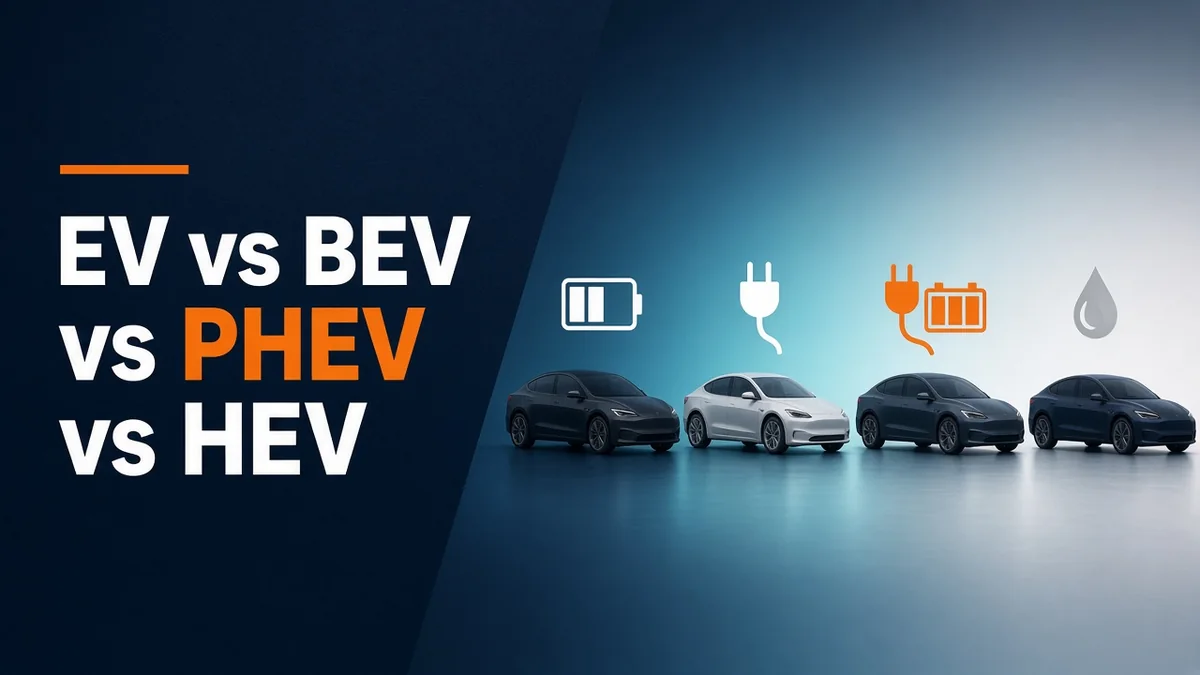
BEV means battery electric vehicle: a car that runs only on a battery and electric motors and must be plugged in to charge. EV (electric vehicle) is the broad umbrella term, and people often use it to mean a BEV. A PHEV (plug-in hybrid electric vehicle) has a gas engine plus a larger battery you can plug in, so it can drive a limited distance on electricity alone. An HEV (hybrid electric vehicle, or “regular hybrid”) has a gas engine and a small battery that charges itself through braking and the engine; it never plugs in. Mild hybrids (MHEV) and hydrogen fuel cell vehicles (FCEV) round out the list.
EV Acronyms at a Glance
| Term | Stands For | Gas Engine? | Plug In? | Electric-Only Driving | Example |
|---|---|---|---|---|---|
| EV | Electric vehicle (umbrella term) | Varies | Varies | Varies | Used for any of the below, most often BEVs |
| BEV | Battery electric vehicle | No | Yes | Always | Tesla Model Y, Ford Mustang Mach-E |
| PHEV | Plug-in hybrid electric vehicle | Yes | Yes | About 20–50 miles typical | Toyota Prius Plug-in, Mitsubishi Outlander PHEV |
| HEV | Hybrid electric vehicle | Yes | No | Very short, low speed | Toyota Camry Hybrid, Ford Maverick Hybrid |
| MHEV | Mild hybrid electric vehicle | Yes | No | None | Many Ram 1500, Mercedes and Audi models with 48V systems |
| FCEV | Fuel cell electric vehicle | No (hydrogen fuel cell) | No (refuel with hydrogen) | Always electric | Toyota Mirai, Hyundai Nexo |
| EREV | Extended-range electric vehicle | Yes, as a generator only | Yes | Most driving | BMW i3 REx (discontinued), upcoming range-extended trucks |
| ICE | Internal combustion engine vehicle | Yes | No | None | Conventional gas or diesel cars |
What Is a BEV (Battery Electric Vehicle)?
A BEV is what most people picture when they hear “electric car.” It has a large lithium-ion battery pack, one or more electric motors, and no gasoline engine, fuel tank or exhaust. It charges from a home outlet, a Level 2 charger or a DC fast charger.
- Range: most new BEVs are rated around 230 to 350 miles, with some over 400.
- Pros: zero tailpipe emissions, low running costs, quiet and quick acceleration, very little routine maintenance.
- Cons: higher purchase price on many models, charging takes longer than filling a tank, and road trips need planning.
BEVs skip oil changes entirely. See our guide on whether electric cars need oil changes for what maintenance they do need, and how long it takes to charge an electric car for real charging times.
What Is a PHEV (Plug-in Hybrid)?
A PHEV combines a gas engine with a battery that is much larger than a regular hybrid’s and can be charged by plugging in. You can drive short trips on electricity alone, then the car switches to hybrid mode when the battery is depleted.
- Electric range: typically about 20 to 50 miles, with some newer models going further.
- Pros: electric commuting with no range anxiety on long trips; can use gas stations anywhere.
- Cons: you maintain both an engine and an electric system; fuel savings depend on plugging in regularly; usually more expensive than a regular hybrid.
- Best for: drivers with short daily commutes and home charging who also take long road trips.
What Is an HEV (Hybrid Electric Vehicle)?
An HEV, or “full hybrid,” pairs a gas engine with an electric motor and a small battery. The battery is recharged by regenerative braking and by the engine, so you never plug it in. At low speeds the car can sometimes run briefly on electricity alone, and the motor assists the engine to improve efficiency.
- Pros: excellent fuel economy, especially in city traffic; no change in habits; typically lower price than a PHEV or BEV.
- Cons: still burns gas for nearly all driving; very limited electric-only operation.
- Best for: drivers without home charging who want big fuel savings.
What Is an MHEV (Mild Hybrid)?
A mild hybrid uses a small electric motor-generator, usually on a 48-volt system, to assist the engine during acceleration, smooth out start-stop operation and recover some braking energy. It cannot drive the car on electric power alone. The fuel economy gain is modest compared with a full hybrid.
What Is an FCEV (Fuel Cell Electric Vehicle)?
An FCEV is an electric car that makes its own electricity on board. Compressed hydrogen gas from the tank reacts with oxygen from the air in a fuel cell stack, producing electricity for the motor and water vapor as the only tailpipe emission. Refueling takes about five minutes, but hydrogen stations are very limited in the US and concentrated mostly in California.
BEV Vs. PHEV Vs. HEV: Which Should You Buy?
| Factor | BEV | PHEV | HEV |
|---|---|---|---|
| Fuel/energy cost | Lowest (especially with home charging) | Low if charged daily | Moderate |
| Purchase price | Often highest | High | Moderate |
| Maintenance | Lowest | Highest complexity (engine + battery) | Low to moderate |
| Road trips | Need charging stops | Easy | Easy |
| Home charging needed? | Strongly recommended | Recommended to get the benefits | No |
| Tailpipe emissions | None | Low if charged, otherwise similar to a hybrid | Reduced |
| Best for | Drivers with home charging and predictable routes | Short commutes plus long trips | No charging access, high city mileage |
Energy cost is one of the biggest differences. Use our EV charging cost calculator and fuel cost calculator to compare what you would pay to drive each type, and our total cost of ownership calculator to include depreciation, insurance and maintenance.
Other Terms You Will See
- ZEV: zero-emission vehicle, a regulatory term that includes BEVs and FCEVs.
- PEV: plug-in electric vehicle, covering both BEVs and PHEVs.
- xEV: any vehicle with electric propulsion (BEV, PHEV, HEV, MHEV, FCEV).
- Regenerative braking: the motor acts as a generator when slowing down, recharging the battery.
- kWh: kilowatt-hour, the unit of battery capacity and energy use.
- MPGe: miles per gallon equivalent, the EPA efficiency rating for electric driving.
- Level 1, Level 2, DC fast charging: charging speeds from a standard outlet, a 240V charger and a high-power station.
- NACS and CCS: the two main DC fast-charging plug standards in North America; most automakers are moving to NACS.
Is a Hybrid an EV?
Technically, hybrids are “electrified” vehicles, and a PHEV is often counted as an EV in sales statistics because it plugs in. But when people say “EV” in everyday conversation, they usually mean a fully electric BEV. Regular hybrids (HEVs) are usually not called EVs.
Charging safety: Use chargers and outlets rated for the load, have a licensed electrician install any 240V home charger, and avoid ordinary extension cords for charging. Never service high-voltage battery components yourself; they are marked with orange cables and require trained technicians.
Related guides: Do electric cars need oil changes? · How long to charge an EV? · EV charging cost calculator
EV Terms FAQs
BEV stands for battery electric vehicle. It runs only on electricity stored in a battery, has no gas engine and must be plugged in to recharge.
A PHEV has a larger battery you can plug in and can drive about 20 to 50 miles on electricity alone. An HEV has a small battery that charges itself and never plugs in.
A BEV is better if you have home charging and mostly predictable driving. A PHEV suits drivers with short commutes who also take long trips or lack reliable charging on the road.