How Long Does It Take to Charge an Electric Car?
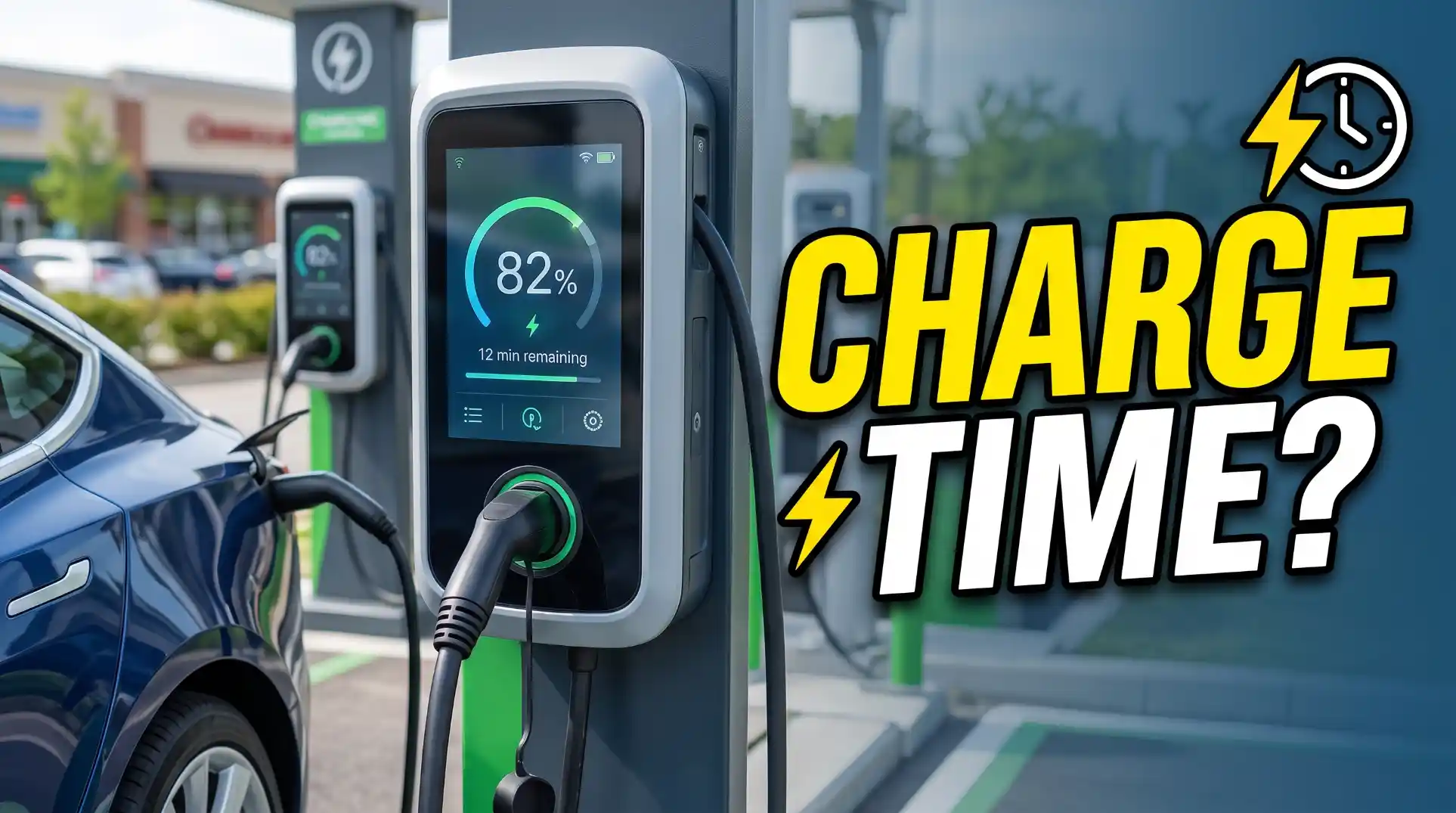
How long does it take to charge an electric car? It depends almost entirely on the charger. Charging an electric car takes anywhere from about 20 minutes to more than 40 hours, depending on the charger. According to the US Department of Transportation, a Level 1 (120-volt household outlet) charger can take 40–50+ hours to bring a battery-electric car from empty to 80%, a Level 2 (240-volt) charger takes about 4–10 hours, and a DC fast charger can reach 80% in roughly 20 minutes to 1 hour. Most owners top up overnight on Level 2 at home rather than charging from empty.
Key Takeaways
- Level 1 (120 V): about 5 miles of range per hour; best for plug-in hybrids or low daily mileage.
- Level 2 (240 V): about 10–70+ miles of range per hour; a full charge overnight for most EVs.
- DC fast charging: about 20 minutes to 1 hour to reach 80% on a road trip.
- Charging slows after about 80% to protect the battery.
- Cold weather and a small onboard charger can make charging take longer.
EV Charging Time by Charger Level
| Charger | Power | Range added per hour | Time to about 80% from empty | Where you find it |
|---|---|---|---|---|
| Level 1 | About 1–1.9 kW (120 V outlet) | About 3–5 miles | 40–50+ hours (EV); 5–6 hours (PHEV) | Any standard household outlet |
| Level 2 | About 3–19 kW (240 V or 208 V) | About 10–70+ miles | About 4–10 hours (EV); 1–2 hours (PHEV) | Home wallbox, workplaces, public lots |
| DC fast charging | About 50–350 kW | Hundreds of miles per hour | About 20 minutes to 1 hour | Highway and public fast-charge stations |
Charging time ranges come from US Department of Transportation guidance. Actual times depend on your car and charger.
How to Estimate Your Own Charging Time
A simple formula gets you close: charging time (hours) ≈ energy needed (kWh) ÷ charging power (kW). Use the lower of the charger’s power and your car’s maximum AC charging rate (its onboard charger) for Level 1 and 2, and add about 10% for charging losses.
| Example | Energy needed | Charging power | Estimated time |
|---|---|---|---|
| Refill a 75 kWh battery from 20% to 80% on a 11 kW home charger | 45 kWh | 11 kW | About 4–4.5 hours |
| Same car, 20% to 80% on a 7.2 kW charger | 45 kWh | 7.2 kW | About 6.5–7 hours |
| Same car on a 1.4 kW Level 1 outlet | 45 kWh | 1.4 kW | About 32–35 hours |
| Daily 40-mile commute (about 12 kWh) on Level 2 at 7.2 kW | 12 kWh | 7.2 kW | About 2 hours |
What Affects EV Charging Speed?
- Battery size: bigger batteries hold more energy and take longer to fill at the same power.
- State of charge: charging is fastest when the battery is low and tapers significantly after about 80%.
- Charger power: a 50 kW fast charger is much slower than a 250 kW one.
- Car’s maximum charging rate: the car limits how much power it accepts, both for AC (onboard charger) and DC fast charging.
- Temperature: cold batteries charge more slowly; preconditioning the battery before fast charging helps.
- Shared stations: some public chargers split power when two cars plug in at once.
- Battery age: older batteries may charge a little slower.
Why Charging Slows Down After 80%
As an EV battery fills, the car reduces charging power to prevent heat and stress on the cells. On a DC fast charger, going from 10% to 80% often takes about the same time as going from 80% to 100%. That is why road-trip advice is to charge to around 80% and move on, and why most EVs are set to a daily charge limit of around 80–90%.
Home Charging: Level 1 vs Level 2
| Level 1 | Level 2 | |
|---|---|---|
| Outlet | Standard 120 V outlet | 240 V circuit (like a dryer outlet) or hardwired |
| Equipment | Usually included with the car | Wallbox charger bought separately |
| Installation | None | Electrician often needed; cost varies by home |
| Best for | Plug-in hybrids, short commutes | Most battery-electric car owners |
A Level 2 home charger is the most convenient setup for most EV owners. Installation cost depends heavily on your electrical panel and distance to the parking spot, so get a quote from a licensed electrician. Some utilities and states offer rebates for home chargers.
Public Charging Tips
- Use your car’s navigation or a charging app to find working chargers and see their speed.
- Precondition the battery on the way to a fast charger if your car supports it.
- Charge to about 80% on road trips, then continue; the last 20% is slow.
- Check connector type: most new US EVs use the NACS (Tesla-style) port, while many public chargers still use CCS1, and adapters are common.
- Move your car when it is done so others can charge; many networks charge idle fees.
Safety note: Only plug an EV into outlets and extension cords rated for the load. Do not use light-duty household extension cords for Level 1 charging, and have an electrician install any Level 2 charger or new 240-volt circuit.
How Much Does It Cost to Charge?
Cost depends on your electricity rate. Multiply the kWh you add by the price per kWh: for example, adding 45 kWh at 16 cents per kWh costs about $7.20 at home. Public DC fast charging usually costs more per kWh than charging at home.
Try the calculator: use our EV charging cost calculator to estimate your charging costs. Charging is only part of EV ownership; see whether electric cars need oil changes and what maintenance they do need.
EV Charging Time FAQ
From about 20 minutes on a DC fast charger to over 40 hours on a standard 120-volt outlet. Most EVs fully charge overnight on a 240-volt Level 2 charger.
On a Level 2 home charger, most EVs go from nearly empty to full in about 4 to 10 hours. On a regular outlet, it can take one to two days.
About 3 to 5 miles on Level 1, roughly 10 to 70 miles on Level 2, and hundreds of miles on a DC fast charger.
The car reduces charging power as the battery fills to limit heat and protect the cells, so the last 20% takes much longer.
Yes. A cold battery accepts power more slowly, especially at fast chargers. Preconditioning the battery before charging helps.
For daily driving, many automakers recommend a limit around 80 to 90%. Charge to 100% before long trips if needed, following your owner’s manual.
It depends on the model and charger, but on a Level 2 home charger most Teslas charge fully overnight, and on a Supercharger they can add a large share of range in 15 to 30 minutes.