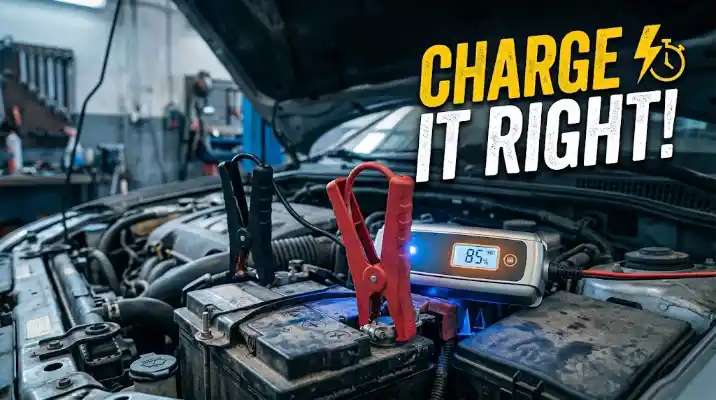
How to Charge a Car Battery: Charger Types, Steps and Charging Time
Here is how to charge a car battery safely at home. To charge a car battery, turn off the car and everything in it, connect the charger’s red clamp to the positive (+) terminal and the black clamp to the negative (−) terminal or a bare metal ground point, choose the right battery type and charge rate, then plug in and switch on the charger. A modern smart charger stops automatically when the battery is full. At 10 amps, a flat battery typically takes about 4 to 8 hours; at 2 amps it can take a day or more.
This guide covers the types of chargers, a safe step-by-step process, charging times, whether driving or idling recharges a battery, and what to do if the battery will not hold a charge.
Key Takeaways
- Connect red to positive first, then black; disconnect in reverse order after unplugging the charger.
- Use a smart charger with the correct setting for flooded, AGM or lithium batteries.
- Time: about 4–8 hours at 10 amps, 12–24+ hours at 2 amps for a flat battery.
- Idling is a poor charger: a 30+ minute drive helps, but a flat battery needs a real charger.
- Never charge a frozen, cracked or swollen battery.
Types of Car Battery Chargers
| Type | What it does | Best for |
|---|---|---|
| Battery maintainer (1–2 amps) | Slowly charges and then holds the battery at full charge | Cars in storage, occasional drivers |
| Smart multi-stage charger (2–15 amps) | Tests, charges in stages and switches to maintenance automatically | Most home charging |
| Fast or boost charger (20+ amps, some with engine start) | Charges quickly or gives a starting boost | Garages and emergencies; harder on the battery |
| Portable jump starter | Starts the engine from its own battery; does not fully recharge yours | Getting home after a dead battery |
| Solar maintainer | Offsets small drains using sunlight | Parked cars, trailers and boats |
For most owners, a smart charger rated around 5 to 10 amps with flooded and AGM modes is the most useful single tool.
How to Charge a Car Battery Step by Step
- Read both manuals: your charger’s instructions and your car’s battery section. Some cars specify remote charging points under the hood.
- Work in a ventilated area away from flames and sparks, wearing safety glasses and gloves.
- Turn everything off: ignition, lights and accessories. Remove the key.
- Keep the charger unplugged while you connect it.
- Clean the terminals if they are corroded.
- Connect the red (positive) clamp to the battery’s positive (+) terminal.
- Connect the black (negative) clamp to the negative (−) terminal, or to a bare metal ground point on the engine or chassis if the manual recommends it.
- Select the battery type (standard/flooded, AGM, lithium) and the charge rate. Choose a lower rate if you have time; it is gentler on the battery.
- Plug in and turn on the charger. A smart charger will show its progress and switch to maintenance mode when done.
- When finished: turn off and unplug the charger first, then remove the black clamp, then the red clamp.
Safety note: lead-acid batteries can release flammable hydrogen gas while charging. Never smoke or create sparks nearby, keep the area ventilated, and do not charge a battery that is frozen, cracked, leaking or bulging. If the battery gets very hot or smells like rotten eggs while charging, stop and unplug the charger.
How Long Does It Take to Charge a Car Battery?
| Charger output | Typical time for a flat battery |
|---|---|
| 1–2 amps (maintainer) | 24–48 hours |
| 4 amps | About 10–20 hours |
| 10 amps | About 4–8 hours |
| 20+ amps (fast charge) | About 2–4 hours, with more heat and stress |
Actual time depends on the battery’s size (amp-hours), how deeply it was drained, its age and the temperature. A battery that is only partly low charges much faster. A smart charger’s display is the most reliable guide to when it is full.
Charging AGM and Other Battery Types
- AGM batteries, common in start-stop cars, need a charger with an AGM setting. The wrong profile can undercharge or overcharge them.
- EFB batteries usually use the standard or flooded setting unless your charger has a specific mode.
- Lithium 12-volt batteries in some newer and performance cars require a lithium-compatible charger; standard lead-acid chargers can damage them.
- Hybrids and EVs: the small 12-volt battery can be charged like a normal battery, often through jump points under the hood. Never connect anything to the high-voltage system.
Does Driving or Idling Charge the Battery?
Yes, the alternator recharges the battery whenever the engine runs, but not very quickly. Idling produces relatively little charging current, especially with lights, heat and electronics on, so idling for a few minutes does little for a low battery. A drive of 30 minutes or more at steady speeds helps much more. A battery that was completely flat usually needs a proper charger to reach full charge; relying on the alternator can leave it partly charged and strain the alternator.
Should You Charge the Battery in the Car or Remove It?
Most modern smart chargers can safely charge the battery while it is installed, which avoids resetting the car’s electronics. Removing the battery can make sense if it is in a hard-to-ventilate spot, if the charger is an old unregulated type, or if the manufacturer recommends it. If you remove it, disconnect the negative cable first and follow the steps in our guide to disconnecting a car battery.
How to Tell When the Battery Is Fully Charged
- The smart charger shows “full,” “charged” or switches to maintenance or float mode.
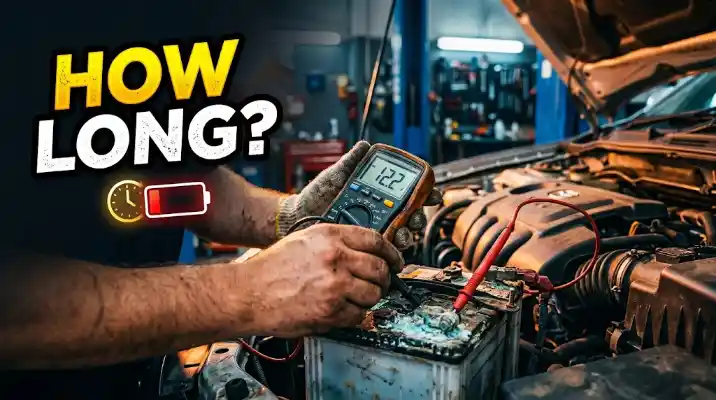
- Resting voltage, measured a few hours after charging, is about 12.6 volts or higher.
- The car starts normally and the battery passes a load test.
If the Battery Will Not Hold a Charge
If a battery reads full after charging but goes flat again within a day or two, or fails a load test, it has likely lost capacity from age, deep discharges or heat, and should be replaced. If a new or healthy battery keeps going flat, look for a charging system problem or a parasitic drain. Most auto parts stores will test the battery, alternator and starter for free. A healthy battery and charging system are part of basic upkeep covered in fueleconomy.gov’s maintenance tips.
Keep Your Battery Charged
- Use a maintainer on cars that sit for more than two or three weeks.
- Take at least one longer drive each week.
- Turn off lights and accessories before leaving the car.
- Keep terminals clean and tight.
- Test the battery yearly after three years.
Battery Charging FAQ
Turn the car off, connect the charger’s red clamp to the positive terminal and the black clamp to the negative terminal or a ground point, select the battery type and rate, then plug in and turn on the charger.
About 4 to 8 hours with a 10-amp charger for a flat battery, and 24 hours or more with a 1 to 2 amp maintainer. Partly discharged batteries charge faster.
Yes. Most modern smart chargers can safely charge a battery while it is still in the car. Follow your charger and vehicle manuals.
Only slowly. The alternator produces less charge at idle, so a 30-minute or longer drive helps more, and a flat battery should be recharged with a proper charger.
Connect red to positive first, then black to negative or ground. When finished, unplug the charger, then remove black first and red last.
Yes, with old unregulated chargers. Smart chargers prevent overcharging by switching to maintenance mode when the battery is full.
They need a charger with an AGM setting or profile so they are charged at the correct voltage.
Usually because it is old or damaged and has lost capacity. If the battery is healthy, a charging system problem or parasitic drain may be the cause.