How Often Should You Wash Your Car? (And the Safest Way to Do It)
How often should you wash your car? Here is the practical answer. Most cars should be washed about every two weeks. Wash more often, as often as weekly, if you drive on salted winter roads, live near the ocean, park under trees or pick up bird droppings, bugs or pollen. A garaged car that is rarely driven can go three to four weeks. The goal is simple: remove contaminants before they have time to etch the paint or start rust.
This guide shows how often to wash in different situations, which washing method is gentlest on your paint, what each option costs, and how to wash a car properly at home.
Key Takeaways
- Normal driving: wash every 2 weeks.
- Winter salt or coastal air: weekly, including the underside.
- Bird droppings, bugs or tree sap: remove within a day or two, even between washes.
- Gentlest methods: a careful two-bucket hand wash or a touchless automatic wash.
- Never use dish soap: it strips wax and dries out rubber seals. Use pH-neutral car shampoo.
How Often to Wash Your Car: Quick Guide
| Your situation | How often to wash | Why |
|---|---|---|
| Average commuter, parked outside | Every 2 weeks | Removes road film, dust and pollution before they bond to the paint |
| Winter with salted roads | Weekly, plus underbody rinse | Road salt speeds up rust on the body and underside |
| Near the ocean | Weekly | Salty air corrodes paint, chrome and metal parts |
| Parked under trees or near birds | Weekly, spot-clean daily | Sap and droppings are acidic and can etch clear coat |
| Summer bugs and pollen | Every 1–2 weeks | Bug residue becomes acidic in the heat; pollen clings when damp |
| Garaged, driven occasionally | Every 3–4 weeks | Little exposure to contaminants |
| Dirt roads, off-road or construction sites | After each dirty trip | Mud and grit trap moisture and hide damage |
| Ceramic-coated car | Every 2 weeks, gently | Coatings make washing easier but still need regular cleaning |
Why Washing Regularly Matters
- Protects the clear coat: bird droppings, bug splatter and tree sap are acidic. Left for days in the sun, they can etch permanent marks into the paint.
- Prevents rust: road salt and brine hold moisture against metal, especially under the car, around wheel arches and along rocker panels.
- Keeps you safe: clean windows, mirrors, lights and camera lenses improve visibility and help driver-assist sensors work.
- Protects resale value: a car with healthy paint and no rust looks newer and sells for more.
- Makes waxing and detailing easier: regular washing stops contamination from building up to the point that it needs heavy correction.
Signs Your Car Needs a Wash Now
- Bird droppings, bug residue or tree sap anywhere on the paint
- White salt film on the lower body after winter driving
- A gritty feel when you gently run a finger over the paint (wash first; never rub dry dirt)
- Dirty headlights, mirrors or camera lenses
- Water no longer beads on a waxed or coated surface
Car Wash Options Compared
| Method | Typical cost | Paint safety | Best for |
|---|---|---|---|
| Two-bucket hand wash at home | $1–$3 in supplies per wash | Best, if done correctly | Regular maintenance, dark or new paint |
| Touchless automatic wash | $10–$20 | Very good; stronger chemicals | Quick washes, winter salt removal |
| Soft-touch (soft cloth) automatic | $10–$25 | Good if well maintained; some swirl risk | Heavy grime when you are short on time |
| Self-serve wand bay | $5–$15 | Good if you skip the shared foam brush | Budget washing, rinsing off salt and mud |
| Hand wash service | $30–$60 | Very good at a reputable shop | Convenience with a gentle wash |
| Waterless or rinseless wash | $1–$2 per wash | Good for light dust only | Apartments, water restrictions, quick touch-ups |
Unlimited wash memberships at many automatic car washes cost around $20 to $40 a month and pay off if you wash more than twice a month, especially in winter.
Are Automatic Car Washes Bad for Your Paint?
Modern car washes are much gentler than the old stiff-bristle tunnels, but friction washes can still leave fine swirl marks over time, especially on dark paint, if the cloth is dirty or poorly maintained. Touchless washes avoid contact but rely on stronger detergents, which can wear down wax or sealant faster when used every week. A good compromise is to use touchless washes when you are busy or in winter, and hand wash when you can.
Avoid the foam brush at self-serve bays for the paint. Other drivers use it on muddy wheels and tires, and it can drag grit across your clear coat.
How to Wash Your Car at Home (Two-Bucket Method)
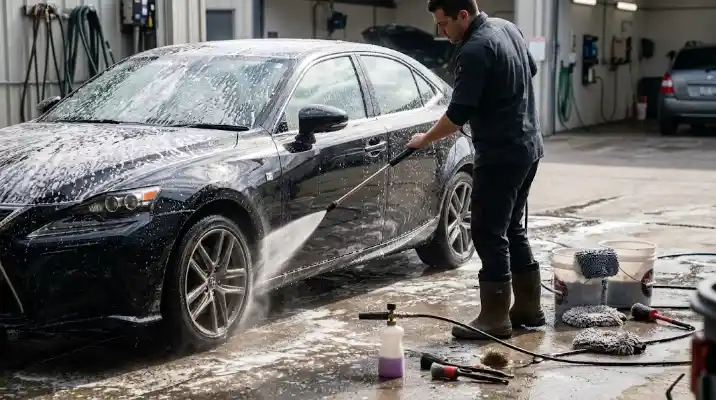
A careful hand wash is the gentlest way to clean your car. You need two buckets, ideally with grit guards, pH-neutral car shampoo, a microfiber or lambswool wash mitt, a separate wheel brush and soft microfiber drying towels.
- Work in the shade on cool paint. Sun and hot panels dry soap and water too fast and leave spots.
- Clean the wheels and tires first with a separate brush and bucket so brake dust does not get into your wash water.
- Rinse the whole car from top to bottom to remove loose dirt.
- Fill two buckets: one with soapy water and one with plain rinse water.
- Wash from the top down in straight lines, one panel at a time. Leave the dirtiest lower panels for last.
- Rinse the mitt in the plain bucket before reloading it with soap. This keeps grit out of your wash water.
- Rinse thoroughly, including door jambs, mirrors and under the bumpers.
- Dry with clean microfiber towels by blotting or gently dragging, or use a blower, to avoid water spots.
Can You Use Dish Soap to Wash a Car?
It is best not to. Dish soap is designed to strip grease. On a car it strips the protective wax or sealant, can dry out rubber and plastic trim, and leaves the paint more exposed to UV and contamination. A bottle of pH-neutral car shampoo costs little and lasts for many washes.
Washing in Winter
Winter is when regular washing matters most in snowy states. Road salt and liquid brine cling to the underside, brake lines, suspension parts and wheel wells, where rust starts unseen. Use a car wash with an underbody spray, or rinse under the car with a hose, at least once a week during salt season and after every big storm.
- Wash on days when the temperature is above freezing, ideally in the afternoon, so the car can dry.
- Dry door jambs and rubber seals, and open and close the doors after washing so they do not freeze shut.
- Avoid spraying cold water directly into door locks and around seals.
Can You Wash Your Car Too Often?
Washing itself does not harm paint. Poor technique does. Using dirty mitts, rough towels, a single bucket, dish soap or friction washes with dirty cloths every day will slowly add swirl marks. With a gentle method and good products you can wash as often as your car needs, even weekly.
How Often to Wax and Clean the Interior
- Wax: about every 2–3 months for traditional carnauba wax; synthetic sealants last about 4–6 months. AAA suggests waxing two to four times a year.
- Ceramic coating: no regular waxing needed, but top it up with a coating-safe spray every few months.
- Interior: vacuum and wipe high-touch surfaces every 2 weeks, and do a deeper interior clean every 3–6 months.
- Full detail: every 4–6 months for most drivers.
Special Cases
- New cars: the paint is fully cured from the factory, so you can wash and wax a new car right away.
- Matte paint and matte wraps: use matte-specific shampoo, never wax or polish, and avoid friction washes.
- Vinyl wraps: hand wash or touchless only, and keep pressure washers away from edges.
- Convertibles: hand wash and use a soft-top cleaner and protectant on fabric roofs.
- Electric vehicles: wash like any other car, but check the owner’s manual for car wash mode, which keeps the car from rolling or locking during an automatic wash.
Is It Legal to Wash Your Car in the Driveway?
In most places, yes, but some cities and counties restrict runoff of soapy water into storm drains, and many areas limit hose use during droughts. Washing on your lawn, using biodegradable car shampoo, or choosing a commercial car wash, many of which treat or recycle their water, are more environmentally friendly options. Check your local water rules if you are unsure.
For more ways to keep your car looking new, see our car care and cleaning guides.
Car Washing FAQ
For most drivers, about every two weeks. Wash weekly if you face road salt, coastal air, bird droppings, tree sap or heavy bugs, and every three to four weeks if the car is garaged and rarely driven.
No. Weekly washing is fine and even recommended in winter or near the ocean, as long as you use a gentle method and pH-neutral car shampoo.
A careful two-bucket hand wash with a clean microfiber mitt is the gentlest method. Touchless automatic washes are a good second choice because nothing touches the paint.
Yes, touchless washes are generally safe because nothing rubs the paint, but they use stronger detergents that can wear down wax or sealant faster if used very often.
At least once a week during road-salt season, and after snowstorms, with an underbody rinse to remove salt from the frame, brake lines and suspension.
It is not recommended. Dish soap strips wax and sealant and can dry out rubber seals and trim. Use a pH-neutral car wash shampoo instead.
Remove them as soon as possible, ideally within a day. In hot sun they can etch the clear coat in a short time and leave permanent marks.
About every two to three months for traditional wax and every four to six months for synthetic sealants. AAA recommends waxing two to four times a year.