Level 1 vs Level 2 vs Level 3 EV Charging Explained
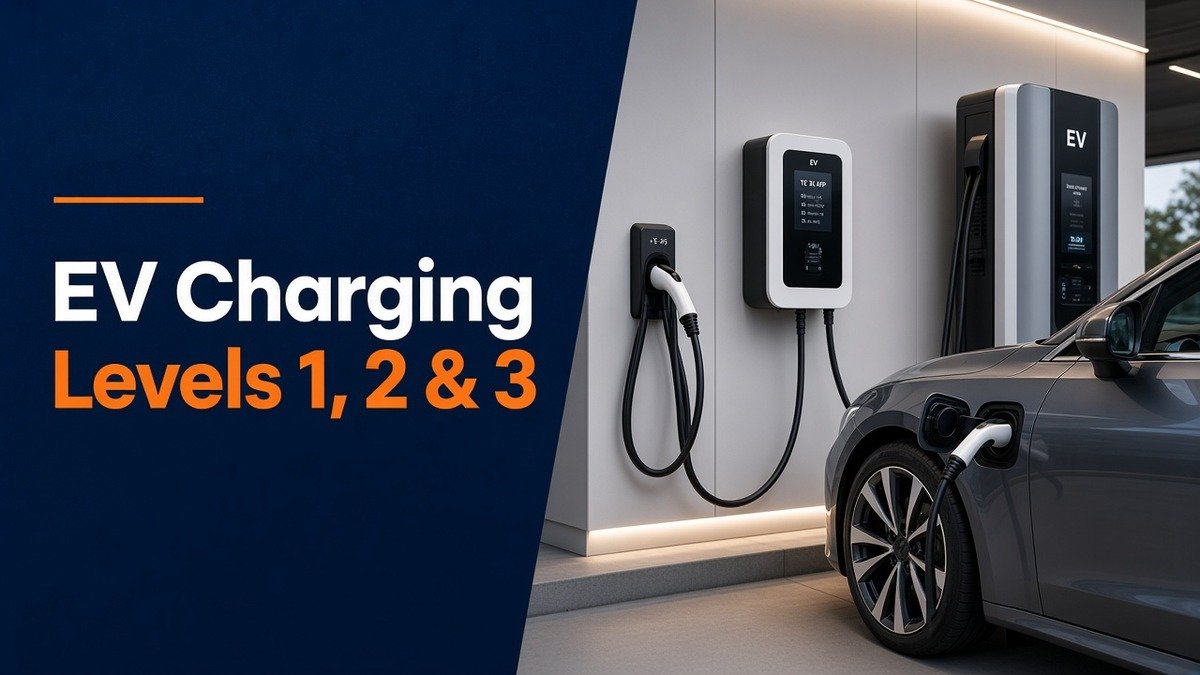
There are three levels of EV charging. Level 1 uses a standard 120-volt household outlet and adds only about 3 to 5 miles of range per hour. Level 2 uses a 240-volt circuit, like a dryer outlet, and typically adds about 20 to 40 miles of range per hour, enough to fully charge most EVs overnight. Level 3, more accurately called DC fast charging, uses high-power public stations from about 50 kW to 350 kW and can take many EVs from about 10% to 80% in roughly 20 to 45 minutes. Most owners charge at home on Level 2 and use DC fast charging on road trips.
EV Charging Levels Compared
| Feature | Level 1 | Level 2 | Level 3 (DC Fast Charging) |
|---|---|---|---|
| Voltage | 120V AC | 208–240V AC | 400–1,000V DC |
| Typical power | 1.4–1.9 kW | 6–19.2 kW | 50–350 kW |
| Range added per hour | About 3–5 miles | About 20–40 miles | Up to hundreds of miles per hour; 10%–80% in ~20–45 min |
| Full charge time (typical EV) | 2–4+ days | 6–12 hours | Not for 100%; charging slows above ~80% |
| Where | Any standard outlet | Homes, workplaces, hotels, public lots | Highway corridors, travel centers, retail hubs |
| Cost to install at home | Usually $0 | About $1,000–$2,500 total | Not installed at homes |
| Best for | Plug-in hybrids, low daily mileage, backup | Daily charging for most EVs | Road trips and quick top-ups |
Charging times depend on battery size, state of charge, temperature and the car’s maximum charging rate. Your car will only charge as fast as the lower of the charger’s output and the vehicle’s own limit.
Level 1 Charging
Level 1 is the simplest option: plug the car’s portable charging cord into a regular household outlet. It is slow but free to set up.
- Pros: no installation, works almost anywhere, fine for plug-in hybrids and short commutes.
- Cons: very slow; may not keep up with daily driving over about 30–40 miles, especially in winter.
- Tip: use a dedicated outlet in good condition, not an extension cord.
Level 2 Charging
Level 2 is the sweet spot for home charging. It requires a 240-volt circuit and either a hardwired wall unit or a plug-in charger on a 240V outlet (such as a NEMA 14-50).
- Speed: a 48-amp charger (about 11.5 kW) adds roughly 30–40 miles per hour on many EVs; a 32-amp charger (about 7.7 kW) adds about 20–30.
- Cost: chargers often cost about $300 to $800; installation commonly adds $500 to $1,500 or more depending on distance to the electrical panel and local labor.
- Panel upgrades: older homes may need a panel upgrade, which can add $1,500 to $4,000 or more.
- Incentives: many utilities offer rebates or special off-peak EV rates.
If you are planning a garage installation, our guide on 2-car garage dimensions can help you plan space for a charger and cable reach.
Level 3 / DC Fast Charging
“Level 3” is a common name for DC fast charging, which sends direct current straight to the battery, bypassing the car’s onboard charger. Power ranges from about 50 kW at older stations to 350 kW at the newest.
- Speed: many EVs can go from about 10% to 80% in roughly 20 to 45 minutes.
- Charging curve: charging slows significantly above about 80% to protect the battery, so it is usually faster to stop at 80% and move on.
- Cost: more expensive per kWh than home charging; some networks charge per minute or offer memberships.
- Networks: Tesla Supercharger (now open to many non-Tesla EVs), Electrify America, EVgo, ChargePoint, IONNA and others.
- Battery health: occasional fast charging is fine; relying on it daily may speed up battery wear slightly.
Charging Connectors Explained
| Connector | Used For | Common On |
|---|---|---|
| NACS (SAE J3400) | Level 1, Level 2 and DC fast charging | Tesla and a growing number of 2025–2026 EVs from other brands |
| J1772 | Level 1 and Level 2 | Most non-Tesla EVs built before the switch to NACS |
| CCS1 | DC fast charging (combines J1772 with DC pins) | Most non-Tesla EVs built before the switch to NACS |
| CHAdeMO | DC fast charging | Older Nissan Leaf and a few older models; being phased out |
Adapters let many EVs use other plug types. Check your automaker’s guidance for approved adapters.
Which Charging Level Do You Need?
- Plug-in hybrid or very low daily mileage: Level 1 may be enough.
- Most EV owners with a driveway or garage: Level 2 at home.
- No home charging: rely on workplace Level 2 and nearby DC fast chargers.
- Frequent road trips: choose an EV with fast DC charging speeds and good access to reliable networks.
For detailed charge times by vehicle and battery size, see our guide on how long it takes to charge an electric car. To compare the cost of home charging versus public fast charging, try our EV charging cost calculator.
What Does Charging Cost?
Home charging costs your local electricity rate, often much less per mile than gasoline, especially on off-peak rates. Public Level 2 is sometimes free or low cost at workplaces, hotels and shopping centers. DC fast charging typically costs the most per kWh. Lower fuel costs, together with reduced maintenance described in do electric cars need oil changes, are a major reason EVs can be cheaper to run.
Electrical safety: Have a licensed electrician install Level 2 equipment and pull any required permits. Use chargers certified by a recognized testing lab (such as UL or ETL), never use ordinary extension cords for EV charging, and stop using any outlet or plug that feels hot.
Related guides: How long does it take to charge an EV? · EV charging cost calculator · Do electric cars need oil changes?
EV Charging Level FAQs
It can be for plug-in hybrids or drivers who travel fewer than about 30 to 40 miles per day, but most EV owners prefer Level 2 at home.
No. DC fast chargers require high-power commercial electrical service and cost tens of thousands of dollars, so they are not practical for homes.
The car reduces charging power as the battery fills to protect it from heat and stress, so the last 20% takes much longer.
Tesla and many newer EVs use NACS. Many older non-Tesla EVs use J1772 for Level 1 and 2 charging and CCS for DC fast charging. Adapters are available for many combinations.