
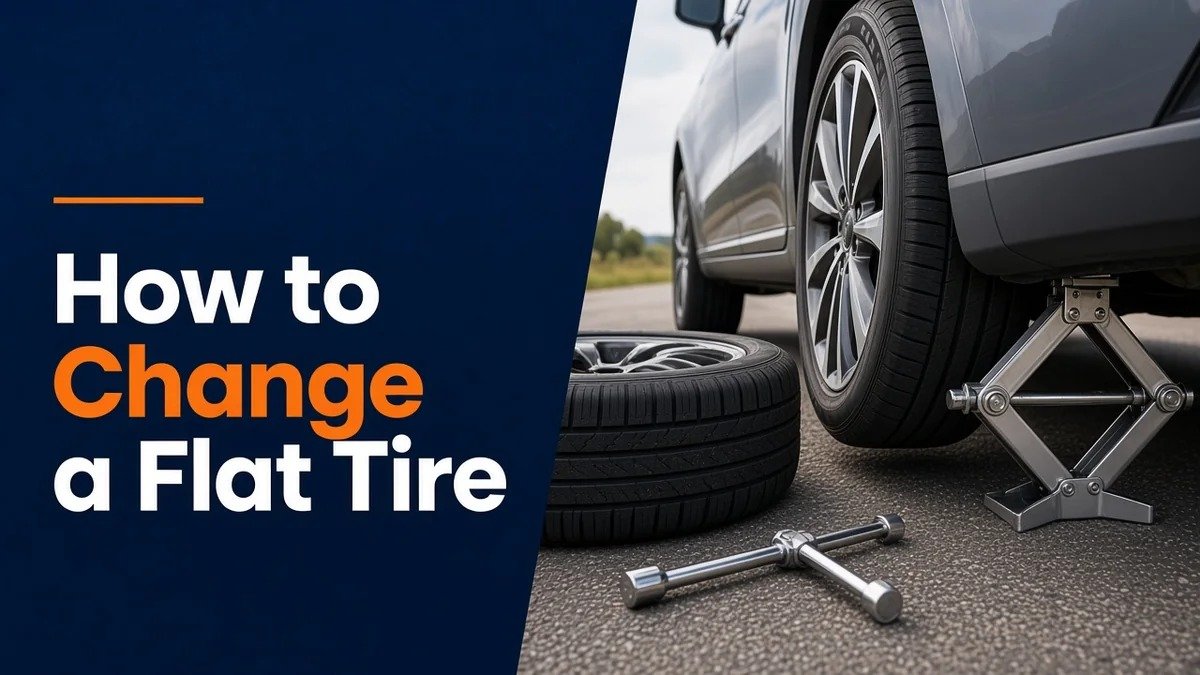
How to Change a Flat Tire: Step-by-Step Guide
To change a flat tire, park on flat ground away from traffic, turn on your hazard lights and set the parking brake. Loosen the lug nuts slightly while the tire is still on the ground, jack the car up at the correct lift point, remove the lug nuts and the flat, mount the spare, and hand-tighten the nuts. Lower the car and tighten the lug nuts fully in a star pattern. The whole job usually takes 15 to 30 minutes. Afterward, check the spare’s pressure and get the flat repaired or replaced soon.
What You Need to Change a Tire
- Spare tire (inflated), often under the trunk floor or beneath the rear of SUVs and trucks
- Jack (scissor or bottle jack)
- Lug wrench
- Wheel lock key if your wheels have locking lug nuts
- Owner’s manual (shows jack points and spare location)
- Wheel chocks or a brick or block of wood
- Flashlight, gloves and a reflective vest or triangles if available
- Tire pressure gauge
Check that these items are in your car before you need them. Some newer cars have no spare at all and include only a tire inflator and sealant kit.
How to Change a Flat Tire: Step by Step
1. Get to a Safe Spot
Slow down and pull as far off the road as possible onto level, solid ground. Avoid soft shoulders, hills and curves. On a highway, try to reach an exit or a wide shoulder. Turn on your hazard lights. If you are on a busy highway with little room, stay in the car with your seatbelt on and call for roadside assistance instead.
2. Secure the Car
Put the car in Park (or in first gear or reverse for a manual), set the parking brake and turn off the engine. Have passengers get out and wait in a safe place away from traffic. Place wheel chocks against the tire diagonally opposite the flat one.
3. Remove the Hubcap or Wheel Cover
If your car has a hubcap, pry it off with the flat end of the lug wrench. Some wheel covers are held on by the lug nuts and come off after they are removed.
4. Loosen the Lug Nuts
With the tire still on the ground, turn each lug nut counterclockwise about a half turn using the lug wrench. Do not remove them yet. If they are tight, position the wrench horizontally and push down with your foot, keeping your balance.
5. Position the Jack
Find the correct jack point in your owner’s manual, usually a reinforced pinch weld or frame area just behind the front wheel or ahead of the rear wheel. Placing the jack in the wrong spot can damage the car or let it slip.
6. Raise the Car
Raise the car until the flat tire is about 6 inches off the ground, enough to fit the inflated spare. Never put any part of your body under the car while it is on the jack.
7. Remove the Lug Nuts and the Flat Tire
Unscrew the lug nuts completely and keep them together, such as in the hubcap. Grip the tire by the treads and pull it straight toward you. Lay it flat so it cannot roll away.
8. Mount the Spare
Line up the spare’s holes with the wheel studs and push it onto the hub until it sits flush.
9. Hand-Tighten the Lug Nuts
Thread the lug nuts on by hand, beveled side toward the wheel, then snug them with the wrench in a star pattern. Do not fully tighten yet.
10. Lower the Car and Tighten Fully
Lower the car until the spare touches the ground and supports some weight, then tighten the lug nuts as firmly as you can in a star pattern. Lower the jack completely and give each nut a final tightening.
11. Replace the Hubcap and Stow Everything
Hubcaps usually do not fit temporary spares. Put the flat tire, jack and tools back in the car.
12. Check the Spare’s Pressure
Spares often lose air over time. Compact spares frequently require about 60 psi; check the label on the spare or the placard in the door jamb.
Lug Nut Star Pattern
| Number of Lug Nuts | Tightening Order |
|---|---|
| 4 | 1 → 3 → 2 → 4 (crisscross) |
| 5 | 1 → 3 → 5 → 2 → 4 (star) |
| 6 | 1 → 4 → 5 → 2 → 3 → 6 (crisscross) |
| 8 | Tighten opposite pairs, working around the wheel |
Tightening in a star pattern seats the wheel evenly and helps prevent warped rotors and loose wheels. A tire shop can torque the nuts to the exact specification when you get the flat repaired.
How Long Can You Drive on a Spare?
Most compact temporary spares are rated for about 50 mph and roughly 50 to 70 miles total. Full-size spares that match your other tires can be driven normally. Head to a tire shop as soon as possible to repair or replace the flat.
Can the Flat Tire Be Repaired?
- Usually repairable: punctures up to about 1/4 inch in the tread area from nails or screws.
- Not repairable: sidewall damage, large cuts, punctures near the shoulder, or a tire driven on while flat for a long distance.
- Typical cost: a plug-patch repair often costs about $20 to $50.
If the tire is worn or old, replacing it may be the better choice. Our guide on how long tires last explains when tires are due, and our tire size calculator helps you match the replacement.
What If You Cannot Change the Tire?
- Roadside assistance: through your insurer, automaker, credit card or a motor club.
- Tire sealant and inflator kit: seals small tread punctures temporarily.
- Run-flat tires: let you drive about 50 miles at up to 50 mph on many vehicles.
- Towing: if the wheel is damaged, lug nuts are seized or it is unsafe to work.
Our guide to how much it costs to tow a car shows typical towing prices.
How to Prevent Flat Tires
- Check tire pressure monthly and before long trips
- Inspect tread depth and look for nails, cuts and bulges
- Rotate tires every 5,000 to 7,500 miles
- Avoid potholes, curbs and road debris when possible
- Replace tires when tread is worn or they are aging
- Pay attention to the tire pressure warning light
The tire pressure light is one of the most common dashboard warnings. See our dashboard symbols guide for what it looks like.
Safety note: Never get under a vehicle supported only by a jack, and never change a tire on the traffic side of a busy road. If you feel unsafe, stay in your car with your seatbelt fastened and hazard lights on, and call for roadside assistance or 911.
Related guides: How long do tires last? · Towing cost guide · Tire size calculator
Changing a Tire FAQs
Park safely, set the parking brake, loosen the lug nuts, jack up the car, remove the lug nuts and flat, mount the spare, hand-tighten the nuts, lower the car and fully tighten the nuts in a star pattern.
Tighten them firmly with the lug wrench in a star pattern, then have them torqued to the manufacturer’s specification at a tire shop and rechecked after about 50 miles.
Most compact spares are limited to about 50 mph. Full-size matching spares can be driven normally.
Use the tire sealant and inflator kit if the puncture is small, or call roadside assistance for a tow or mobile tire service.