DOT 3 vs DOT 4 vs DOT 5 Brake Fluid
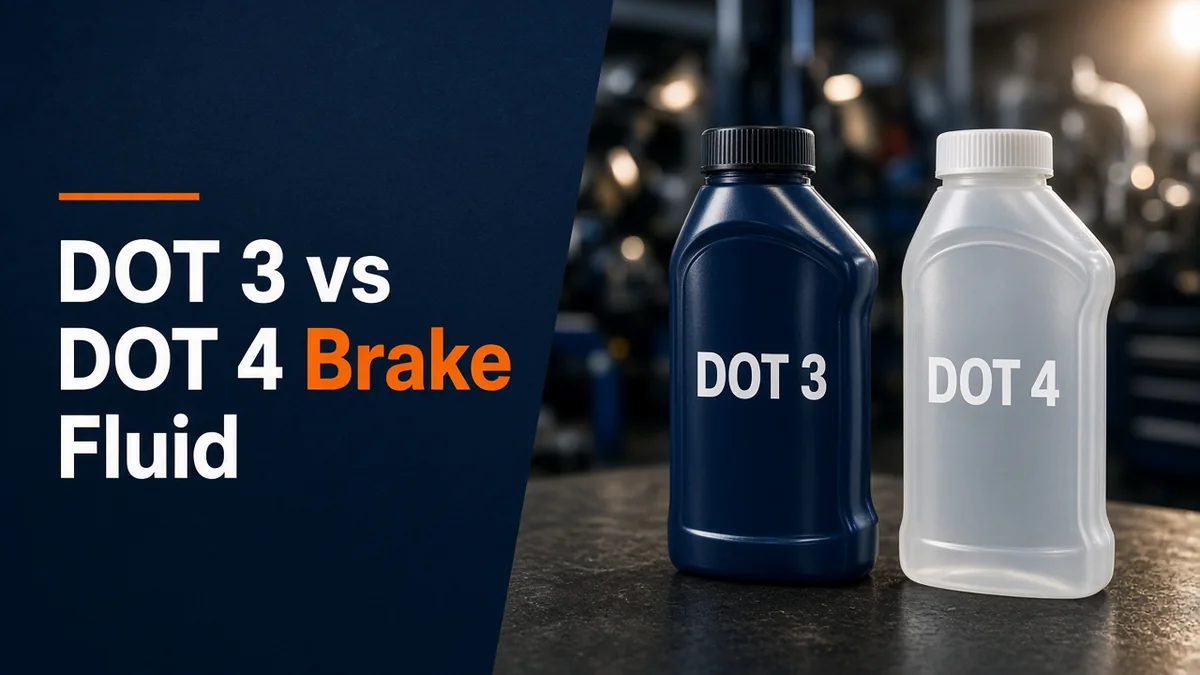
The main difference between DOT 3, DOT 4 and DOT 5.1 brake fluid is boiling point: under the federal standard, DOT 3 must boil no lower than 401°F when fresh, DOT 4 no lower than 446°F, and DOT 5.1 no lower than 500°F. All three are glycol-based and can be mixed, and DOT 4 or 5.1 can generally be used where DOT 3 is specified. DOT 5 is different: it is silicone-based, does not mix with the others and should only be used in systems designed for it. Always use the DOT type printed on your brake fluid reservoir cap.
What Brake Fluid Does
Brake fluid is the hydraulic link between your foot and the brakes. When you press the pedal, the master cylinder pushes fluid through the brake lines to the calipers and wheel cylinders, which clamp the pads and shoes against the rotors and drums. Because liquid does not compress, almost all of your pedal force reaches the wheels. Brake fluid also has to resist boiling, since braking turns motion into heat, stay fluid in freezing weather, and protect metal parts from corrosion.
Glycol-based fluids (DOT 3, DOT 4 and DOT 5.1) are hygroscopic, meaning they absorb moisture from the air over time. That water lowers the boiling point, which is why brake fluid needs periodic replacement even if the level looks fine.
Brake Fluid Types Compared
| DOT 3 | DOT 4 | DOT 5.1 | DOT 5 | |
|---|---|---|---|---|
| Base | Glycol ether | Glycol ether with borate esters | Glycol ether with borate esters | Silicone |
| Minimum dry boiling point | 401°F (205°C) | 446°F (230°C) | 500°F (260°C) | 500°F (260°C) |
| Minimum wet boiling point | 284°F (140°C) | 311°F (155°C) | 356°F (180°C) | 356°F (180°C) |
| Absorbs water | Yes | Yes | Yes | No |
| Mixes with DOT 3/4/5.1 | Yes | Yes | Yes | No |
| Typical use | Many older and some current cars | Most modern and European cars | Performance and some modern cars | Some classic and military vehicles; not for most ABS cars |
| Damages paint | Yes | Yes | Yes | Less so |
Boiling points are the minimums set by the US federal standard (FMVSS 116); many fluids exceed them. “Wet” boiling point is measured after the fluid has absorbed a set amount of water, which reflects fluid that has been in a car for a while.
Why Boiling Point Matters
Braking turns motion into heat, and that heat travels into the calipers and fluid. If the fluid boils, it forms vapor bubbles, which compress when you press the pedal. The result is a soft pedal and reduced braking, called vapor lock or brake fade. Glycol-based fluids absorb moisture over time, which steadily lowers the boiling point, so old fluid is more likely to boil. That is why brake fluid needs replacing every few years.
Can You Mix DOT 3 and DOT 4?
Yes. DOT 3, DOT 4 and DOT 5.1 are all glycol-based and chemically compatible, so topping up one with another will not damage the system. Mixing lowers the boiling point of the higher-rated fluid toward the lower one, so a full flush with a single type gives the best performance.
Can You Use DOT 4 Instead of DOT 3?
In most cases, yes. DOT 4 exceeds the DOT 3 requirements and is often used as an upgrade. Going the other way, putting DOT 3 in a system that specifies DOT 4, is not recommended, because it lowers the boiling point below what the brakes were designed for. Some DOT 4 formulations absorb moisture a little faster, so follow your replacement interval.
What Makes DOT 5 Different
DOT 5 is silicone-based. It does not absorb water, does not damage paint as readily and is usually dyed purple. The downsides are significant for most cars: it does not mix with glycol fluids, any water that gets in pools rather than dispersing, it can aerate and feel spongier, and it is generally not recommended for ABS systems. Never put DOT 5 in a system that uses DOT 3, 4 or 5.1, and never add glycol fluid to a DOT 5 system. Converting requires a complete clean-out.
Never use the wrong fluid: engine oil, power steering fluid, transmission fluid or DOT 5 in a glycol system can swell and destroy rubber seals and lead to brake failure. If the wrong fluid goes in, do not drive the car; the system must be flushed and seals may need replacing.
DOT 5.1: Not the Same as DOT 5
Despite the similar name, DOT 5.1 is a glycol-based fluid like DOT 3 and 4, with a boiling point close to DOT 5. It can be mixed with DOT 3 and 4 and is used in some performance and modern vehicles. Always check the label: DOT 5 and DOT 5.1 are not interchangeable.
Which Vehicles Typically Use DOT 3 vs DOT 4?
| Fluid | Commonly Specified For |
|---|---|
| DOT 3 | Many older domestic and Asian vehicles, some current economy cars and trucks |
| DOT 4 | Most European vehicles and many newer cars with ABS, stability control and electronic brake systems |
| DOT 4 low-viscosity (often labeled LV or Class 6) | Many newer vehicles whose ABS and stability systems require fast-flowing fluid in cold weather |
| DOT 5.1 | Some performance vehicles, motorcycles and heavy-duty applications |
| DOT 5 (silicone) | Some classic cars, show cars and military vehicles without ABS |
The specification on your reservoir cap or in the owner’s manual always takes priority. If your car calls for a low-viscosity DOT 4, a standard DOT 4 may flow too slowly for the ABS in very cold conditions.
DOT 3 vs DOT 4: Cost and Maintenance
| Factor | DOT 3 | DOT 4 |
|---|---|---|
| Typical price per 12 oz bottle | About $5–$12 | About $8–$20 |
| Typical replacement interval | About every 2–3 years (check manual) | About every 2 years, as it absorbs moisture faster |
| Heat resistance | Good for normal driving | Better for towing, mountains, performance |
| Upgrade potential | Can often be replaced with DOT 4 | Should not be replaced with DOT 3 |
How to Tell Which Brake Fluid Your Car Uses
- Look at the brake fluid reservoir cap, which usually says DOT 3 or DOT 4.
- Check the owner’s manual under fluids and capacities.
- Ask a dealer parts counter with your VIN.
Our guide to checking car fluids shows where the brake fluid reservoir is and how to read the level.
How Often to Replace Brake Fluid
Most manufacturers recommend replacing glycol brake fluid every two to three years, regardless of type, because it absorbs moisture. Signs it is due include dark amber or brown color and a softer pedal. Our car maintenance schedule by mileage shows where the brake fluid change typically falls, and moisture in the fluid also contributes to internal corrosion of lines, a problem that is worse in salty climates, as our guide to preventing rust explains.
Storing and Handling Brake Fluid
- Buy small, sealed bottles and use them soon after opening
- Keep the cap on tightly; opened fluid absorbs moisture from the air
- Wipe up spills immediately, since glycol fluid damages paint
- Dispose of old fluid at a recycling center, not down a drain
Related guides: car inspection, dashboard symbols and meanings and car noises explained.
Brake Fluid Types FAQ
Not for most cars. DOT 5 is silicone-based, does not mix with DOT 4 and is generally not recommended for ABS systems. Use it only where specified.
DOT 4 has higher dry and wet boiling points, so it handles heat better. It absorbs moisture a bit faster, so it may need changing more often. Use the type your manufacturer specifies.
DOT 4 LV is a low-viscosity DOT 4 fluid that flows faster in cold temperatures. Many newer cars with ABS and stability control specify it.