Can You Sell a Car Without a Title? (Title Transfer Guide)
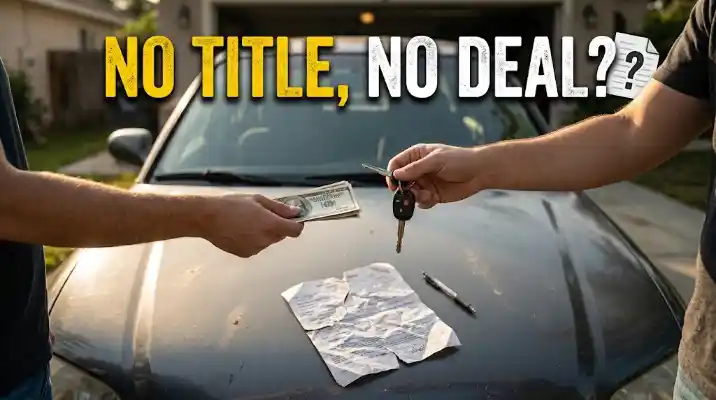
Can you sell a car without a title? Usually not legally, but it is easy to fix. In most states you cannot legally sell a car to a private buyer without the title, because the title proves you own it and lets the buyer register it. If yours is lost or damaged, the fix is usually simple: apply for a duplicate title at your state DMV for a small fee. If a lender holds the title because you still have a loan, the loan must be paid off at or before the sale. For older or junk vehicles, some states and licensed salvage buyers accept other paperwork.
This guide covers your options when the title is missing, how to fill out a title correctly when you sell, what the buyer needs to transfer it, and what branded titles such as salvage and rebuilt mean.
Key Takeaways
- Lost title? Apply for a duplicate at the DMV; fees are usually modest.
- Loan on the car? The lender holds the title; the payoff releases it to you or the buyer.
- Fill it out carefully: errors, cross-outs or correction fluid can void a title.
- Protect yourself after the sale: file a notice of sale or release of liability and keep a bill of sale.
- Branded titles (salvage, rebuilt, flood) must be disclosed and lower the car’s value.
Can You Sell a Car Without a Title?
| Situation | Your options |
|---|---|
| Title lost, stolen or damaged | Apply for a duplicate title before selling; many states allow online or mail applications |
| You still owe money on the car | Pay off the loan, or complete the sale at the lender or a dealer so the payoff releases the title |
| Title never transferred into your name | Get the previous owner to sign it properly, or use your state’s process for proving ownership |
| Old vehicle past a certain age | Some states exempt older vehicles from titling and allow a bill of sale plus registration |
| No title can be obtained | Some states offer a bonded title backed by a surety bond, or a court-ordered title |
| Junk or scrap car | Licensed junkyards and salvage buyers may accept a registration and ID in some states, often for older cars only |
Rules vary widely by state, so check your DMV’s website before advertising the car. Be cautious of buyers who offer to take a car “no title needed”; a legitimate buyer needs a clear title to register the vehicle.
How to Get a Duplicate Title
- Find your state’s duplicate or replacement title application on the DMV website.
- Provide your ID, the VIN, the license plate number and proof of ownership such as registration.
- If there was a loan, include a lien release letter from the lender if the lien has been paid off.
- Pay the fee, often somewhere around $5 to $50 depending on the state.
- Wait for the title by mail, or get it the same day at some offices.
How to Fill Out a Title When Selling a Car
- Use the correct section: sign where the title says “seller” or “transferor,” exactly as your name appears on the front. If two owners are joined by “and,” both usually must sign.
- Enter the buyer’s name and address if your state requires the seller to do so.
- Write the sale date and price if the title has spaces for them.
- Record the odometer reading accurately. Federal law requires an odometer disclosure for most vehicles from model year 2011 and newer, until they are 20 years old.
- Do not use correction fluid or cross out mistakes: an altered title may be rejected and you may need a new one.
- Notarize if required: some states require notarized signatures.
Look at the back of your title and your state’s DMV instructions before signing anything; a mistake is easy to make and slow to fix.
Paperwork to Complete When Selling Privately
- Signed title handed to the buyer after you receive payment.
- Bill of sale with the date, price, VIN, make, model and both parties’ names and signatures. Some states require their own form.
- Notice of sale or release of liability filed with your DMV, so you are not responsible for tickets, tolls or accidents after the sale.
- License plates: in many states plates stay with the seller; check your state’s rules.
- Cancel insurance and toll tags only after the sale is complete.
What the Buyer Needs to Transfer the Title
- The signed title and bill of sale
- Proof of insurance
- A photo ID
- Payment for title, registration and any sales tax
- A state title application form, and in some states a VIN inspection or emissions test
Most states give buyers a limited time, often 10 to 30 days, to transfer the title, with late fees afterward.
Examples of state forms: in Texas, buyers typically use Form 130-U to apply for title, and sellers can file a Vehicle Transfer Notification (VTR-346). In Florida, buyers use form HSMV 82040 and sellers can file a Notice of Sale (HSMV 82050). Forms change over time, so download the current versions from your state’s official DMV or motor vehicle website.
Selling a Car You Still Owe Money On
When there is a lien, the lender usually holds the title. Ask your lender for the exact payoff amount. The simplest approach is to complete the sale at your lender’s branch, where the buyer pays, the lender is paid off and the title is released. Alternatively, you pay off the loan first and wait for the title. If you sell to a dealer, the dealer handles the payoff.
What Do Branded Titles Mean?
| Title brand | What it means |
|---|---|
| Clean | No major damage history recorded on the title |
| Salvage | Declared a total loss, usually by an insurer; generally cannot be driven on public roads until repaired and inspected |
| Rebuilt or reconstructed | A former salvage vehicle that was repaired and passed a state inspection; can be registered and driven |
| Flood | Significant water damage recorded |
| Lemon or manufacturer buyback | Returned to the manufacturer under lemon law |
| Not actual mileage / odometer brand | The odometer reading is known to be inaccurate |
| Junk or non-repairable | Can only be dismantled for parts or scrap |
Branded titles must be disclosed and usually cut a car’s value substantially, and some insurers limit coverage on them. Buyers can check a title’s history through the National Motor Vehicle Title Information System (NMVTIS) and vehicle history reports.
Common Title Mistakes to Avoid
- Handing over a signed title before you have been paid in full
- Leaving the buyer section blank (“open title”), which is illegal in many states
- Using correction fluid or crossing out errors
- Forgetting to file a notice of sale or release of liability
- Not removing your plates where your state requires it
Car Title FAQ
In most states you need the title to sell to a private buyer. If it is lost, apply for a duplicate title. Some states allow older or junk vehicles to be sold with other paperwork, and some offer bonded titles.
Apply for a duplicate title at your state DMV with your ID, VIN and proof of ownership, pay the fee, and sell once the new title arrives.
Yes. Pay off the loan or complete the sale at your lender so the payoff releases the title to the buyer. Dealers can also handle the payoff when you sell or trade in.
Sign and print your name in the seller section exactly as it appears on the title, enter the odometer reading and, where required, the buyer’s name, sale date and price. Do not use correction fluid.
A salvage title means the car was declared a total loss, usually by an insurer. It generally cannot be driven on public roads until it is repaired and passes a state inspection.
A rebuilt title is given to a former salvage vehicle that has been repaired and passed a state inspection. It can be registered and driven, but it usually lowers the car’s value.
It varies by state, often about 10 to 30 days after the sale. Late fees may apply after the deadline.
It is strongly recommended and required in some states. It records the price, date and VIN and protects both buyer and seller.