How to Buy a Used Car: Step-by-Step Checklist and Red Flags
Here is how to buy a used car without overpaying or inheriting someone else’s problems. To buy a used car safely: set an all-in budget, get pre-approved for a loan, research reliable models, check the vehicle history and recalls, inspect and test-drive the car, and pay an independent mechanic for a pre-purchase inspection before you negotiate and sign. The inspection and history report catch most expensive surprises, and a seller who refuses either is a red flag you should not ignore.
Use this step-by-step guide and checklist whether you are buying from a dealer or a private seller, and learn when a certified pre-owned car is worth the extra cost.
Key Takeaways
- Budget for the total cost: price, tax, title, registration, insurance and early repairs.
- Get pre-approved by a bank or credit union so you know your rate before the dealer’s finance office.
- Always check a vehicle history report and open recalls using the VIN.
- Never skip the pre-purchase inspection (about $100–$250).
- Red flags: salvage or rebuilt title, flood signs, mismatched VINs, warning lights and pressure to decide fast.
Step 1: Set Your Budget
Decide what you can afford for the whole cost of ownership, not just the price. Add sales tax, title and registration fees, insurance (get quotes on the models you are considering), and a cushion of several hundred dollars for tires, brakes or maintenance the car may need soon. A common guideline is to keep total car costs, including the payment and insurance, to a manageable share of your monthly income.
Step 2: Arrange Financing First
If you are borrowing, get pre-approved by a bank or credit union before you shop. You will know your rate and maximum loan, and you can compare it with any dealer financing. Used-car loans usually carry higher rates than new-car loans, and shorter terms cost less in interest.
Step 3: Choose the Right Models
- Pick two or three models that fit your needs: size, fuel economy, cargo space and safety features.
- Check reliability ratings and common problems for the exact model years you are considering.
- Look up crash-test ratings from NHTSA and IIHS.
- Compare typical prices using online pricing guides for the year, mileage, trim and condition.
Step 4: Decide Where to Buy
| Private seller | Used-car dealer | Certified pre-owned (CPO) | |
|---|---|---|---|
| Price | Usually lowest | Higher | Highest |
| Warranty | None, sold as-is | Sometimes a limited dealer warranty; often as-is | Manufacturer-backed extended warranty |
| Inspection | You arrange it | Varies | Multi-point inspection by the manufacturer’s standards |
| Paperwork | You handle title transfer and registration | Dealer handles it | Dealer handles it |
| Protection | Least | FTC Buyers Guide must be displayed | Most |
Certified pre-owned cars are usually a few years old, have passed a detailed inspection and add warranty coverage from the manufacturer. They cost more than comparable non-certified cars, so the extra warranty is the main thing you pay for. Manufacturer-certified programs are generally stronger than dealer-only “certified” labels.
Step 5: Check the Car’s History
- Vehicle history report: use the VIN to get a Carfax or AutoCheck report showing accidents, title brands, odometer readings and service records.
- NMVTIS: the federal National Motor Vehicle Title Information System checks title brands such as salvage, flood or junk.
- Open recalls: enter the VIN at NHTSA.gov/recalls. Recall repairs are free at a dealer.
- Service records: ask for maintenance receipts.
- Match the VIN: it should be identical on the dashboard, driver’s door jamb, title and history report.
Step 6: Inspect the Car Yourself
| Area | What to check |
|---|---|
| Body and paint | Mismatched paint, uneven panel gaps, overspray, dents and rust, especially on wheel arches, rocker panels and underneath |
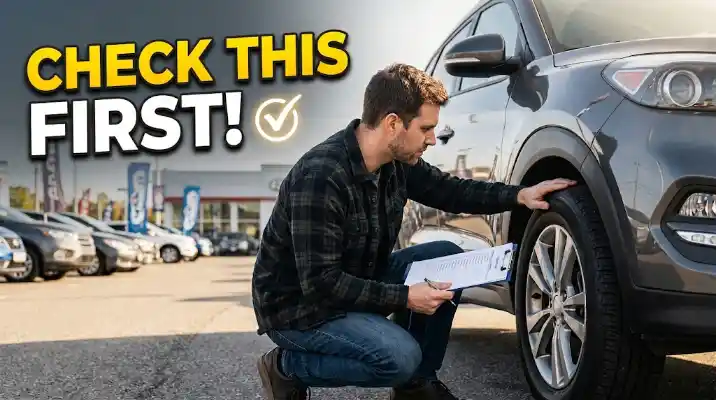
| Tires | Even tread wear (uneven wear can signal alignment or suspension problems), matching brands and tread depth, age codes |
| Under the hood | Leaks, low or dirty fluids, milky oil, cracked belts and hoses, corrosion on the battery |
| Interior | Musty smell, damp carpet or silt (flood signs), worn pedals and seat that do not match the mileage, working electronics, AC and heat |
| Dashboard | All warning lights come on briefly at start-up and then go off; a check engine or airbag light that stays on is a problem |
| Underneath | Fresh drips, rusted or damaged frame, exhaust leaks |
| Paperwork | Title in the seller’s name, no liens, and matching VINs |
Step 7: Take a Thorough Test Drive
Drive for at least 20–30 minutes on city streets, the highway and a parking lot. Turn the radio off and listen.
- Start the engine cold if possible; hard starts and smoke are warning signs.
- Check that the transmission shifts smoothly without slipping, jerking or delays.
- Brake firmly: the car should stop straight without pulling, grinding or pedal pulsing.
- Feel for vibration at highway speed and pulling to one side.
- Turn the wheel fully both ways at low speed and listen for clicking or clunking.
- Test the AC, heat, windows, locks, lights, wipers, infotainment, cameras and driver-assist features.
Step 8: Get a Pre-Purchase Inspection
Have an independent mechanic you choose, not one the seller recommends, inspect the car for about $100 to $250. They will put it on a lift, check for leaks, frame damage, worn parts and stored trouble codes, and give you a list of issues and repair costs. Use that list to negotiate or walk away. If a seller will not allow an inspection, walk away.
Step 9: Negotiate the Price
- Know the market value for the car’s exact trim, mileage and condition.
- Use inspection findings and upcoming maintenance as leverage.
- Negotiate the out-the-door price, including all fees, not the monthly payment.
- Be ready to walk away; there are always other cars.
- At dealers, decline add-ons you do not want, such as extended warranties, paint protection or etching, or negotiate them separately.
Step 10: Complete the Paperwork Safely
Buying From a Dealer
Read the FTC Buyers Guide window sticker, which must show whether the car is sold as-is or with a warranty. Review the purchase contract line by line, confirm the price, fees, interest rate and term, and do not sign anything with blank spaces.
Buying From a Private Seller
- Meet in a safe public place, ideally at a bank or the police station parking lot.
- Check that the seller’s ID matches the name on the title and that there is no lien.
- Get a signed title and a bill of sale with the date, price, VIN and both signatures.
- Pay by cashier’s check or bank transfer at the bank rather than carrying large amounts of cash.
- Register the car, pay any sales tax and get insurance before driving it home, following your state’s rules.
Red Flags: When to Walk Away
- Salvage, rebuilt, flood or lemon title brands
- VINs that do not match or look tampered with
- Signs of flood damage: musty smell, silt under carpets, rust on seat bolts
- Warning lights that stay on, or a seller who says it is “just a sensor”
- Mileage that does not match the history or wear
- A seller who will not allow an inspection or pushes you to decide immediately
- A price far below market value, especially online listings asking for deposits or wire transfers
When Is the Best Time to Buy a Used Car?
Deals are often better at the end of the month, quarter or year, when dealers try to meet sales targets, and in late fall and winter, when fewer people shop. Tax-refund season in early spring usually brings more demand and firmer prices. Convertibles tend to be cheaper in winter and four-wheel-drive vehicles in summer. Buying your first car? Our first-time car buyer guide covers budgeting, financing and buyer programs.
After You Buy
- Change the oil and check all fluids unless records show it was just done.
- Fix any open recalls at a dealer for free.
- Replace wiper blades, the cabin air filter and any worn tires.
- Set up a maintenance schedule from the owner’s manual.
- Keep all paperwork, including the bill of sale and title, in a safe place.
Used Car Buying FAQ
Check the vehicle history report and open recalls using the VIN, inspect the body, tires, fluids, interior and warning lights, take a thorough test drive and get an independent pre-purchase inspection.
Yes. For about $100 to $250, a mechanic can find leaks, frame damage and worn parts that could cost thousands, and the report gives you leverage to negotiate.
It can be if you want a nearly new car with a manufacturer-backed warranty and inspection. You pay more than for a comparable non-certified car, so compare the price difference with the value of the extra warranty.
Salvage or flood title brands, mismatched VINs, signs of water damage, warning lights, mileage that does not match the history and a seller who refuses an inspection.
Private sellers usually charge less, but you get no warranty and handle the paperwork. Dealers cost more but handle paperwork, must display the FTC Buyers Guide and sometimes offer warranties.
At least 20 to 30 minutes, including city streets, highway speeds and a parking lot, with the radio off so you can hear problems.
Enter the car’s VIN at NHTSA.gov/recalls. Open safety recalls are repaired free at a franchised dealer.
Often at the end of the month, quarter or year and in late fall or winter, when demand is lower. Early spring, during tax-refund season, tends to be busier.