How Does a Car Lease Work? Terms, Payments, Fees and Lease-End Options
How does a car lease work? Here is the simple version. A car lease is a long-term rental. You pay to use a new car for a set period, usually 24 to 36 months, and a set number of miles, typically 10,000 to 15,000 a year. Your monthly payment mainly covers the car’s expected loss in value during that time plus a finance charge, which is why lease payments are usually lower than loan payments on the same car. At the end, you return the car, buy it for a preset price, or trade it in.
This guide explains every part of a lease in plain English: the terms on the contract, how the payment is calculated with a worked example, the fees to watch for, your options at lease end, and how to get a better deal.
Key Takeaways
- You pay for depreciation, not the whole car, plus a finance charge called the money factor.
- Payment formula: (cap cost − residual) ÷ months, plus (cap cost + residual) × money factor, plus tax.
- Negotiate the price (capitalized cost) just like buying; the residual value is set by the lender.
- Watch the fees: acquisition ($595–$1,295), disposition ($350–$500) and excess mileage (10–30 cents a mile).
- Avoid a big down payment: if the car is totaled early, that money is usually lost.
How a Car Lease Works, Step by Step
- Choose the car and terms: the model, lease length and yearly mileage allowance.
- Negotiate the price: the agreed selling price becomes the capitalized cost, the starting point of the lease.
- The lender sets the residual value: its estimate of what the car will be worth at lease end.
- The lender sets the money factor: the lease equivalent of an interest rate, based largely on your credit.
- Sign and pay the due-at-signing amount: often the first month’s payment, fees, taxes and any down payment.
- Drive and maintain the car: you are responsible for maintenance, insurance and staying within the mileage allowance.
- At lease end: return it, buy it at the residual price, or trade it in.
Lease Terms Explained
| Term | What it means |
|---|---|
| MSRP | The manufacturer’s suggested retail price; residual value is based on it |
| Capitalized cost (cap cost) | The negotiated price of the car plus fees or add-ons rolled into the lease |
| Cap cost reduction | Money that lowers the cap cost: down payment, trade-in equity or rebates |
| Residual value | The car’s predicted value at lease end, set by the lender as a percentage of MSRP |
| Money factor | The finance rate on a lease; multiply by 2,400 to get an approximate APR |
| Lease term | Length of the lease in months, often 24, 36 or 39 |
| Mileage allowance | Miles per year included, commonly 10,000, 12,000 or 15,000 |
| Acquisition fee | A bank fee to start the lease |
| Disposition fee | A fee for returning the car at lease end |
| Excess wear and tear | Charges for damage beyond normal use when you return the car |
How Lease Payments Are Calculated
A lease payment has three parts:
- Depreciation fee: (adjusted cap cost − residual value) ÷ number of months
- Rent charge (finance charge): (adjusted cap cost + residual value) × money factor
- Sales tax: in most states, charged on each monthly payment rather than the full car price
Worked Example
| Item | Amount |
|---|---|
| MSRP | $35,000 |
| Negotiated price | $33,000 |
| Acquisition fee rolled in | $995 |
| Adjusted cap cost (no down payment) | $33,995 |
| Residual value (58% of MSRP, 36 months) | $20,300 |
| Money factor | 0.0025 (about 6% APR) |
| Depreciation fee: ($33,995 − $20,300) ÷ 36 | $380.42 |
| Rent charge: ($33,995 + $20,300) × 0.0025 | $135.74 |
| Base monthly payment | $516.16 |
| With 7% sales tax on the payment | About $552 |
This is an illustration; your numbers depend on the car, the lender’s residual and money factor, your credit and your state’s tax rules. The example shows why two things matter most: a lower negotiated price shrinks both parts of the payment, and a higher residual value lowers the depreciation you pay for.
Common Lease Fees and Costs
| Fee | Typical amount | Notes |
|---|---|---|
| Acquisition fee | $595–$1,295 | Set by the lender; sometimes marked up by the dealer |
| Security deposit | Often $0; sometimes one payment | Some lenders offer lower money factors with multiple security deposits |
| Dealer and documentation fees | Varies by state | Ask for them in writing |
| Disposition fee | $350–$500 | Charged when you return the car; often waived if you lease or buy another car from the same brand |
| Excess mileage | $0.10–$0.30 per mile | Buying extra miles up front is usually cheaper |
| Excess wear and tear | Varies | Dents, deep scratches, stains, worn tires and damaged wheels |
| Early termination | Can be thousands of dollars | Often the remaining payments plus fees |
Mileage Limits: How to Choose
Estimate your real yearly driving before you sign, including road trips. Leases with 10,000 miles a year have the lowest payment, but going over costs 10 to 30 cents a mile at return. Driving 15,000 miles a year on a 10,000-mile lease for three years means 15,000 extra miles, or $1,500 to $4,500 in charges. Paying for a higher allowance at the start is almost always cheaper.
What Happens at the End of a Lease?
- Return the car: schedule an inspection, fix minor damage beforehand if it is cheaper than the wear charges, and pay any disposition, mileage or damage fees.
- Buy the car: pay the residual value listed in your contract, plus any purchase fee and taxes. This makes sense if the car is worth more than the buyout or you love it.
- Trade it in or sell it: if the car is worth more than the buyout price, you may have equity you can use toward your next car. Check whether your leasing company allows third-party buyouts.
- Extend the lease: many lenders offer month-to-month extensions if you need more time.
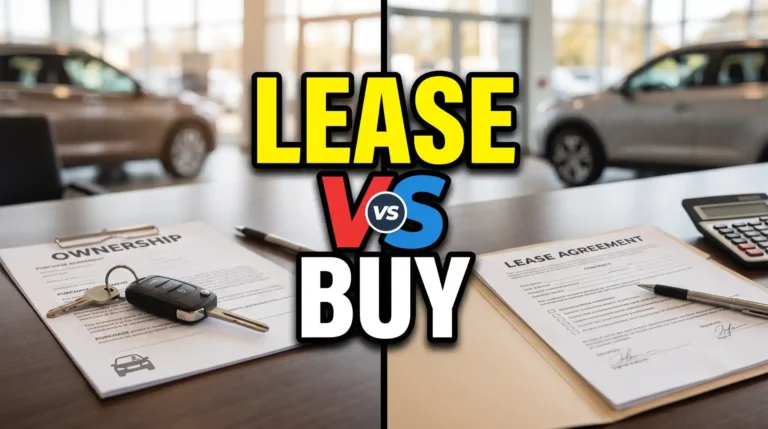
Leasing vs Buying at a Glance
| Lease | Buy (finance) | |
|---|---|---|
| Monthly payment | Usually lower | Usually higher |
| Ownership | No; you return the car | Yes, once the loan is paid off |
| Mileage | Limited | Unlimited |
| Customizing | Limited | Anything you like |
| Repairs | Usually under warranty for the whole term | Out of pocket after the warranty ends |
| Long-term cost | Higher if you always lease | Lower if you keep the car for years |
Leasing suits drivers who want a new car every few years, drive predictable mileage and prefer lower payments with warranty coverage. Buying suits drivers who keep cars a long time, drive a lot or want to build equity.
Other Questions People Ask About Leasing
Can You Lease a Used Car?
Yes, although it is less common. Some manufacturer finance companies and dealers offer leases on certified pre-owned vehicles, usually only a few years old. Payments can be lower than on a new car, but the money factor may be higher and choices are limited.
What About Lease-to-Own?
Any standard lease lets you buy the car at the end for the residual price. So-called lease-to-own programs at some independent dealers are different and often expensive, so read the total cost carefully and compare it with a regular auto loan.
Do EV Leases Still Get a Tax Credit?
Not federally. For several years, leasing companies could claim a federal clean vehicle credit of up to $7,500 and pass it on through lower lease payments. That credit ended for vehicles acquired after September 30, 2025. Some automakers and states still offer their own EV incentives, so ask about current offers.
What Credit Score Do You Need to Lease?
Most leases require good credit, and the best money factors usually go to borrowers with scores in the 700s or higher. Leasing with lower credit is possible but typically costs more.
What Insurance Do You Need on a Leased Car?
Leasing companies usually require collision and comprehensive coverage plus higher liability limits than the state minimum. Many leases include gap coverage, which pays the difference between what the car is worth and what you owe if it is totaled; confirm this before buying it separately.
How to Get a Better Lease Deal
- Negotiate the selling price, not just the monthly payment.
- Ask for the money factor and residual and compare them with what the lender publishes for your model.
- Put little or nothing down beyond the required fees.
- Look for cars with high residual values; they depreciate less, so payments are lower.
- Watch for manufacturer lease specials with subsidized money factors.
- Choose the right mileage and do not pay for extras you do not want rolled into the lease.
- Read the wear-and-tear guide before you sign.
For more help with money decisions, browse our buying and selling guides.
Try the calculator: use our lease vs buy calculator to compare leasing and buying. Still deciding? Compare leasing vs buying a car side by side, and if your credit is shaky, see whether you can lease with bad credit.
Car Leasing FAQ
You pay to use a new car for a set term, usually 24 to 36 months, and a set mileage. The payment covers the car’s expected depreciation plus a finance charge and tax. At the end you return the car, buy it or trade it in.
Leasing can be smart if you want a new car every few years, drive a predictable number of miles and prefer lower payments. Buying is usually cheaper if you keep cars for many years or drive a lot.
The money factor is the lease finance rate. Multiply it by 2,400 to get an approximate APR; for example, 0.0025 is about 6 percent.
Yes. You can negotiate the selling price (capitalized cost), dealer add-ons and sometimes the money factor markup. The residual value is set by the lender and usually is not negotiable.
You pay an excess mileage charge when you return the car, usually 10 to 30 cents per mile over the allowance.
Usually not much. If the car is stolen or totaled early, the down payment is typically lost. Paying only the required fees at signing is safer.
Yes. Most leases let you buy the car for the residual value in your contract, plus any purchase fee and taxes.
Yes, but early termination can be expensive. Alternatives include a lease buyout and resale, a lease transfer if allowed, or trading the car in to a dealer.